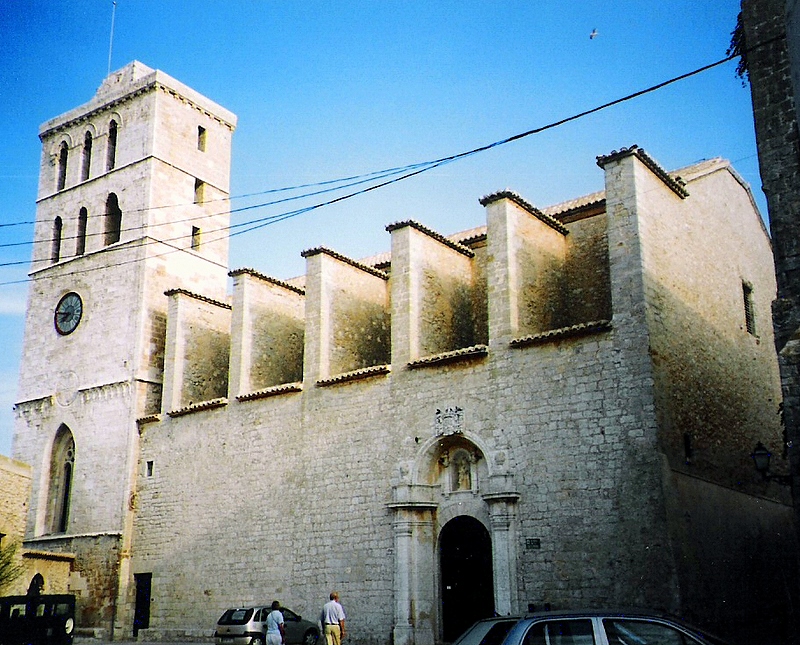
Photo: Jaume Meneses, CC BY-SA 2.0
Ibiza Cathedral
out of 5 0 ratingsPerched atop the ancient walls of Ibiza’s old town, the Cathedral of Ibiza watches over the island like a quiet sentinel. Its sun-bleached stone, weathered by centuries of salt-laden winds, blends seamlessly into the golden hues of Dalt Vila, the historic quarter that unfurls around it. Unlike the towering cathedrals of continental Europe, this one doesn’t overwhelm with grandeur. Instead, it invites you to linger, to notice the small things—the way the light filters through the stained glass, the worn grooves in the flagstones, the faint scent of incense lingering in the air. There’s a humility here, a sense that this place has always been more about the people who built it than the building itself.
The cathedral’s story is woven into the fabric of Ibiza’s past. The first church rose here in the 13th century, not long after King James I of Aragon reclaimed the island from Moorish rule. Back then, it was little more than a fortified chapel, serving both as a place of worship and a defensive stronghold. As Ibiza grew into a key Mediterranean outpost, the chapel was expanded into a Gothic cathedral in the 14th century, a symbol of Christian authority over the island. But what stands today is the result of centuries of additions and renovations, each layer reflecting the tastes and needs of the time.
Step inside, and you’ll find a space that feels like a patchwork of eras. The Gothic portal, with its pointed arches and delicate tracery, gives way to Baroque flourishes added in the 17th century, when the cathedral was enlarged and adorned with new ornamentation. The interior is understated yet elegant—tall vaulted ceilings supported by sturdy columns, wooden pews with intricate carvings, an altar gleaming with gilded details. One of the most striking features is the Chapel of Saint Anthony, home to a revered 18th-century statue of the island’s patron saint. The figure, with its serene expression and finely crafted robes, draws both pilgrims and curious visitors, a quiet focal point in the cathedral’s otherwise unassuming space.
For centuries, this cathedral was the heart of Ibiza’s community. Coronations of local bishops took place here, as did the weddings of noble families. It was where victories were celebrated, where merchants gathered, where decrees were read aloud. In the Middle Ages, the square outside buzzed with life—traders haggling, craftsmen displaying their wares, sailors swapping stories. Even now, though Dalt Vila is no longer the bustling hub it once was, the cathedral remains a gathering place. Tourists wander in to admire the architecture, locals stop by to light a candle, and the occasional pilgrim kneels in prayer. The stone floors echo with footsteps, a reminder of all who have passed through these doors over the centuries.
The bell tower, though modest in height, offers one of the best views on the island. A narrow spiral staircase winds upward, past ancient bells that have marked the hours for generations. From the top, the old town unfolds like a maze of whitewashed alleys, tumbling down toward the fortified walls and the modern city beyond. On clear days, the horizon stretches endlessly, the sea merging with the sky until it’s impossible to tell where one begins and the other ends. In the distance, the faint outlines of neighboring islands shimmer in the haze, a reminder of how small this place once was—and how much it has seen.
The cathedral has its own rhythm, one that shifts with the hours. Mornings are quiet, the only sounds the distant chime of bells and the soft murmur of prayers. By midday, tourists drift in, snapping photos of the frescoes and reading the plaques that hint at the building’s long history. As evening falls, the light softens, casting long shadows across the stone. Sometimes, the stillness is broken by the strains of a classical concert or an organ recital, the music swelling through the nave like a living thing. It’s in these moments that the cathedral feels most alive, as if the past and present are briefly intertwined.
Ibiza is often associated with its legendary nightlife, but the cathedral offers a different perspective—one of stillness, of history, of a slower pace. There are no crowds here, no rush to the next attraction. Instead, there’s space to breathe, to reflect on the generations who have walked these same floors, who have whispered the same prayers, who have left their mark in ways both seen and unseen. It’s a place where time feels elastic, where the weight of centuries settles gently on your shoulders.
More than just a monument, the Cathedral of Ibiza is a living piece of the island’s identity. It doesn’t demand attention with opulence or scale, but rather draws you in with its quiet dignity. If you visit Ibiza, take the time to climb the steep streets of Dalt Vila, to step inside, to stand beneath its vaulted ceilings and listen. The island has many faces, and this is one of its most enduring—a reminder that beneath the glitter and the noise, there’s a place where history is still very much alive.
Day around this place
Where else to go on the same day
Building the day…
Where it is
38.90667, 1.43667