- Home
- Cuba
- Old Havana
- Cathedral Square
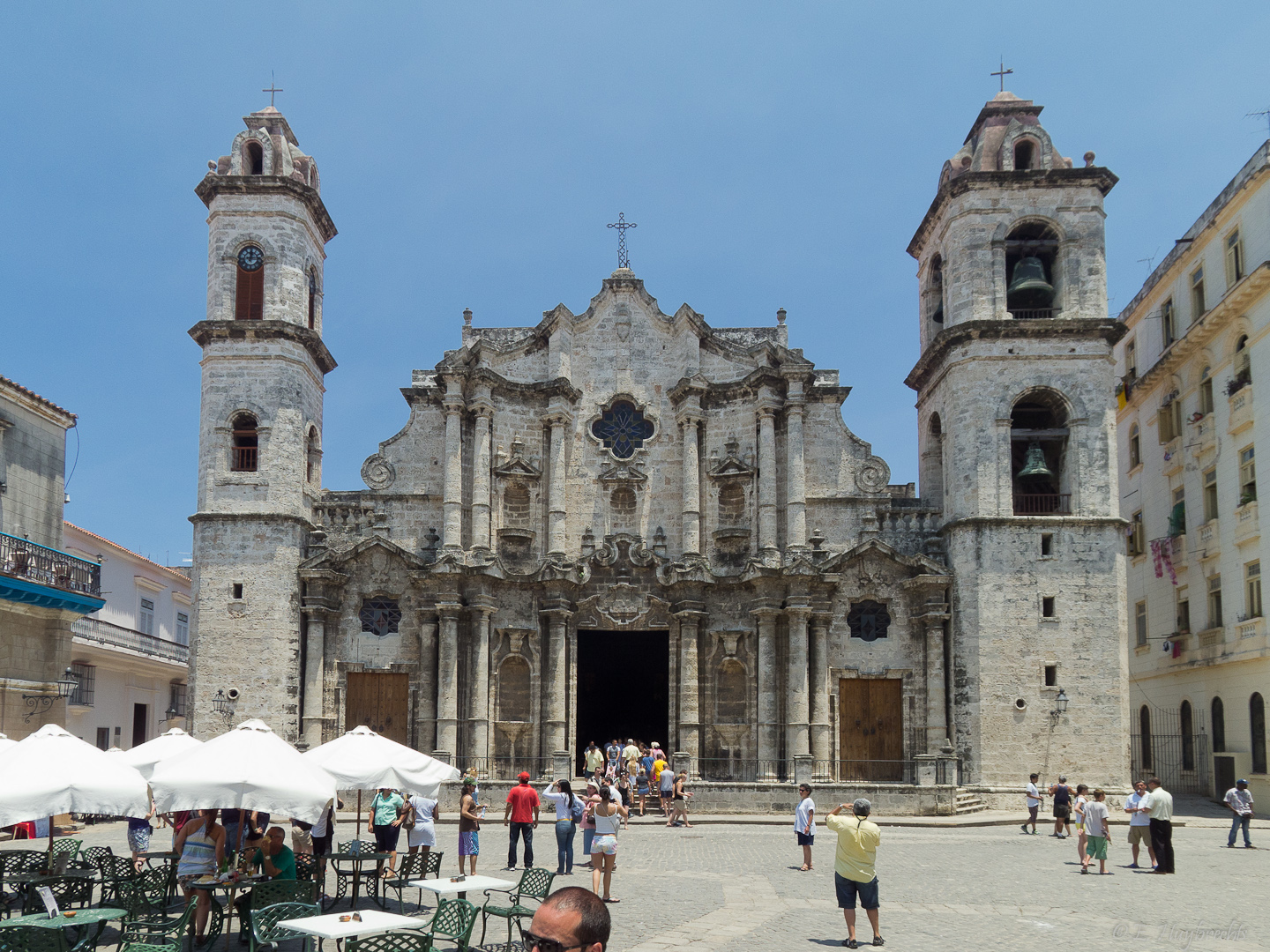
Photo: Emmanuel Huybrechts from Laval, Canada, CC BY 2.0
Cathedral Square
out of 5 0 ratingsCatedral Square in Old Havana is one of those rare places where time seems to soften, as if the weight of centuries has settled into the very stones underfoot. Tucked into the heart of the city’s colonial core, the square is small but carries an outsized presence, a quiet crossroads where history, faith, and daily life have intertwined for generations. The worn cobblestones, the wrought-iron balconies sagging slightly with age, and the faded facades of the surrounding buildings all whisper stories of a past that refuses to fade entirely. This is not just a tourist stop—it’s a living piece of Havana, where the city’s rhythms still move to an old, unhurried beat.
The square takes its name from the Catedral de San Cristóbal, which anchors the eastern side with its striking, if slightly lopsided, silhouette. Built in the mid-18th century, the cathedral is a fine example of Cuban Baroque, though its design carries a distinctly local twist. The two bell towers are mismatched—one broader than the other—giving the facade an almost playful asymmetry. Inside, the walls are adorned with faded frescoes, and the floor is laid with marble tiles shipped from Europe centuries ago. For a time, the cathedral housed the remains of Christopher Columbus, a detail that once drew pilgrims and dignitaries, though the bones were later moved to Seville. Today, the cathedral remains an active place of worship, its doors open to both the faithful and the curious. The air inside is cool and still, the scent of candle wax mingling with the faint dampness of old stone, a quiet refuge from the heat outside.
The buildings encircling the square each have their own character, their facades bearing the marks of time and the hands of those who have lived within them. To the north stands the Palacio de los Marqueses de Aguas Claras, a grand 18th-century mansion built for one of colonial Cuba’s wealthiest families. Its imposing columns and dark wooden balconies speak of a time when Havana was a jewel in Spain’s imperial crown, a city of merchants and aristocrats who filled their homes with European luxuries. The palace’s interior has long since been repurposed—offices, small museums, and cultural spaces now occupy its rooms—but the exterior remains largely unchanged, a testament to the city’s layered history.
On the southern side, the Casa del Conde de Lombillo offers a gentler contrast. Painted a soft, sun-bleached yellow, the building’s wooden balconies are intricately carved, their details softened by years of tropical sun and rain. This was once a gathering place for Havana’s elite, where deals were struck over glasses of rum and politics were debated in hushed tones. Today, the house feels more approachable, its rooms now home to small galleries and cafés where visitors can linger over a cup of strong Cuban coffee. The high ceilings and tiled floors still echo with the voices of the past, and the inner courtyard, with its trickling fountain, offers a moment of respite from the bustle of the square.
The western side of the square is quieter, lined with more modest buildings that nonetheless hold their own stories. Here, small shops sell handmade crafts, paintings by local artists, and yellowed books with cracked spines. One of these buildings was once the home of José Martí, Cuba’s national hero, though no plaque marks the spot. Instead, it’s the locals who keep the memory alive, pointing out the unassuming doorway to visitors with a mix of pride and casual familiarity. The square itself is often dotted with musicians, their guitars and bongos filling the air with the rhythms of son, bolero, or salsa. The music blends with the murmur of conversations, the clatter of dominoes being slapped onto tables, and the occasional laughter of children chasing each other between the columns.
Life on Catedral Square moves at its own pace. Mornings are slow, the square nearly empty save for a few early risers heading to the cathedral or locals hurrying to work. By midday, the space fills with tourists snapping photos, sipping coffee at outdoor tables, and browsing the small stalls. But the real magic happens in the evening, when the heat of the day gives way to a softer, golden light. The square comes alive in a different way—teenagers gather by the fountain, old men set up domino games on makeshift tables, and somewhere in the background, a radio plays an old song. Couples drift toward the edges of the square, and if you’re lucky, you might catch the beginning of an impromptu dance, the kind that starts with a single step and grows until half the square is clapping along.
Old Havana is a UNESCO World Heritage site, but Catedral Square doesn’t feel like a museum exhibit. There are no rigid barriers or signs dictating where to stand, no attempts to sanitize the space for visitors. The buildings have been restored with care, but their age still shows—the peeling paint on shutters, the cracks in the plaster, the way the balconies sag just a little. Even the tourists, who come in steady numbers, don’t disrupt the square’s rhythm. They simply become part of the scene, another layer in the living tapestry of the place. The square doesn’t try to impress; it simply exists, as it has for centuries, with all its imperfections and charm.
If you find yourself in Havana, don’t rush past Catedral Square. Take a moment to sit on one of the benches, to watch the way the light shifts across the cathedral’s facade, or to listen to the music drifting from a nearby doorway. You might see an old man scattering crumbs for pigeons, or a group of children darting between the columns, or a couple stealing a kiss by the fountain. Perhaps you’ll hear a guitarist playing a melody that’s been passed down through generations. The square isn’t just about what you see—it’s about what you feel. The weight of history here isn’t heavy; it’s woven into the air, into the laughter and the music, into the quiet moments between one day and the next. That’s what makes it unforgettable.
Day around this place
Where else to go on the same day
Building the day…
Where it is
23.14089, -82.35163