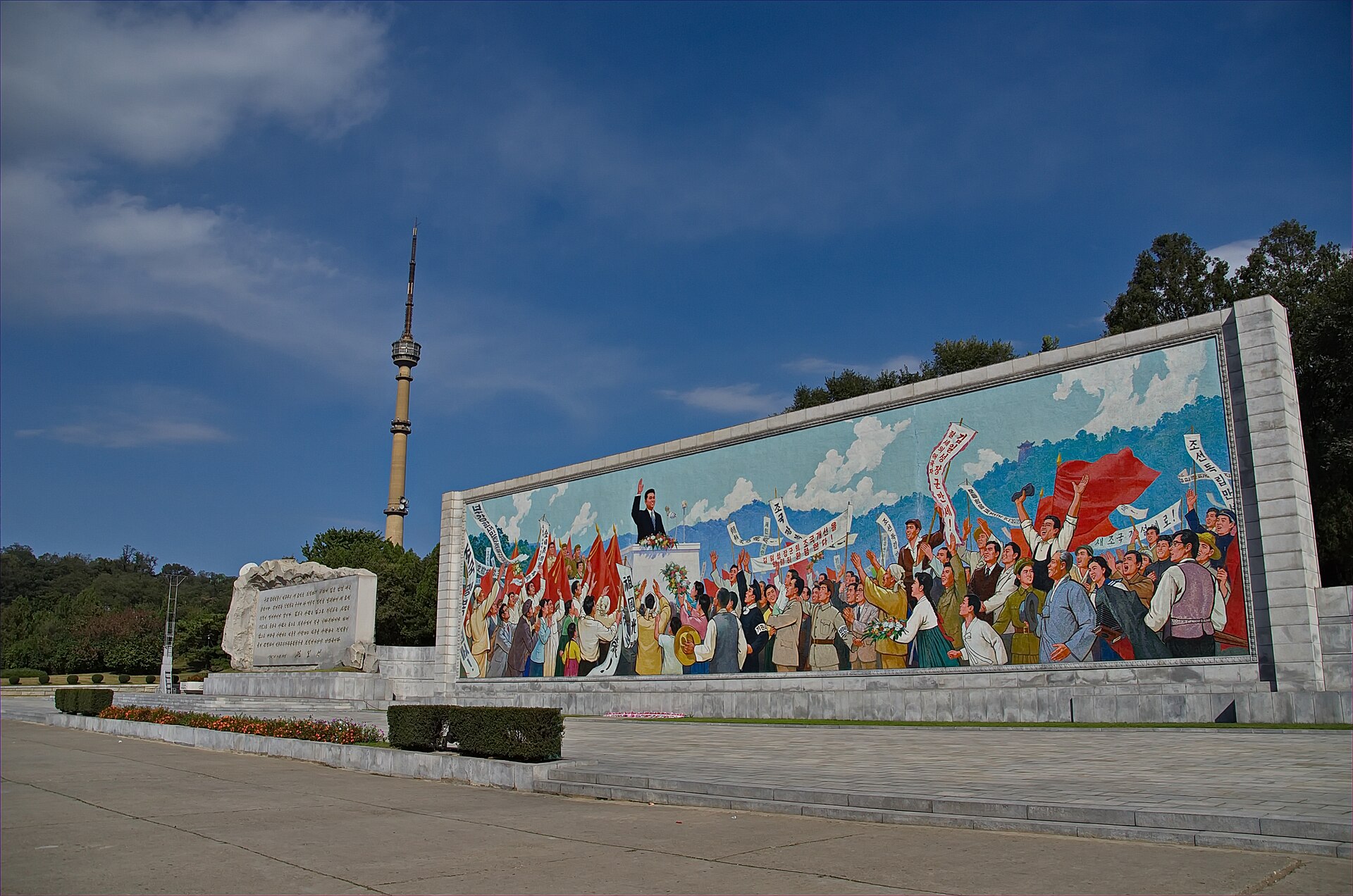
The Kaeson Revolutionary Site is one of those places in Pyongyang where the official history of North Korea unfolds in its most solemn and symbolic form. Perched on a modest hill in the heart of the city, it marks the spot where Kim Il Sung first addressed the public after Korea’s liberation from Japanese occupation in 1945. This wasn’t just a speech—it was the moment that set the course for the nation’s future, and the site has since become a cornerstone of North Korea’s ideological narrative. It’s less a museum in the conventional sense and more a physical embodiment of the state’s founding myths, where history, leadership, and national identity converge.
The memorial was inaugurated in 1987, on the 40th anniversary of that pivotal speech. Back in October 1945, Kim Il Sung, then a young leader returning from years of guerrilla resistance in Manchuria, stood here before a crowd and laid out his vision for a new Korea. Today, a towering bronze statue of him dominates the hill, flanked by granite slabs inscribed with excerpts from his address. The monument’s design is unmistakably North Korean—grand, symmetrical, and steeped in the monumental style of the mid-to-late 20th century, where every line and angle reinforces the weight of history and the permanence of the state’s ideals.
The location itself is no accident. The hill sits just steps away from Kim Il Sung Square, Pyongyang’s central political and ceremonial hub, offering sweeping views of the city and, on clear days, the distant mountains. Decades ago, this spot was home to a Soviet-era stadium, but after the Korean War, it was dismantled to make way for the memorial complex. Now, it serves as both a stage for official events and a mandatory stop for foreign delegations and the few tourists permitted to visit the capital. For outsiders, it’s often the first glimpse into how North Korea constructs and presents its past.
The architecture of the site is deliberately imposing. A vast granite plaza stretches out before the statue, designed to accommodate thousands during mass gatherings. Flanking the monument are stone steles adorned with bas-reliefs depicting key moments in Kim Il Sung’s life—his guerrilla campaigns, his early meetings with the people, and the foundational years of the new state. The artistry is unapologetically socialist realist, where every detail is crafted to evoke reverence and loyalty. There’s no ambiguity here; the narrative is clear, and the imagery is meant to inspire.
For North Koreans, the Kaeson site is far more than a historical landmark—it’s a place of pilgrimage. Schoolchildren visit on field trips, young pioneers take their oaths here, and delegations from across the country come to pay their respects. On national holidays, like the Day of the Foundation of the Party or Kim Il Sung’s birthday, the plaza fills with people laying flowers and reaffirming their commitment to the *juche* ideology. For foreigners, the experience can feel surreal, a carefully choreographed encounter with a version of history that’s both meticulously curated and deeply personal to the nation.
The memorial isn’t just about Kim Il Sung, though. Nearby stands the building where the first congress of the Workers’ Party of Korea was held in 1946, where Kim was elected its chairman. Today, it houses a museum dedicated to the party’s history and the revolutionary struggle, filled with documents, photographs, and artifacts from the era. The exhibits are a mix of propaganda and genuine historical relics, offering a glimpse into how the state frames its origins. There are no competing narratives here—just a single, unbroken story of struggle, triumph, and leadership.
The atmosphere at Kaeson is always one of quiet reverence. Laughter and casual conversation are rare; even tourists tend to fall into step with the solemnity of the place. It’s a space where history isn’t just remembered—it’s performed, with every element, from the architecture to the rituals, reinforcing the state’s version of events. For those accustomed to more critical or nuanced interpretations of history, it can feel jarring, but that’s precisely the point. North Korean memorials don’t just recount the past; they shape how it’s understood and felt.
And yet, the site isn’t frozen in time. It evolves alongside the state, with new elements added to reflect the present. In recent years, references to Kim Jong Il and Kim Jong Un have appeared, weaving the current leadership into the same narrative of continuity and destiny. The memorial doesn’t just preserve history—it actively participates in shaping it, ensuring that the past remains relevant to the present. It’s a living monument, one that adapts to the needs of the moment while maintaining its core message.
For first-time visitors to Pyongyang, the Kaeson Revolutionary Site can feel like a crash course in North Korea’s worldview. There’s no room for ambiguity or alternative perspectives—everything is deliberate, from the placement of the statues to the wording of the inscriptions. But that’s what makes it fascinating. It’s a place where history is distilled into myth, and myth is transformed into the bedrock of national identity. Whether one agrees with its version of events or not, the site offers a rare window into how a nation constructs its own story—and why that story matters so deeply to those who live by it.