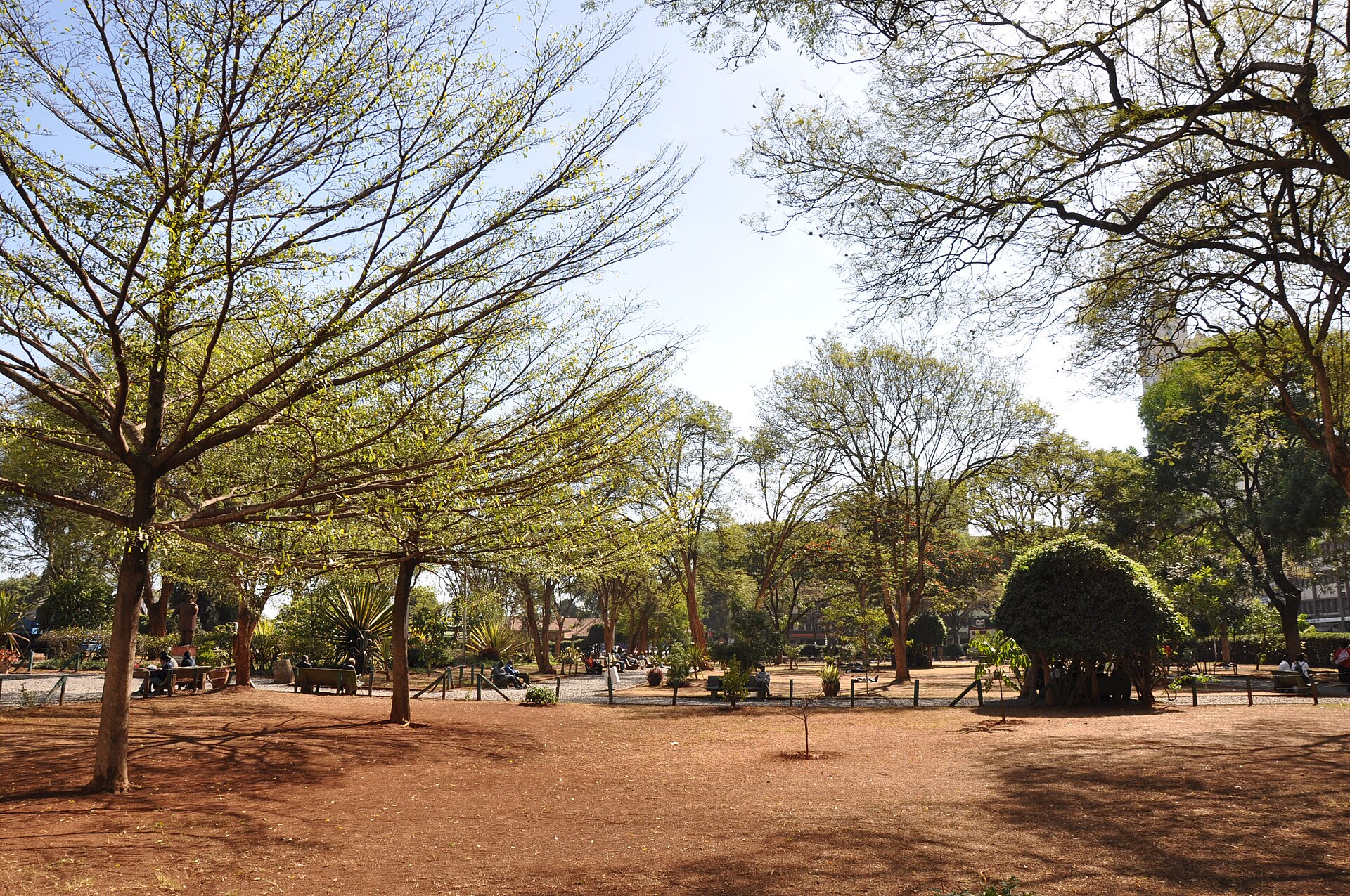
Nairobi is a city that moves at a relentless pace, where the hum of traffic and the energy of its people never seem to fade. Yet tucked away in its heart is a quiet refuge that offers a rare pause—Jeevanjee Gardens. This small but enduring park has been a fixture of the city since the early 1900s, a gift from Alibhai Mulla Jeevanjee, an Indian businessman and philanthropist who saw the need for a public space where Nairobi’s diverse communities could gather, rest, and breathe. At the time, the city was still finding its footing, evolving from a modest railway settlement into the administrative hub of British East Africa. Green spaces were scarce, and Jeevanjee’s vision filled a vital gap, one that remains just as relevant today.
The park’s design is unassuming, yet it carries the subtle elegance of its colonial-era origins. A central pathway, lined with towering trees, leads to a modest fountain that once served as the gardens’ focal point. Benches dot the area, offering a place to sit with a book, share a conversation, or simply watch the world go by. There are no grand monuments or elaborate sculptures here—just the quiet beauty of nature and the easy rhythm of people enjoying a moment of respite. A small plaque near the entrance commemorates Jeevanjee’s contribution, a quiet reminder of how one person’s generosity shaped the city’s character.
Jeevanjee Gardens is more than just a park; it’s a living piece of Nairobi’s multicultural history. In the early 20th century, the city was a melting pot of cultures—British administrators, Indian merchants, African laborers, and entrepreneurs from across the globe all called it home. The gardens became a neutral ground where these communities could mix, relax, and connect. Jeevanjee, himself of Indian descent, understood the importance of such spaces in fostering unity. Today, that legacy endures in the park’s atmosphere, where people from all walks of life come together without pretense, drawn by the promise of shade and stillness.
Unlike many of Nairobi’s more famous parks, Jeevanjee Gardens has never become a tourist hotspot. There are no guided tours or crowded events here. Instead, it’s a place for locals—office workers grabbing a quick lunch on a bench, students studying under the trees, or elderly couples strolling along the paths. On weekends, the park comes alive in a different way: families picnic on the grass, street musicians play impromptu tunes, and artists sketch portraits of passersby. The energy is organic, unscripted, a reflection of the city’s everyday life rather than a curated experience.
What makes Jeevanjee Gardens special is its ability to offer an escape without demanding anything in return. Nairobi’s air can be thick with dust, its streets overwhelming, but here, the pace slows. There are no rigid rules—visitors can sit on the grass, feed the birds, or simply watch the leaves sway in the breeze. It’s this sense of freedom that makes the park so appealing to those seeking a break from the city’s relentless energy. In a place where time often feels like it’s moving too fast, Jeevanjee Gardens offers a rare chance to slow down.
Architecturally, the park is far from extravagant, but it has a charm all its own. The trees, some of which have stood since the gardens were first established, provide a natural canopy that shields visitors from the harsh midday sun. The lawns are well-kept, the flowerbeds add splashes of color, and the old-fashioned lampposts lining the paths cast a warm glow in the evenings. There’s a sense of care here, though never ostentation. It’s a place that feels lived-in, not polished for show.
Beyond its role as a green space, Jeevanjee Gardens has also been a witness to Nairobi’s history. Over the decades, it has hosted political rallies, cultural festivals, and public gatherings. During Kenya’s struggle for independence, the park became a stage for speeches and debates, while in more peaceful times, it served as a venue for celebrations and performances. Though those events are now part of the past, their echoes linger in the stories of longtime residents and in the very air of the gardens. For some, it’s just a park; for others, it’s a tangible connection to the city’s evolution.
In recent years, the area surrounding Jeevanjee Gardens has transformed rapidly, with new office buildings, cafes, and shops springing up nearby. The city’s growth is inevitable, but the park itself remains unchanged, a constant in a landscape of flux. That steadiness is part of its appeal. In a world where everything seems to shift at breakneck speed, Jeevanjee Gardens offers something rare: a sense of permanence. It may not be Nairobi’s most famous landmark, but for those who know it, the park is an essential part of the city’s fabric.
Visiting Jeevanjee Gardens is an opportunity to see Nairobi through a different lens. There are no blaring horns, no crowded markets, no tourist crowds—just the quiet rustle of leaves and the occasional laughter of children playing. It’s a place where the city’s true rhythm reveals itself, unfiltered by the usual distractions. Whether you spend an hour or an afternoon here, the key is to let the moment unfold at its own pace. After all, it’s these unassuming corners that often reveal the soul of a city.