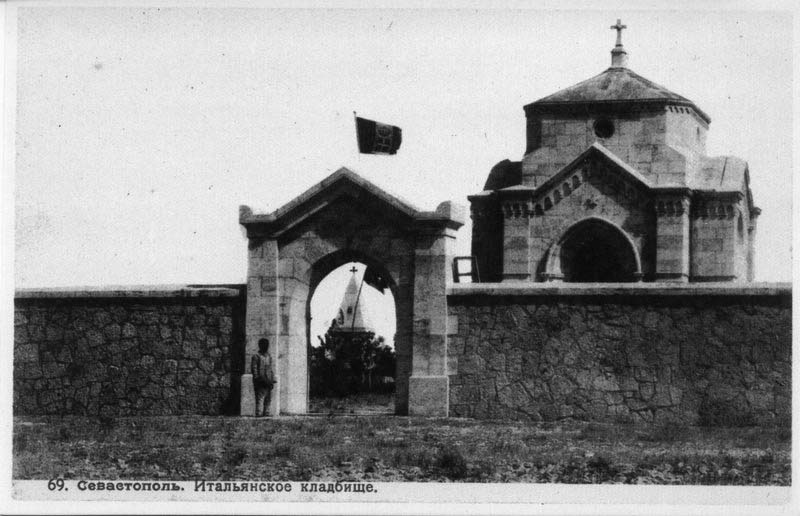
Perched on a quiet hillside overlooking the deep blue waters of Balaklava Bay, the Italian Military Cemetery is one of those rare places where history feels tangible, almost within reach. It stands as a silent witness to the Crimean War, a conflict that drew soldiers from across Europe to this rugged peninsula in the mid-19th century. Among them were troops from the Kingdom of Sardinia, who fought alongside British and French forces against the Russian Empire. Many never returned home, and this cemetery was established in 1857 to honor their memory, long after the guns had fallen silent.
The choice of location was deliberate. Balaklava, with its sheltered harbor and steep surrounding hills, had been a strategic stronghold during the war. Allied hospitals and supply depots once stood here, and in the years that followed, the area became a place of remembrance. The cemetery itself is nestled on a slope, offering sweeping views of the sea and the town below—a reminder of how far these men had traveled, only to find their final rest in this distant land. Today, it remains a peaceful, well-tended space, far removed from the bustle of nearby Yalta or Sevastopol.
The design of the cemetery is understated, reflecting the solemnity of its purpose. At its heart stands a white marble obelisk, its surface etched with the names of Italian officers and soldiers who perished here. A simple inscription in Italian pays tribute to their courage. Around it, rows of modest gravestones stretch across the hillside, many worn by time but still bearing faint traces of names and dates. Some are marked with crosses, others with laurel wreaths, symbols of military honor that have endured for over a century.
What strikes visitors most is the atmosphere. There is no grandeur here, no overwhelming monumentality—just a profound stillness, broken only by the rustling of cypress trees and the distant cries of gulls. It feels as though the place itself holds the memories of those who came from the Apennine Peninsula, driven by ideals they believed worth fighting for. Descendants of the fallen still visit, making pilgrimages to honor their ancestors, while others come simply to reflect on the past.
This cemetery is more than a burial ground; it is a thread connecting Crimea to Europe, a reminder that war leaves behind not just destruction, but also stories that transcend borders and generations. Here, political divisions fade into insignificance. In the face of time, all are equal, and the respect this place commands is universal. It doesn’t demand attention like the grand palaces or ancient ruins nearby, yet it lingers in the mind long after a visit.
Over the years, the cemetery has been carefully restored, always with an eye toward preserving its original character. Local authorities and Italian diplomats have ensured that the graves remain tended, the memorial intact. As interest in the Crimean War has grown in recent decades, this site has become an important stop for those seeking to understand the conflict’s scale and legacy. For many, it offers a chance to engage with history not through textbooks, but through the quiet testimony of weathered stone and fading names.
Balaklava itself is a town steeped in history, its narrow streets and old houses whispering of the past. The cemetery is just one piece of that story, but an especially poignant one. Unlike the crowded tourist spots of Livadia Palace or Chersonesus, it remains a place of quiet reflection. Visitors can wander the paths, reading the inscriptions, or simply sit on a bench, gazing out at the sea while pondering the fragility of life and the weight of sacrifice.
The Italian Military Cemetery is a tribute to those who fell, but also a reminder that history knows no borders. It binds Crimea to Italy, Europe to Russia, the past to the present. Its value lies not in its size or splendor, but in its ability to make us pause and consider what unites us, despite our differences. And perhaps that is why it endures—not just as a monument, but as a place that continues to speak to those who take the time to listen.