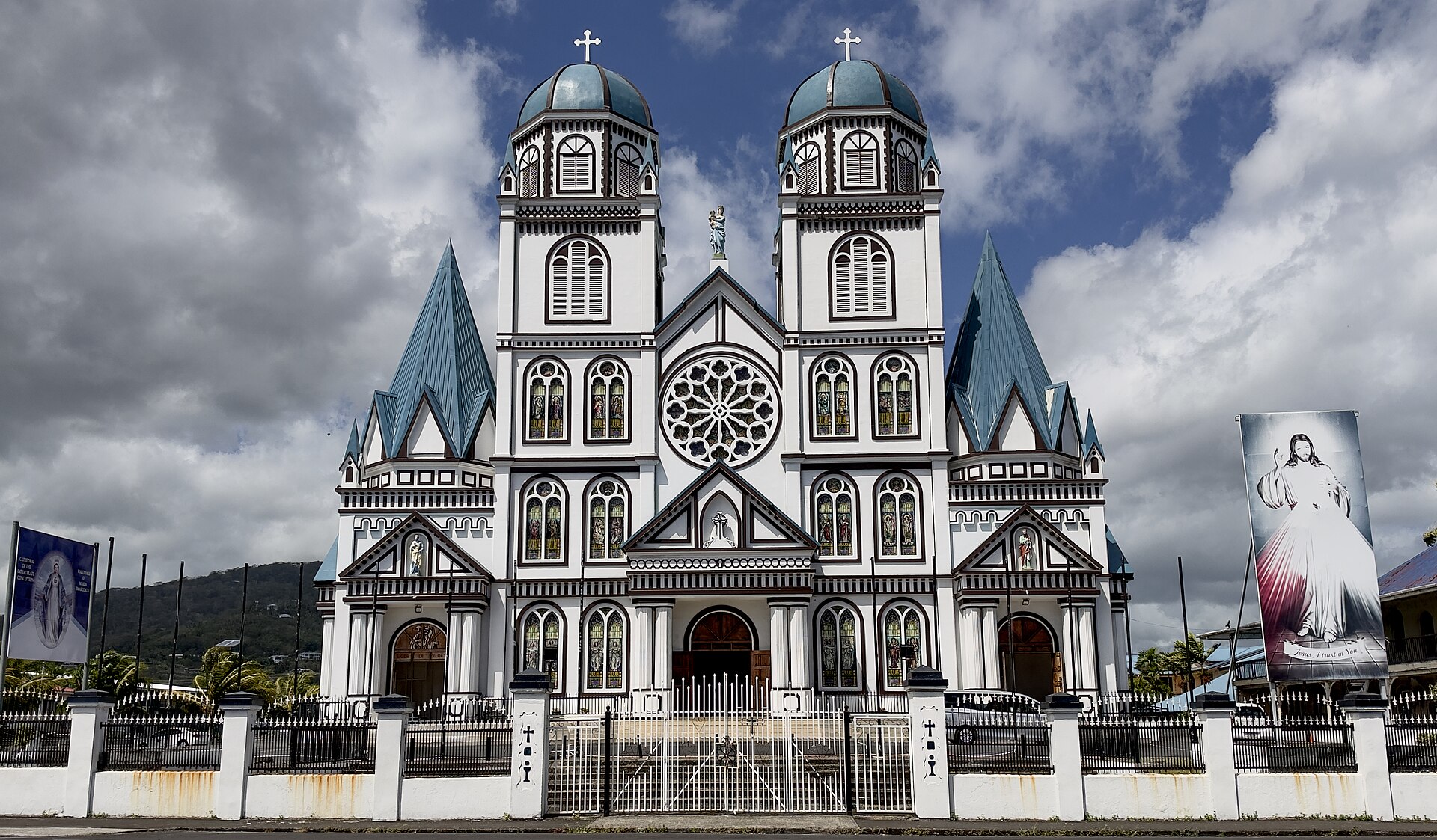
Immaculate Conception Cathedral in Apia is one of those places that doesn’t demand attention but quietly lingers in your memory long after you’ve left. Tucked among the low-rise buildings and swaying palms of Samoa’s capital, it feels like a pocket of stillness in the middle of the city’s gentle hum. Its white walls and gently sloping roof blend into the tropical surroundings, yet there’s something distinctly local in its unhurried presence—a reflection of the islands’ own rhythm.
The cathedral’s story is woven into the broader history of Samoa’s encounter with the outside world. Catholicism arrived later than Protestantism, brought by European missionaries in the 19th century, but it found a receptive audience among Samoans who saw in the faith not just a new religion but a way to preserve elements of their own culture under the church’s protection. The first wooden church stood here as early as the 1850s, but time and the elements took their toll. By the early 20th century, plans were made for a more permanent structure. The current building took shape in the 1960s, a time when Samoa was on the cusp of independence, and its architecture mirrors that transitional era—a fusion of European traditions adapted to the local climate and materials.
Inside, the cathedral is far from ornate, and that’s part of its charm. High ceilings and pale walls create a sense of openness, a welcome respite from the tropical heat. The altar is crafted from local wood, and the stained glass, though subdued compared to European cathedrals, bathes the space in a soft, warm glow. There are no gilded icons or marble columns here, just a quiet dignity that feels entirely in keeping with Samoan values, where substance matters more than spectacle.
For the people of Apia, the cathedral is more than just a place of worship. On Sundays, families gather in their finest traditional attire—vibrant *lavalava* and shirts adorned with intricate patterns. Services are conducted in both Samoan and English, and the choir’s hymns carry the unmistakable cadence of Polynesian melodies. It’s a rare glimpse into how Christianity has become interwoven with Samoan culture, not by erasing tradition but by finding harmony with it. Visitors who step inside during a service often leave with a deeper understanding of how faith and identity coexist here.
Beyond the cathedral’s walls, a small garden offers a place to pause. Fruit trees and flowering plants line the paths, and after services, you’ll often find people lingering in the shade, chatting or simply enjoying the quiet. Unlike the bustling markets or crowded beaches, this corner of Apia moves at its own pace. Tourists do wander in, but not in large numbers, which only adds to the sense of stepping into a space that feels both sacred and deeply personal.
What makes Immaculate Conception Cathedral special isn’t its grandeur or historical weight, but its unassuming presence. It doesn’t try to impress; it simply exists as part of Apia’s daily life. For locals, it’s a place of prayer and community. For visitors, it’s a chance to see a side of Samoa that isn’t immediately obvious—a place where time slows down, where the air carries the scent of frangipani, and where the quiet beauty of simplicity speaks volumes. There’s no fanfare here, just the gentle reminder that some of the most meaningful experiences are the ones that unfold without pretense.