Long before Angkor Wat rose from the Cambodian jungle, another city stood as the beating heart of an empire. Few today remember its name—Yashodharapura—but for nearly two centuries, this was the capital of the Khmer world, a place where gods and kings walked the same earth. Founded in the 9th century by King Yashovarman I, it marked the first permanent seat of power for a civilization that would shape Southeast Asia. The ruins that remain are quiet now, scattered among rice fields and tangled vines, but they carry the weight of an era when this corner of the world was the center of everything.
The city was designed as a perfect reflection of cosmic order, its layout dictated by both practicality and deep spiritual belief. At its core stood Phnom Bakheng, a temple built atop a natural hill, its summit offering a view across the entire valley. This was no ordinary temple; it was the sacred stage for coronations, where kings were crowned not just as rulers, but as divine intermediaries between heaven and earth. Surrounding the city were vast artificial reservoirs called barays, their still waters serving as both lifeline and symbol—they provided irrigation for the land while representing the primordial ocean that separated the human realm from the gods. Every stone, every canal, every step of the temple stairs was placed with intention, each element a thread in the grand tapestry of Khmer cosmology.
Yashovarman I envisioned Yashodharapura as an eternal capital, a city that would outlast his reign and stand as a testament to his dynasty’s power. Unlike earlier Khmer capitals, which shifted with the whims of rulers, this one was built to endure. Architects and artisans were brought from across the empire to carve the king’s vision into stone, arranging the city in the shape of a mandala—a sacred diagram where the center held the divine, and everything radiated outward in perfect symmetry. The walls, aligned with the cardinal directions, enclosed a world where religion, politics, and nature existed in harmony. Even the streets and canals followed this logic, guiding not just movement but meaning.
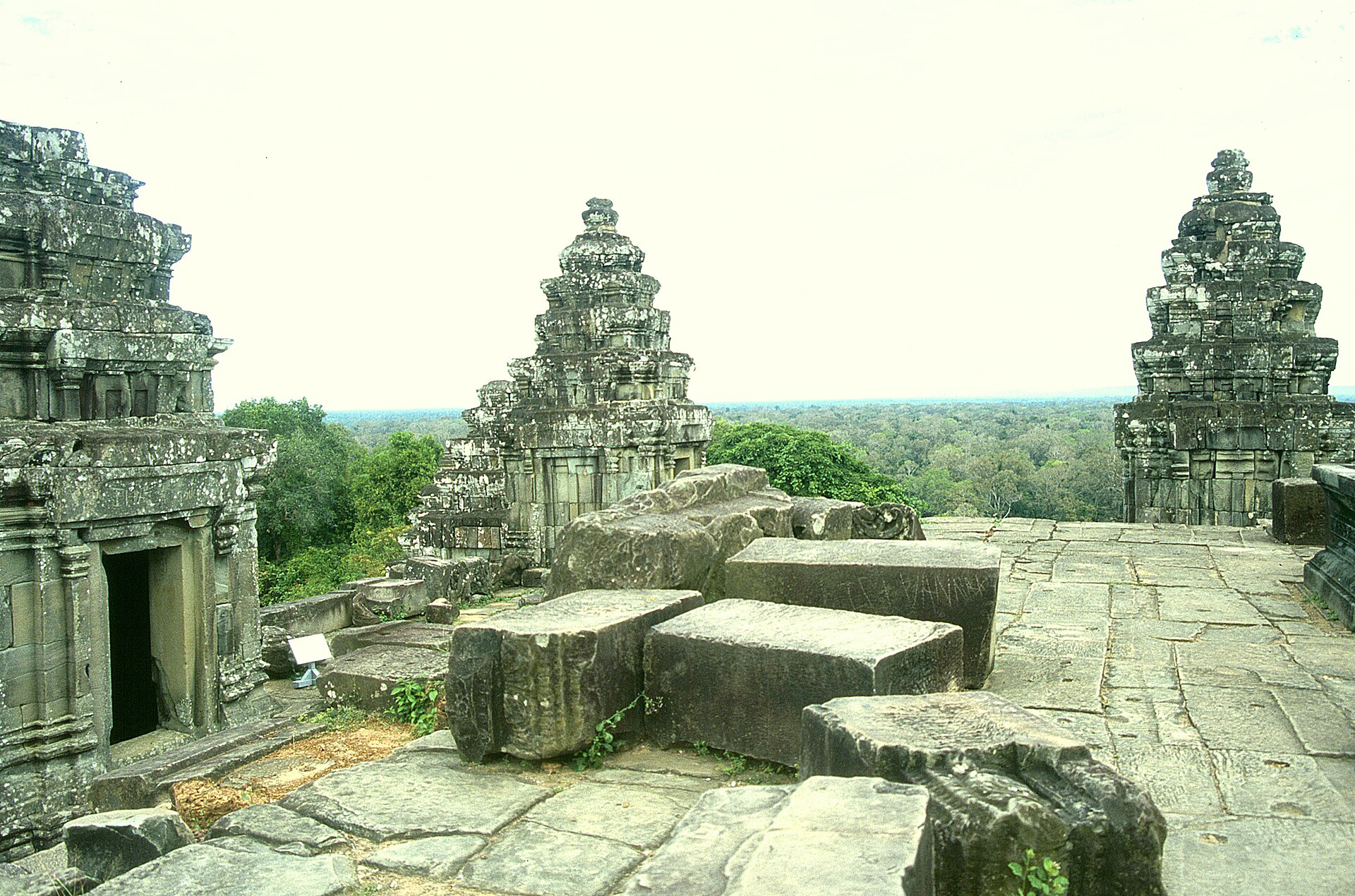
Today, Yashodharapura is a shadow of what it once was. Time, war, and the relentless creep of the jungle have erased much of the city, leaving only fragments of walls, crumbling staircases, and the occasional lintel half-buried in the earth. Yet there is something hauntingly beautiful about its decay. Unlike the more famous temples of Angkor, this place sees few visitors, and that solitude allows for a different kind of encounter. The ruins feel less like a museum and more like a living memory, where moss-covered stones and gnarled roots blur the line between man-made and natural. The past here isn’t preserved behind ropes or glass; it lingers in the air, in the way the light filters through the trees, in the silence that settles over the land at dusk.
Phnom Bakheng remains the most tangible link to Yashodharapura’s former glory. Climbing its steep, uneven steps is like stepping back in time. The temple’s five tiers, once crowned with golden spires, now stand bare, their sandstone worn smooth by centuries of wind and rain. But at sunset, when the sky turns gold and the jungle below fades into shadow, the place takes on a quiet magic. Some say the echoes of ancient rituals still whisper in the breeze, though it’s more likely just the rustle of leaves. Still, there’s a sense of continuity here, as if the land itself remembers what once took place on this hill.
For the Khmer kings, Yashodharapura was more than a capital—it was a physical manifestation of divine rule. They believed themselves to be god-kings, and their city had to reflect that status. Temples weren’t built for worship in the way we understand it today; they were portals, places where the earthly and the celestial met. Every carving, every altar, every drop of water in the barays was imbued with sacred meaning. The reservoirs, in particular, were more than engineering marvels—they were symbols of purity, renewal, and the cyclical nature of life, a reminder that even kings answered to forces beyond their control.
When the Khmer Empire’s center of power shifted to Angkor in the 12th century, Yashodharapura was gradually abandoned. The jungle reclaimed its streets, and the once-great city faded from memory until European explorers rediscovered it in the 19th century. Today, it exists in a kind of limbo—not forgotten, but not quite remembered either. There are no grand restorations here, no crowds jostling for the perfect photograph. What remains is raw, unpolished history, a place where the past feels closer than it does in the more famous temples nearby.
Visiting Yashodharapura is less about seeing and more about feeling. There are no detailed plaques explaining every ruin, no neatly marked paths to follow. Instead, you’re left to wander, to imagine the processions of priests that once wound through these streets, the sound of drums during coronations, the bustle of markets at the city gates. Or you can simply sit on the steps of Phnom Bakheng and listen to the silence, which here feels ancient and unbroken. The absence of modern distractions makes it easier to sense the layers of time beneath your feet.
In the end, Yashodharapura is a reminder of how fleeting even the greatest empires can be. What was once the center of a vast civilization is now a quiet corner of the Cambodian countryside, its stones scattered like the remnants of a dream. Yet those stones still have stories to tell—not just of kings and gods, but of the people who built this city, who lived and died within its walls, who believed in something greater than themselves. It’s a place for those who want to understand history not as a series of dates, but as something lived, something that lingers in the land long after the last king is gone.