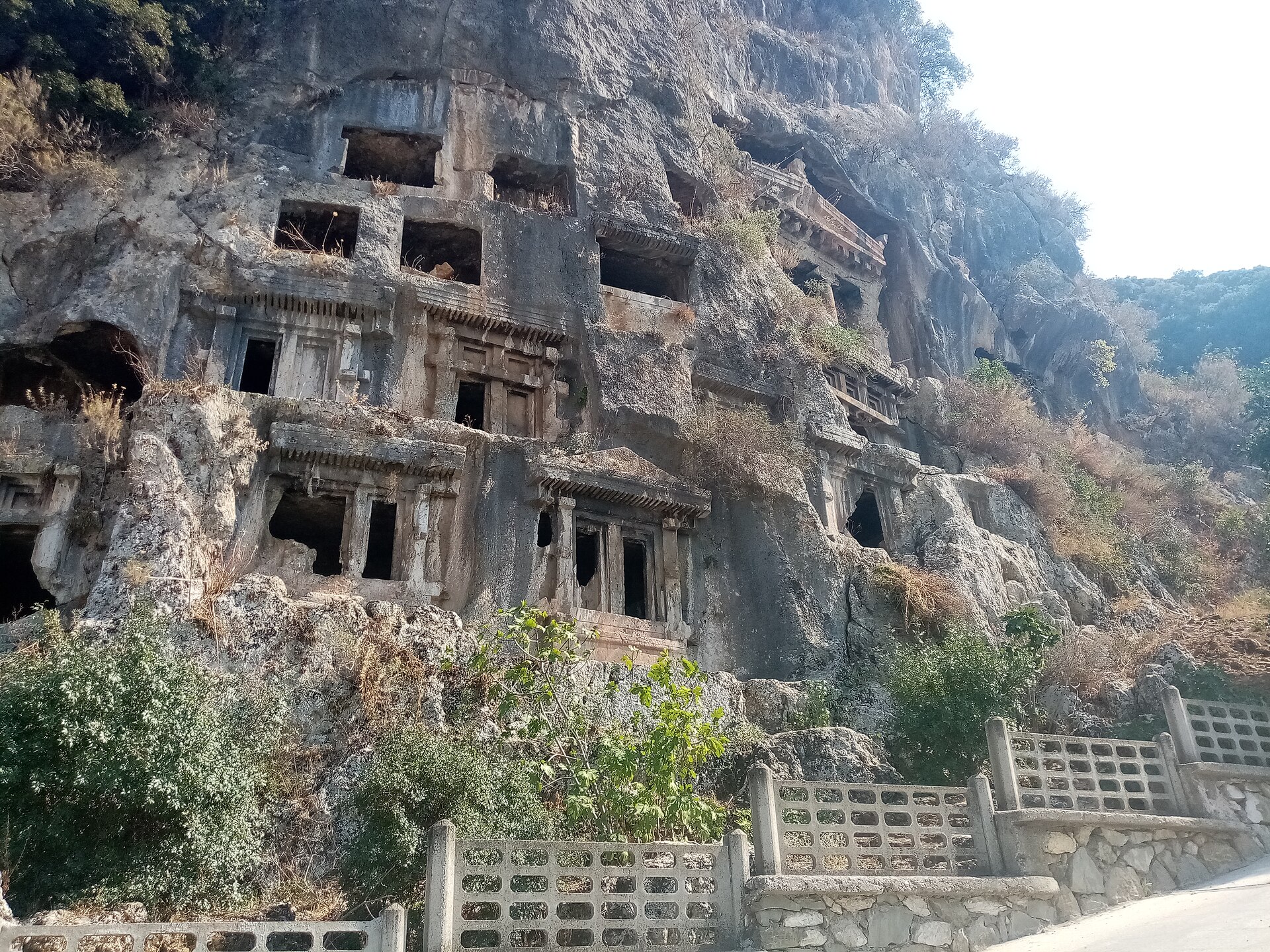
Perched on the rocky slope above Fethiye, the Tomb of Amyntas watches over the town like a silent guardian of a forgotten world. Carved into the limestone more than two thousand years ago, it belongs to an era when this coastline was part of Lycia, a loose confederation of city-states known for their fierce independence and seafaring prowess. The Lycians left behind more than just ruins—they built tombs that resembled palaces, not graves, as if defying the finality of death. The Tomb of Amyntas is one of the most striking examples, not just for its size but for the inscription that gives it its name, a rare clue to the person who once rested here.
The tomb’s facade mimics a Greek temple, complete with two fluted columns and a triangular pediment, though it’s all an illusion—just stone shaped by human hands. The entrance leads to a small chamber where a sarcophagus once lay, its contents long since vanished. The inscription in ancient Greek identifies the occupant as Amyntas, son of Hermagios, but history offers no further details. Was he a warrior, a ruler, or simply a wealthy citizen? The Lycians didn’t build these tombs as personal memorials so much as statements of family prestige, a way to assert their place in the world and their connection to the divine.
Reaching the tomb takes about twenty minutes of steady climbing along a narrow path that winds up the hillside. The first stretch passes through the outskirts of Fethiye, where modern houses give way to wild thyme and pine-scented slopes. From the top, the view stretches across the town and the bay below, a natural harbor that once sheltered Lycian ships. Other tombs dot the cliffs nearby—smaller, less grand, but no less intricate, their facades carved with columns and reliefs. Together, they create the impression of an entire mountainside turned into a necropolis, frozen in time.
The Lycians believed the dead continued to dwell in their tombs, so they designed them to resemble homes. Many are adorned with scenes of feasts, hunts, or battles, as if to remind visitors of the life that once was. The Tomb of Amyntas is plainer by comparison, its simplicity lending it a certain solemnity. There are no elaborate carvings here, just the raw presence of stone, inviting reflection on the people who created it. Perhaps they saw death not as an end but as a return to the gods, with the tomb serving as a threshold between worlds.
Over the centuries, Lycia faded from history. First came the Persians, then Alexander the Great, and later the Romans, who absorbed the region into their empire. Yet the tombs endured, untouched—whether out of respect for ancient traditions or simply because they were too solid to dismantle. In Byzantine times, some Lycian necropolises were repurposed as shelters or even homes, but the Tomb of Amyntas seems to have escaped such a fate. It remains where it was built, a relic of a civilization that once thrived along this coast.
Today, the tomb attracts fewer visitors than the grand ruins of Ephesus or Pamukkale, and that’s part of its appeal. There are no crowds, no souvenir stalls, just the quiet hum of the wind and the distant cry of gulls. It’s a place where history feels tangible, where you can stand in the same spot as someone did two millennia ago and imagine them gazing out at the sea, contemplating the same horizon. The absence of modern distractions makes it easier to connect with the past, if only for a moment.
The Tomb of Amyntas is far from unique. Across Lycia, similar tombs can be found, from simple rock-cut niches to elaborate burial complexes. Some are hidden in remote valleys, while others stand in the heart of modern towns, like those in Myra or Xanthos. But this one, in Fethiye, feels particularly well-placed. It’s neither hidden away nor swallowed by urban sprawl—just a natural part of the landscape, as if the mountain itself had always meant to hold it.
From the top of the cliff, another remnant of Lycia’s past comes into view: the ruins of an ancient theater. Small by Roman standards, it once seated a few hundred spectators, and from its upper rows, the view of the bay and the distant islands is breathtaking. On clear days, the sea seems endless, stretching to the horizon in every direction. It’s easy to see why the Lycians chose this spot for their tombs. The sea was their lifeline, their highway, and perhaps they wanted to remain close to it even in death.
The tomb won’t tell you the full story of Lycia, but it offers something more immediate: a sense of the people who lived here. There are no museum plaques or guided tours, just the stone, the wind, and the sea—the same elements that shaped the lives of those who came before. If you’re lucky, you might leave with the feeling that you’ve touched something deeper than just another tourist site, something that lingers long after you’ve descended the hill.