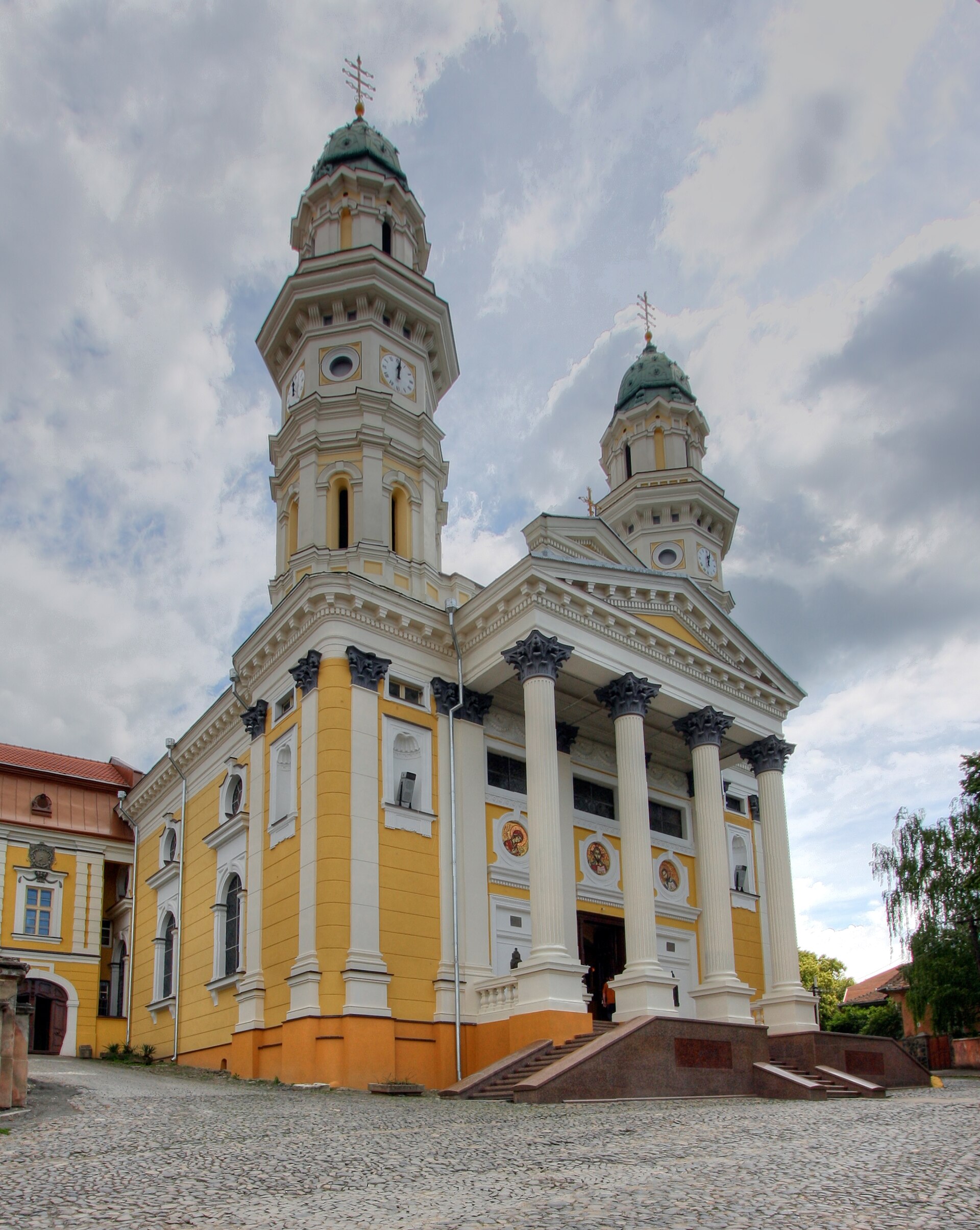
Photo: Elke Wetzig (Elya), CC BY-SA 3.0
St. George's Greek Catholic Cathedral
out of 5 0 ratingsUzhhorod’s Greek Catholic Cathedral stands quietly at the heart of the city, a place where history and faith have shaped its walls for centuries. Built in the late 17th century, the cathedral was originally part of a Jesuit monastery, a reflection of the religious currents that swept through this corner of Europe. Over time, it became a center for the Greek Catholic community, a tradition that blends Eastern Orthodox rituals with Catholic doctrine—a unique fusion born from the complex religious landscape of the region.
The building itself is a mix of architectural styles, though its Baroque roots are the most visible. The façade is simple, almost unassuming, with a single bell tower rising above the entrance. Inside, the space opens up into a warm, intimate interior where light filters through tall windows, illuminating the iconostasis—a wooden screen adorned with religious icons that separates the altar from the nave. The icons here are traditional, painted in the style that has defined Eastern Christian art for centuries, with gold leaf and deep, rich colors that draw the eye upward.
What makes this cathedral particularly interesting is its role in the city’s cultural and religious life. Uzhhorod has long been a crossroads of different faiths and ethnicities, and the cathedral has witnessed much of that history. During the Soviet era, when religious practice was suppressed, the building was repurposed, like many others, for secular use. It wasn’t until Ukraine regained independence that the cathedral was returned to the Greek Catholic Church, restored, and reopened as a place of worship. Today, it remains an active parish, where services are held in both Ukrainian and Church Slavonic, preserving a linguistic tradition that dates back to the earliest days of Christianity in these lands.
The cathedral’s location in the city center makes it easy to visit, though it doesn’t always draw the same crowds as more famous landmarks. That’s part of its charm—there’s a sense of quiet dignity here, a place where locals come to pray, light candles, or simply sit in contemplation. The square in front of the cathedral is often lively, with people passing through on their way to the nearby market or the old castle that overlooks the city. On Sundays, the sound of bells rings out across the rooftops, a reminder of the rhythms that have governed life in Uzhhorod for generations.
For those interested in history, the cathedral offers a glimpse into the religious and political shifts that have defined this part of Ukraine. The Greek Catholic Church itself emerged from the Union of Brest in 1596, when Orthodox bishops in the Polish-Lithuanian Commonwealth sought to reconcile with Rome while retaining their Eastern traditions. This compromise was not without controversy, and the church’s history has been marked by periods of both flourishing and persecution. The cathedral in Uzhhorod is one of many that tell this story, a physical testament to the resilience of a faith that has survived empire, war, and ideological upheaval.
Beyond its religious significance, the cathedral is also a piece of the city’s architectural heritage. The Baroque elements, though understated, are a reminder of the influence of Central European styles in this region. The interior, with its wooden iconostasis and frescoes, speaks to the Eastern Christian aesthetic that has endured despite political changes. Even the way the building is oriented—with the altar facing east, as is traditional in Orthodox and Greek Catholic churches—reflects centuries-old practices that connect it to a broader spiritual geography.
Visiting the cathedral doesn’t require much planning. There are no grand tours or audio guides, just an open door and the chance to step inside. The atmosphere is one of quiet reverence, though not in a way that feels exclusionary. Locals might nod in greeting, and visitors are free to wander, take in the details, or simply sit for a while. The lack of crowds means you can appreciate the space at your own pace, whether you’re admiring the craftsmanship of the icons or listening to the faint echo of footsteps on the stone floor.
Uzhhorod itself is a city that rewards slow exploration, and the cathedral is a good starting point. From here, you can walk to the old castle, stroll along the Uzh River, or wander through the streets of the historic center, where pastel-colored buildings and cobblestone lanes hint at the city’s Austro-Hungarian past. The cathedral, with its unassuming presence, serves as a kind of anchor—a place that has seen the city change around it but remains steadfast in its purpose.
In the end, the Greek Catholic Cathedral is more than just a building. It’s a living part of Uzhhorod’s identity, a place where the past is not just remembered but actively preserved. Whether you come for the history, the art, or the quiet moment of reflection, it offers something that feels both personal and universal—a connection to the people who have walked these aisles before, and to the enduring power of faith in a place that has known so much change.
Day around this place
Where else to go on the same day
Building the day…
Where it is
48.62278, 22.30222