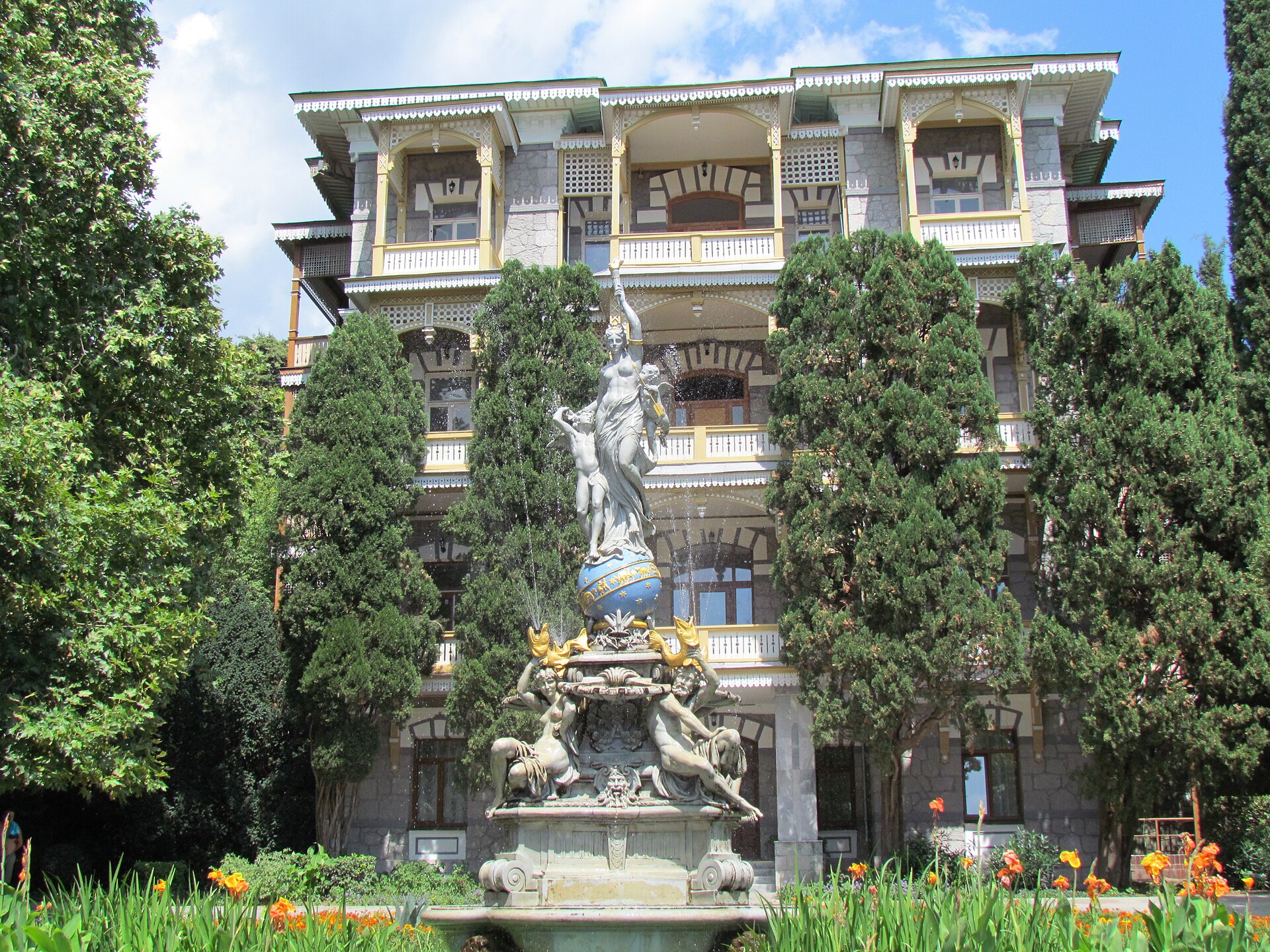
Photo: Vlad2003, CC BY-SA 3.0
Gubonin Hotels
out of 5 0 ratingsThe Gubonin Hotels in Gurzuf are more than just buildings—they are a living piece of the Crimean coast’s history, one that began in the late 19th century. At the time, the entrepreneur and philanthropist Pyotr Gubonin envisioned transforming this quiet seaside village into a resort that could rival those of Europe. He didn’t just construct hotels; he built an entire world for leisure, complete with guesthouses, parks, and even a private power station. Gubonin understood that Crimea had the potential to attract not only aristocrats but also the growing middle class, and his instincts proved right. By the end of the century, Gurzuf had become a destination for those seeking both comfort and inspiration.
The first of these hotels, the Grand Hotel, opened in 1889. A three-story structure in the late classical style, it featured spacious rooms with high ceilings and large windows framing views of the sea. Such luxury was rare even in major cities, and in Gurzuf, the Grand Hotel became an instant sensation. Writers, artists, and scientists flocked here, drawn by the promise of not just relaxation but creativity. Anton Chekhov stayed in 1899, and it’s said he worked on *The Three Sisters* while sitting on the veranda, the silhouette of Ayu-Dag mountain looming in the distance.
Over time, the complex expanded. By the early 20th century, several more hotels had been built under the Gubonin name, including the famous *Rossiya*, which opened in 1902. Unlike the Grand Hotel, *Rossiya* catered to a broader audience, offering more affordable rates. The architecture of these buildings reflected the elegance of the era—delicate balconies, intricate ironwork, and wide terraces where guests could sip tea or simply enjoy the sea breeze. The atmosphere was one of effortless charm, a place where time seemed to slow down.
The Gubonin Hotels were never just a place to sleep. They became a cultural hub, attracting intellectuals from across Russia. Literary evenings, concerts, and art exhibitions were common, and the park surrounding the hotels buzzed with conversation. Painters debated new artistic movements, scientists discussed the latest discoveries, and writers found inspiration in the salty air. In summer, the sound of waves mingled with music drifting from open windows, while guests strolled along the paths in long dresses and light suits, the scent of pine and sea filling the air.
After the 1917 Revolution, the hotels were nationalized, and their original purpose faded. During the Soviet era, they were repurposed as sanatoriums and rest homes, their architecture gradually altered to fit new needs. Some buildings retained their original character, while others were modernized, but the spirit of old Gurzuf lingered. The park, in particular, still holds traces of the past—trees planted in Gubonin’s time, quiet corners that feel untouched by the decades.
Today, the Gubonin Hotels are no longer the grand retreats they once were. Some structures have lost their original elegance, while others now serve as modest guesthouses. Yet even now, walking along Gurzuf’s waterfront or climbing the old steps to the park, it’s easy to imagine how it all looked a century ago. Fragments of the past remain—carved balconies, wrought-iron railings, heavy doors with brass handles—whispering of a time when this was one of the empire’s most fashionable resorts.
Visitors come to Gurzuf not just for the sea but for the history. The Gubonin Hotels are part of Crimea’s cultural legacy, a rare surviving example of a bygone era. Here, you can sense the passage of time, the evolution of leisure, the way travel itself has changed. The park still has a statue of Chekhov, and one of the buildings houses a small museum dedicated to Gurzuf’s past. The hotels may no longer be what they were, but their essence endures in these places.
Gurzuf never became as famous as Yalta or Alupka, but that’s part of its charm. Here, the atmosphere of a lost era remains intact. The Gubonin Hotels aren’t just architectural landmarks; they’re witnesses to a time when Crimea was a place people came to for more than just sun and sea. They came for culture, for conversation, for the kind of inspiration that only a place like this could provide. Today, sitting on a bench in the park or walking along the promenade, you can almost hear the murmur of the past—the sound of waves, the notes of a piano drifting from an open window, the rustle of dresses and the quiet hum of ideas being exchanged.
Day around this place
Where else to go on the same day
Building the day…
Where it is
44.54306, 34.27722