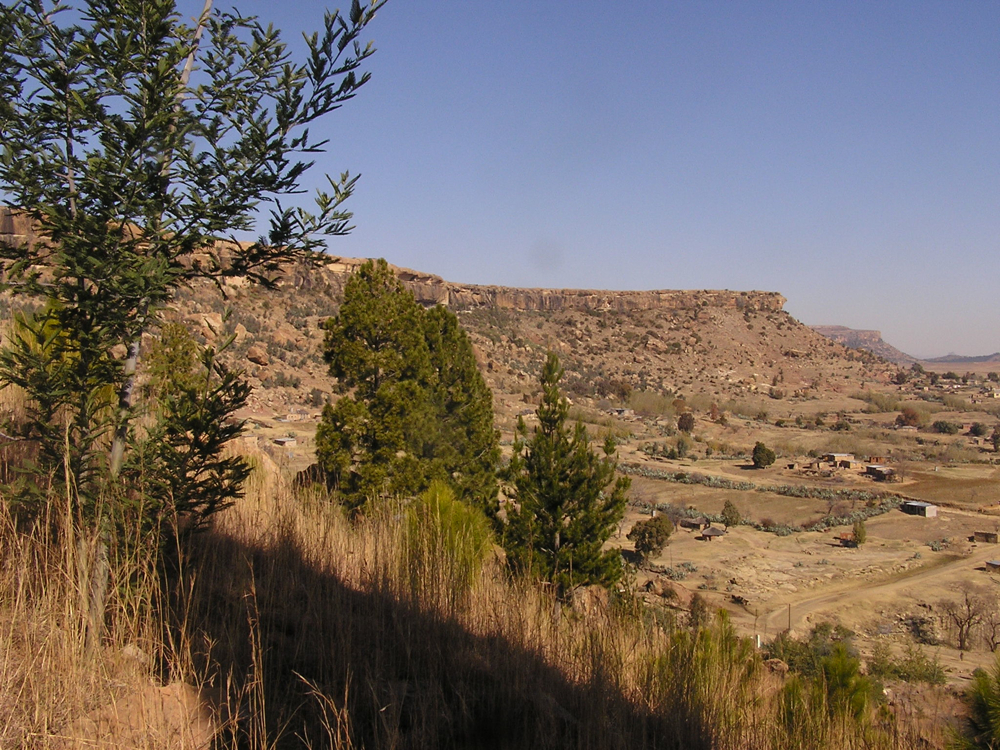
Roma sits in a valley surrounded by the rugged Maloti Mountains, where the air is thin and the light has a way of making even ordinary landscapes feel dramatic. One of the most striking features of this highland landscape is Thaba Bosiu, a flat-topped mountain that rises abruptly from the plains like a natural fortress. For centuries, it has been more than just a landmark—it was the heart of the Basotho nation, a place where history was written in stone and silence.
The name Thaba Bosiu means Mountain at Night, a reference to the belief that it grew larger after dark, making it impossible for enemies to scale its slopes. Whether or not the mountain actually changes size, its sheer cliffs and steep sides have always made it a formidable stronghold. The plateau at the top covers about two square kilometers, offering sweeping views of the surrounding countryside—rolling hills, deep valleys, and the distant peaks of the Drakensberg. On clear days, the horizon seems endless, and the wind carries the scent of wild herbs and damp earth.
This was the capital of King Moshoeshoe I, the founder of the Basotho nation, who chose Thaba Bosiu as his seat in the early 19th century. At the time, southern Africa was in turmoil, with wars and migrations reshaping communities. Moshoeshoe, a skilled diplomat and strategist, gathered scattered clans under his leadership and used the mountain’s natural defenses to protect his people. From here, he negotiated with European missionaries, traders, and colonial powers, ensuring that Lesotho remained one of the few African kingdoms to retain its independence during the colonial era.
The ruins of Moshoeshoe’s settlement still dot the plateau. Stone walls, some barely more than knee-high, mark the foundations of houses, kraals, and royal residences. The most prominent structure is the king’s own dwelling, a simple but sturdy roundhouse built from local stone. Nearby, the remains of a church stand as a reminder of the missionaries who arrived in the 1830s, bringing Christianity and literacy to the Basotho. The blend of traditional and European influences is subtle but unmistakable—stone walls meet thatched roofs, and the layout of the settlement follows both practical needs and symbolic order.
Walking across the plateau, it’s easy to imagine the life that once thrived here. The Basotho were not just warriors; they were farmers, herders, and craftsmen. The mountain’s slopes would have been dotted with cattle posts and fields of maize and sorghum. Water was drawn from natural springs, and the community lived in a rhythm dictated by the seasons. Even today, the silence up here is broken only by the wind and the occasional call of a bird. The absence of modern noise makes it easier to picture the past—children playing between the houses, elders gathering to discuss matters of state, and the king himself standing at the edge of the plateau, surveying his domain.
Thaba Bosiu was never just a military stronghold. It was a symbol of resilience and unity, a place where the Basotho identity was forged. Moshoeshoe’s leadership was not about conquest but about survival—protecting his people from the Zulu expansion, the Boers, and later, the British. His ability to balance strength with diplomacy earned him the respect of both his allies and adversaries. The mountain became a refuge not just for the Basotho but for other groups fleeing conflict, further cementing its reputation as a place of safety.
The site is still sacred to the Basotho people. Many believe that the spirits of Moshoeshoe and his descendants reside here, watching over the land. Visitors are often struck by the sense of reverence that lingers in the air. There are no grand monuments or polished tourist attractions—just the quiet weight of history. Local guides, often descendants of those who lived here, share stories of the past with a mix of pride and solemnity. They point out the graves of Moshoeshoe’s family, the remnants of the old trading posts, and the paths worn smooth by generations of feet.
Getting to Thaba Bosiu is part of the experience. The road from Roma winds through villages where life moves at a slower pace. Women in traditional blankets walk along the roadside, balancing bundles of firewood on their heads. Children wave as cars pass, and the occasional herd of sheep or cattle slows traffic to a crawl. The final approach to the mountain is steep, and the last stretch must be done on foot. The climb is not difficult, but the altitude makes it feel more strenuous than it is. By the time you reach the top, the effort is forgotten—the view alone is worth it.
Thaba Bosiu is not a place for those seeking grand architecture or bustling activity. It is a place for reflection, for understanding how a landscape can shape a people’s destiny. The mountain stands as it always has, unchanged by time, a silent witness to centuries of struggle and survival. For the Basotho, it remains a source of pride, a reminder of what was achieved here. For visitors, it offers a rare glimpse into a history that is both deeply local and profoundly human. There are no crowds, no souvenir stalls, just the wind, the stones, and the stories they hold.