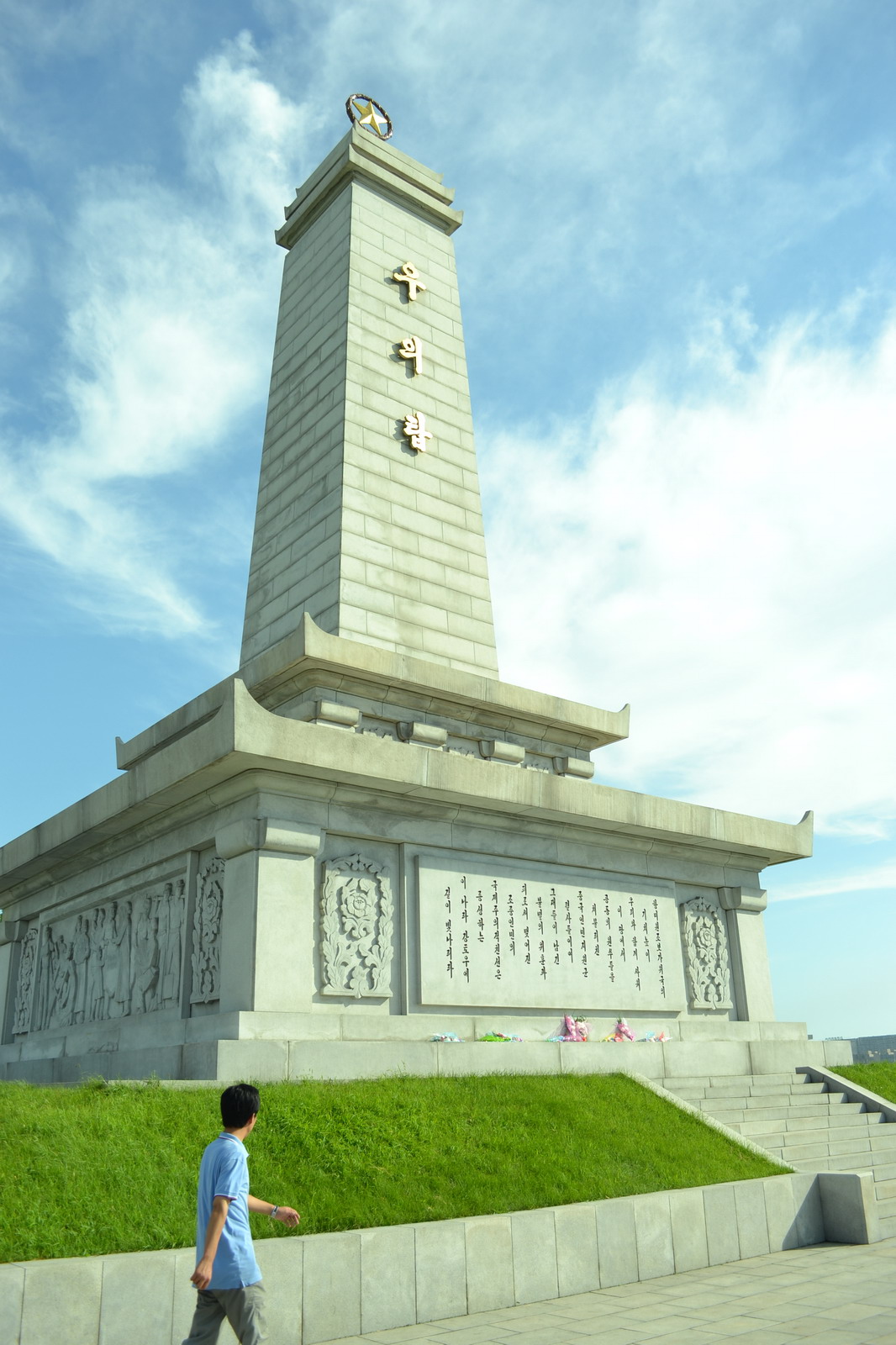
The Friendship Tower stands on a hill overlooking Pyongyang, a quiet sentinel to an era when North Korea and China shared more than just borders—they shared a vision. Built in 1959, just a few years after the Korean War, the monument was more than symbolic; it was a testament to the deep ties forged in conflict and solidarity. China had played a crucial role in supporting North Korea during the war, and in the years that followed, the two nations found common ground in their socialist ideals and shared struggles for independence. The tower was a physical manifestation of that bond, a promise etched in stone and bronze.
The architecture is unmistakably of its time—simple, imposing, and purposeful, much like many of Pyongyang’s mid-century structures. A tall white stone stele rises from the hill, crowned by a sculpture of two soldiers, one Korean and one Chinese, standing side by side with their flags held high. The figures are rendered in the realist style typical of socialist art, where every detail carries weight, every expression is deliberate. The soldiers’ postures suggest unity, their faces set with determination, as if guarding not just a monument but an idea. Around the base, a small park unfolds with neatly trimmed lawns and trees that offer shade in the summer and blaze with color in the autumn.
Inscribed on the pedestal are words in Korean and Chinese, declarations of eternal friendship between the two nations. Inside the tower, a modest museum holds relics of that relationship: letters exchanged between Kim Il Sung and Mao Zedong, photographs of historic meetings, and gifts that once carried diplomatic significance. The exhibits trace the arc of the two countries’ alliance, from the fervor of the post-war years to the more pragmatic ties of later decades. It’s a small space, but it tells a story—one of shifting alliances, shared ideologies, and the quiet persistence of history.
Over the years, the tower’s meaning has subtly shifted. What was once a symbol of an unbreakable alliance is now more of a historical marker, a reminder of a time when rhetoric and reality aligned more closely. China remains North Korea’s most important partner, but the nature of their relationship has evolved, shaped by pragmatism as much as by sentiment. Still, the tower retains its place in the country’s official narrative. Ceremonies are held here to mark anniversaries of diplomatic ties, and foreign visitors are sometimes brought to see it, a curated glimpse into the enduring—if carefully managed—friendship between the two nations.
For locals, the Friendship Tower is likely just another part of Pyongyang’s landscape, visible from afar when standing on one of the city’s hills or crossing the Taedong River. It doesn’t have the grandeur of the Arch of Triumph or the ideological weight of the Juche Tower, but its understated silhouette is familiar. On holidays, people gather here to lay flowers or take a quiet stroll, the park offering a rare moment of respite in a city where public spaces often serve a more overtly political purpose. The atmosphere is calm, almost serene, a contrast to the bustle of the city center.
The view from the hill is expansive. Below, the rooftops of Pyongyang stretch out in orderly rows, the Taedong River winding through the city like a silver thread. On clear days, the distant mountains blur into the horizon, and the outskirts of the capital come into focus. It’s a place where the city feels both vast and intimate, where the weight of history and the rhythm of daily life intersect. The tower itself, with its clean lines and unadorned design, feels almost timeless, a relic of an era when monuments were built to last, both physically and symbolically.
In many ways, the Friendship Tower is a microcosm of North Korea’s relationship with the outside world. It speaks to a time when alliances were forged in the fires of war and ideology, when solidarity was not just a word but a guiding principle. For outsiders, it offers a glimpse into how the country constructs its narrative, how it chooses to remember—and be remembered. The tower is a reminder that even in a nation often seen as isolated, there have always been connections, partnerships, and shared histories that shape its identity.
Today, the tower feels slightly out of step with the modern buildings rising in Pyongyang, their glass and steel facades a stark contrast to the solid, unyielding stone of the monument. But perhaps that’s part of its appeal. It carries the weight of another era, one where words like "friendship" and "solidarity" were not just political slogans but lived realities. Time moves on, borders shift, and alliances evolve, but monuments like this endure, standing as silent witnesses to the past. The Friendship Tower is one such place—a meeting point of history and the present, where the ideals of yesterday are preserved in the materials of today.