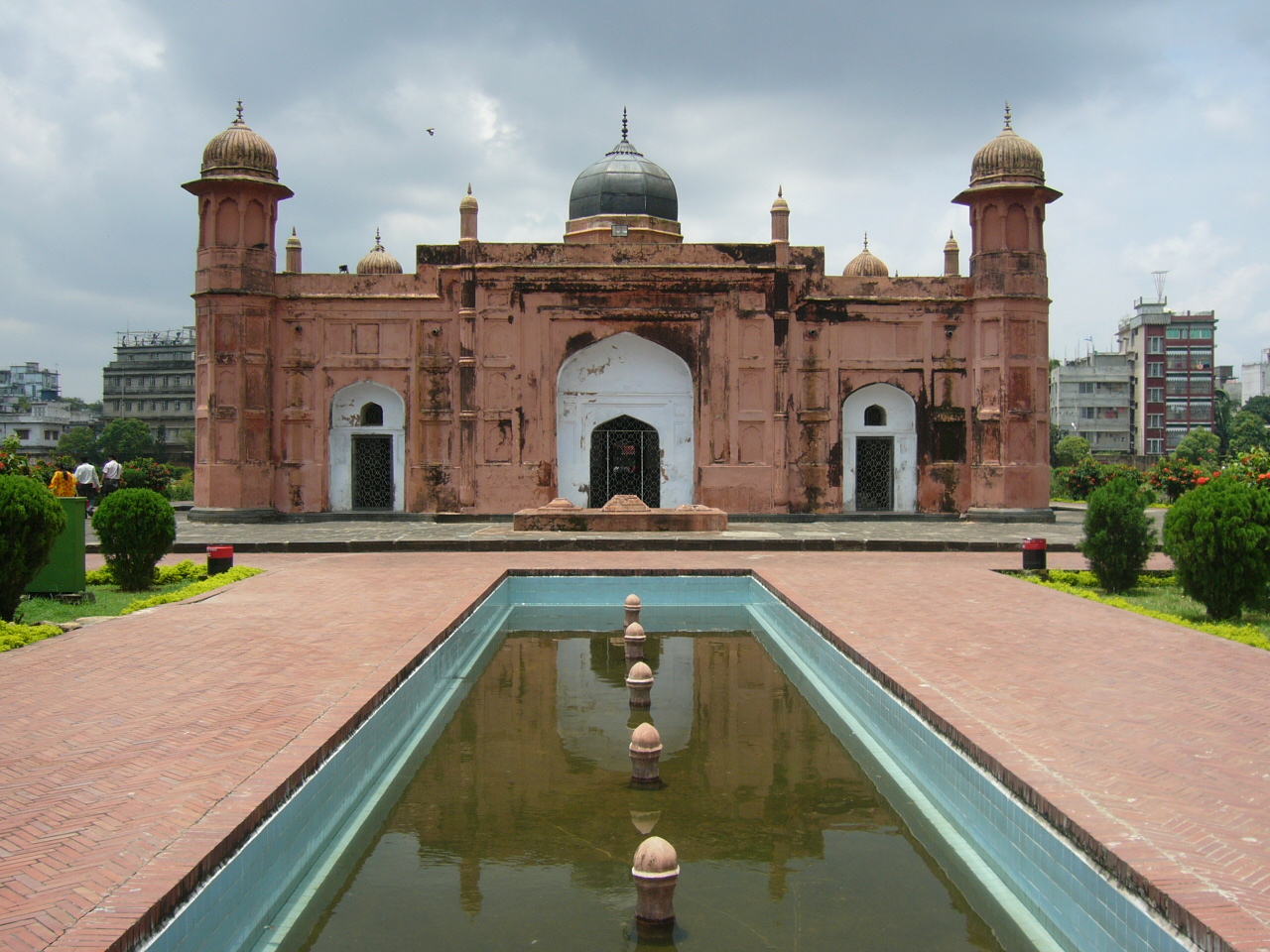
Lalbagh Fort stands in the heart of Old Dhaka, a quiet witness to the passage of centuries in a city that has long since outgrown its walls. Though often called a fort, the complex was never fully completed as one—its construction began in the late seventeenth century under the Mughal prince Muhammad Azam, son of Emperor Aurangzeb, who was then serving as the governor of Bengal. The prince envisioned a grand palace-fortress, but his tenure was cut short, and the project was abandoned before it could take its final shape. Later, his successor, Shaista Khan, continued the work, though with less ambition, leaving the fort in the state we see today: a mix of sturdy ramparts, half-finished structures, and elegant pavilions that hint at what might have been.
The fort’s most striking feature is its southern gateway, a massive three-story structure that still dominates the skyline of this part of the city. Built in the classic Mughal style, it combines red sandstone and white marble in a way that feels both imposing and delicate. The gateway was meant to be the main entrance, but its grandeur suggests it may have been intended as more than just a passage—perhaps a ceremonial arch or even a royal viewing platform. Inside, the fort’s layout is deceptively simple: a large open courtyard surrounded by walls, with a few key buildings clustered toward the western side. The absence of a full defensive perimeter is one of the reasons historians debate whether this was ever truly meant to be a military stronghold or simply an imperial retreat.
At the center of the complex lies the Diwan-i-Aam, or Hall of Public Audience, a long, low building with a series of arched doorways. Its purpose was to serve as a place where the governor could address his subjects, hear petitions, and dispense justice. The hall’s design is unpretentious, with thick walls and high ceilings that would have kept the interior cool even in the sweltering Bengal heat. Nearby, the Hammam Khana, or royal bathhouse, offers a glimpse into the private life of the Mughal elite. Though small, it is intricately designed, with a system of underground channels that once carried hot and cold water to the baths. The remnants of these channels are still visible, a reminder of the sophistication of Mughal engineering.
The most poignant part of Lalbagh Fort is the tomb of Pari Bibi, a figure shrouded in legend. She is said to have been the daughter of Shaista Khan, though some accounts suggest she was a beloved concubine or even a Hindu princess who converted to Islam. Her tomb, a small but elegant structure in the center of the fort, is built entirely of white marble, a rare material in Bengal at the time. The interior is decorated with intricate floral motifs and Quranic inscriptions, reflecting the fusion of Persian and Bengali artistic traditions. The tomb’s location—right in the middle of the fort—has led to speculation that her death may have been the reason construction was halted. Some say Shaista Khan, grief-stricken, ordered the work to stop, while others believe the fort was simply no longer a priority after his departure.
Beyond its historical significance, Lalbagh Fort is a place where the layers of Dhaka’s past are still tangible. The fort’s walls have seen the rise and fall of empires, the shift from Mughal rule to British colonialism, and the transformation of a provincial town into a sprawling metropolis. Today, the complex is surrounded by the dense, chaotic life of Old Dhaka, where narrow streets teem with rickshaws, street vendors, and the constant hum of activity. Yet within its boundaries, the fort remains a pocket of relative calm. The courtyard is often quiet in the early morning, when the light is soft and the air is still cool, or in the late afternoon, when the setting sun casts long shadows across the brickwork.
Visitors to Lalbagh Fort will find that it rewards those who take the time to explore slowly. The western side of the complex, where the main buildings are concentrated, is the most developed, but the eastern half is equally interesting for its sense of abandonment. Here, the walls are lower, the vegetation wilder, and the structures more skeletal. It’s easy to imagine how the fort might have looked in its unfinished state, with workers hauling stone and masons chiseling away at the details that would never be completed. The contrast between the polished marble of Pari Bibi’s tomb and the rough, weathered brick of the outer walls speaks to the fort’s interrupted history—a place caught between aspiration and reality.
For those interested in Mughal architecture, Lalbagh Fort offers a more intimate alternative to the grander monuments of Delhi or Agra. Its scale is smaller, its details less overwhelming, but its charm lies in its imperfections. The fort was never meant to be a showpiece; it was a personal project, a retreat, a place where the governor could escape the pressures of administration. That sense of intimacy is still present today. Unlike the Taj Mahal or the Red Fort, which were designed to impress and intimidate, Lalbagh feels almost domestic in places. The bathhouse, the audience hall, the tomb—these were spaces meant for living, not just for display.
The fort’s location in Old Dhaka also makes it a natural starting point for exploring the surrounding area. Just a short walk away is the Buriganga River, where wooden boats still ferry passengers across the water, much as they have for centuries. The riverfront is lined with markets, mosques, and old merchant houses, their facades worn by time but still full of character. Nearby, the Ahsan Manzil, the former palace of the Nawabs of Dhaka, offers another glimpse into the city’s colonial past. Together, these sites paint a picture of a place where history is not confined to museums but spills out into the streets, where the past and present coexist in a way that is both jarring and fascinating.
Lalbagh Fort is not a place that reveals itself all at once. It requires patience, a willingness to look beyond the obvious, and an appreciation for the stories that are not always written down. There are no grand narratives here, no sweeping epics of conquest or revolution. Instead, there are fragments—of a prince’s ambition, a governor’s grief, the daily life of a bygone era. In a city as fast-paced and crowded as Dhaka, the fort offers a rare opportunity to step back, to breathe, and to reflect on the quiet persistence of history. It may not be the most famous monument in South Asia, but it is one of the most human.