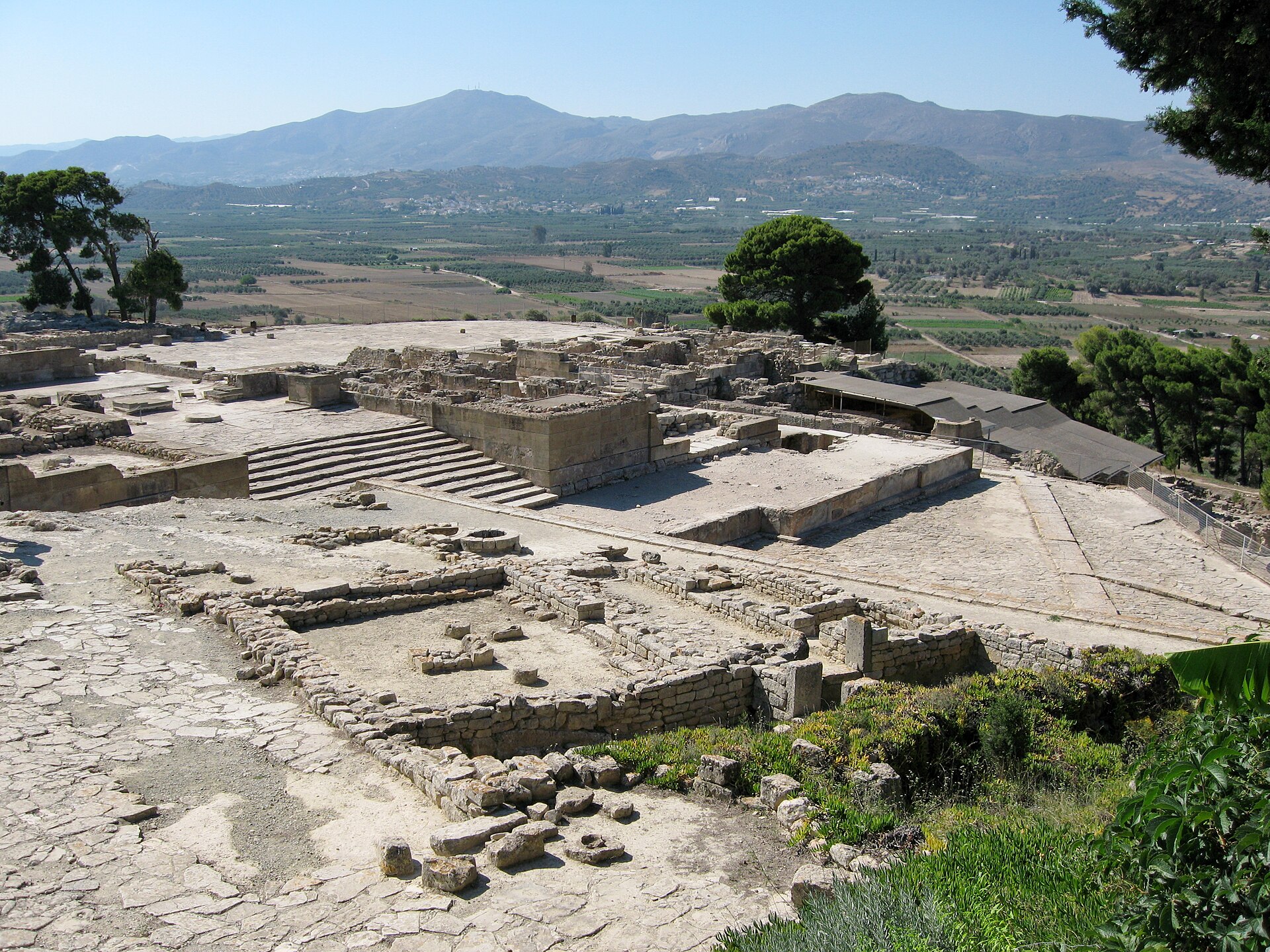
Perched on a gentle rise in the Mesara plain, Phaistos feels like a quiet secret tucked away from the well-trodden paths of Crete’s more famous ruins. Just over twenty kilometers south of Heraklion, this ancient city was once the second most important center of Minoan civilization, yet today it sees only a fraction of the visitors that flock to Knossos. There’s no grand reconstruction here, no crowds jostling for the best photo spot—just the wind rustling through olive groves and the sun casting long shadows over weathered stone. It’s a place where history isn’t explained so much as felt, where the past lingers in the silence between the ruins.
The palace at Phaistos was first built around 2000 BCE, only to be rebuilt after a devastating earthquake in 1700 BCE. Unlike Knossos, where restorations sometimes feel too polished, Phaistos has been left largely as it was found. The remains are sparse but evocative: crumbling staircases that lead nowhere, vast courtyards where the echoes of ancient footsteps might still be heard, and the skeletal outlines of once-grand halls. The central courtyard, paved with stone slabs and framed by the remnants of columns, is particularly striking. From here, the view stretches across the fertile Mesara valley to the distant mountains, a panorama that hasn’t changed much since Minoan rulers stood in this very spot, surveying their domain.
Phaistos was more than just a palace—it was a hub of administration, religion, and trade. Warehouses held vast jars of olive oil and wine, workshops hummed with the work of artisans, and sanctuaries hosted rituals whose meanings are now lost to time. Among the most intriguing discoveries here is the Phaistos Disc, a small clay tablet covered in spirals of undeciphered symbols. The original is housed in the Archaeological Museum of Heraklion, but a replica stands near the ruins, a tantalizing reminder of how much we still don’t know about this civilization. The disc’s purpose remains a mystery, adding to the sense that Phaistos is a place where questions outnumber answers.
Myth and history blur at Phaistos. Some legends claim it was the birthplace of Rhadamanthys, a son of Zeus and brother of Minos, who later became a judge in the underworld. Others say the city was founded by Minos himself, its people renowned for their wisdom. But like so much of Minoan Crete, Phaistos couldn’t withstand the forces of nature. The palace was destroyed in the 15th century BCE, and by the time the Romans arrived, the city was little more than a shadow of its former self. What remains today is a haunting reminder of how fleeting even the greatest civilizations can be.
There’s no need to rush at Phaistos. The site is compact enough to explore in a few hours, but its atmosphere invites lingering. Early mornings and late afternoons are especially magical, when the light softens and the stones seem to glow. The lack of modern distractions—no flashy signs, no guided tours clamoring for attention—means you’re left alone with your thoughts. It’s easy to imagine the clatter of pottery in the workshops, the murmur of prayers in the sanctuaries, or the footsteps of a ruler pacing the courtyard. The wind carries the scent of wild thyme and dry earth, a fragrance that hasn’t changed in millennia.
Beyond the ruins, the Mesara plain stretches out in all directions, one of Crete’s most fertile regions. Olive groves and vineyards blanket the landscape, their orderly rows contrasting with the wild beauty of the surrounding hills. Nearby, the village of Agia Triada holds the remains of another Minoan settlement, smaller but no less intriguing. And if you’re willing to drive another half-hour south, the Libyan Sea awaits with its quiet beaches and crystalline waters. But even if you never leave Phaistos, the experience is complete in itself—a rare chance to step into the past without the filter of modern interpretation.
For those who want a deeper understanding of Minoan culture, Phaistos pairs well with a visit to Knossos and the Archaeological Museum in Heraklion. Together, they offer a fuller picture of this enigmatic civilization. But Phaistos stands on its own, too. There’s something about its unassuming nature that makes it all the more powerful. It doesn’t try to impress or entertain; it simply is. And in a world where so much is curated for consumption, that quiet authenticity is its greatest gift. The best way to experience it is to wander slowly, let the stones speak for themselves, and listen to the silence.