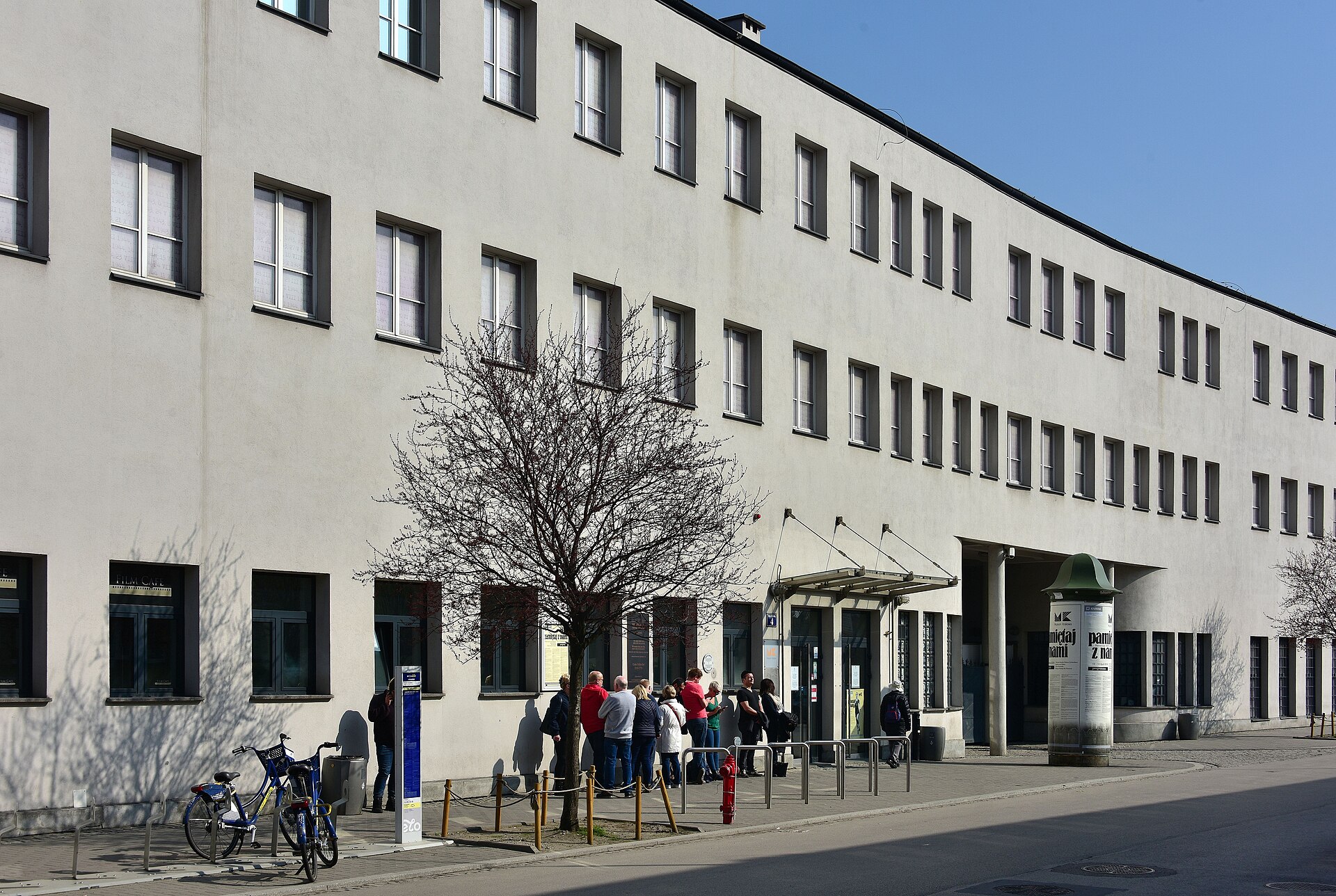
Oskar Schindler’s Factory is one of those places in Kraków where history isn’t just remembered—it lingers in the air, in the worn brick walls, in the quiet spaces between exhibits. What was once an ordinary industrial building, humming with the clatter of enamelware production, became an unlikely sanctuary during one of the darkest chapters of the Second World War. The factory, owned by the German industrialist Oskar Schindler, was a place of contradictions: a business profiting from war, yet also a refuge where over a thousand lives were saved from the machinery of the Holocaust.
The building itself is unremarkable in appearance—functional, utilitarian, the kind of structure built for efficiency rather than beauty. Constructed in the early 20th century, its red-brick facade and large windows speak of its industrial past, not of grand architectural ambition. And yet, that very plainness makes it all the more powerful. There are no ornate details to distract from the weight of what happened here. The factory continued operating long after the war, changing hands and purposes, until it was finally transformed into a museum in the 2000s, preserving not just its own story but that of an entire city under occupation.
The museum’s exhibition does more than recount Schindler’s actions; it immerses visitors in Kraków during the Nazi occupation. Reconstructed streets, apartments, offices, and even prison cells recreate the atmosphere of those years with unsettling precision. There are no soft edges here—only the raw evidence of history: documents, photographs, personal belongings, and firsthand accounts that lay bare the brutality of the occupation, the horrors of the ghetto, and the systematic extermination of Kraków’s Jewish community. The story of the city’s Jews, forced into the ghetto before being deported to death camps, is given particular attention, a stark reminder of how quickly normal life can unravel.
Schindler himself was a complicated figure—a businessman who initially saw the war as an opportunity, a man who drank with Nazi officers and profited from their regime. But something shifted as he witnessed the suffering around him. At great personal risk, he compiled the now-famous list of Jewish workers, declaring them essential to his factory’s operations. These people, spared from the camps, worked in relative safety while the world outside descended into chaos. The story gained global recognition through Thomas Keneally’s book and Steven Spielberg’s film, but the museum offers something different: not a dramatized version of events, but the tangible remnants of real lives—letters, identity cards, the tools of daily survival.
This is not a place that glorifies heroes. Instead, it asks difficult questions about human nature, about the choices people make when faced with impossible circumstances. The exhibition doesn’t end with the war; it follows Kraków into the postwar years, showing how the city grappled with its past, rebuilding not just its buildings but its identity. The factory stands as a testament to the fragility of morality in times of crisis, a reminder that even in the darkest moments, small acts of defiance can ripple outward in ways no one could predict.
Visiting Schindler’s Factory is not like touring a typical attraction. There are no flashy displays or interactive gimmicks, just a quiet, deliberate unfolding of history. The museum doesn’t aim to shock or entertain; it asks visitors to listen, to reflect, to sit with the discomfort of what happened here. The experience lingers long after leaving, not because of any single exhibit, but because of the cumulative weight of so many individual stories—stories of fear, resilience, and the thin line between survival and loss.
Kraków is a city of layers—of medieval squares, of grand cathedrals, of centuries of art and culture. But Schindler’s Factory cuts through those layers to something more immediate, more human. It’s a place where the past isn’t just preserved in glass cases but felt in the hush of a reconstructed wartime apartment, in the faded ink of a deportation order, in the silence of a room where people once waited, not knowing if they would live to see another day. The question it leaves behind isn’t about what happened here, but about what any of us might have done in their place. And that’s a question without easy answers.