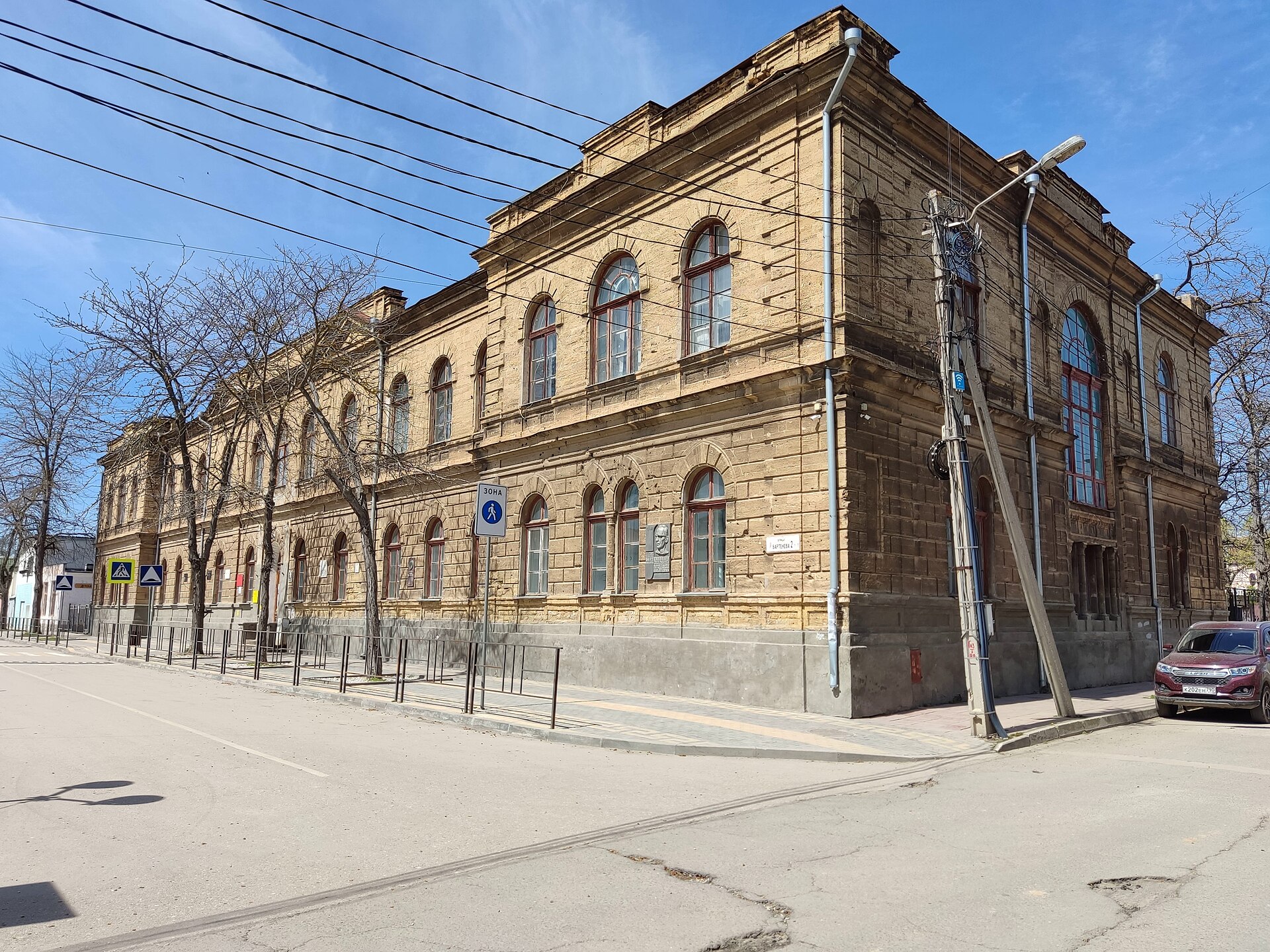
The Yevpatoria Women’s Gymnasium is one of those quiet buildings that hold the city’s past without demanding attention. Built in the late 19th century, it stands as a silent witness to the changes that swept through Yevpatoria and Russia as a whole. Today, it blends into the urban landscape, often overlooked as just another old structure, though its walls remember a time when education for women was rare, and a gymnasium like this was a small beacon of progress in a provincial town.
Designed by architect Alexander Bernardazzi, the building was completed in 1893. Bernardazzi, known for his work across southern Russia, left his mark on Yevpatoria with several notable structures, this one among them. The gymnasium’s facade reflects a classical style with touches of Neo-Renaissance—symmetrical windows, pilasters, and restrained but elegant detailing. In that era, such buildings weren’t just functional; they were statements of a city’s aspirations, its desire to align with the cultural and architectural standards of the capital.
When the gymnasium opened, women’s education in Russia was still in its early stages. Before the mid-19th century, girls from wealthy families were typically educated at home, and formal schooling was a rarity. Yevpatoria’s gymnasium was part of a broader movement following reforms under Alexander II, offering not just traditional subjects like religious studies and needlework, but also foreign languages, mathematics, and history—subjects considered essential for cultivating an educated woman.
The students here were daughters of local merchants, officials, doctors, and teachers. For many, this was their only chance at a structured education, a way to step beyond the limited opportunities of provincial life. Yevpatoria was already a known resort town by then, but it remained a quiet backwater, and the gymnasium gave young women not just knowledge, but a glimpse of a different future, however constrained by the norms of the time.
After the revolution, the building took on new roles. During the Soviet era, it housed various institutions—a school, a technical college, administrative offices. The exterior remained largely unchanged, though the interiors were adapted to suit new purposes. Today, it still serves as an educational space, long after the gymnasium itself ceased to exist. The building’s original function may be gone, but its connection to learning endures.
Walking along Revolution Street, where the gymnasium stands, it’s easy to miss at first glance. There’s nothing flashy about it—no bold colors or ornate decorations—but its understated elegance catches the eye of those who pause to look. The facade retains its original structure, though time and neglect have left their marks. Trees shade the sidewalk, and students hurry past on their way to class, a reminder that life moves on, and the building remains a part of it.
The Yevpatoria Women’s Gymnasium is more than just an old building; it’s a symbol of an era when education for women became more accessible, and provincial towns began to embrace the cultural shifts of the capital. It stands as a quiet testament to how perceptions of women’s roles in society evolved, and how even small cities could be part of that change. In that sense, the gymnasium is not just an architectural relic but a living piece of history, its walls still echoing the past.