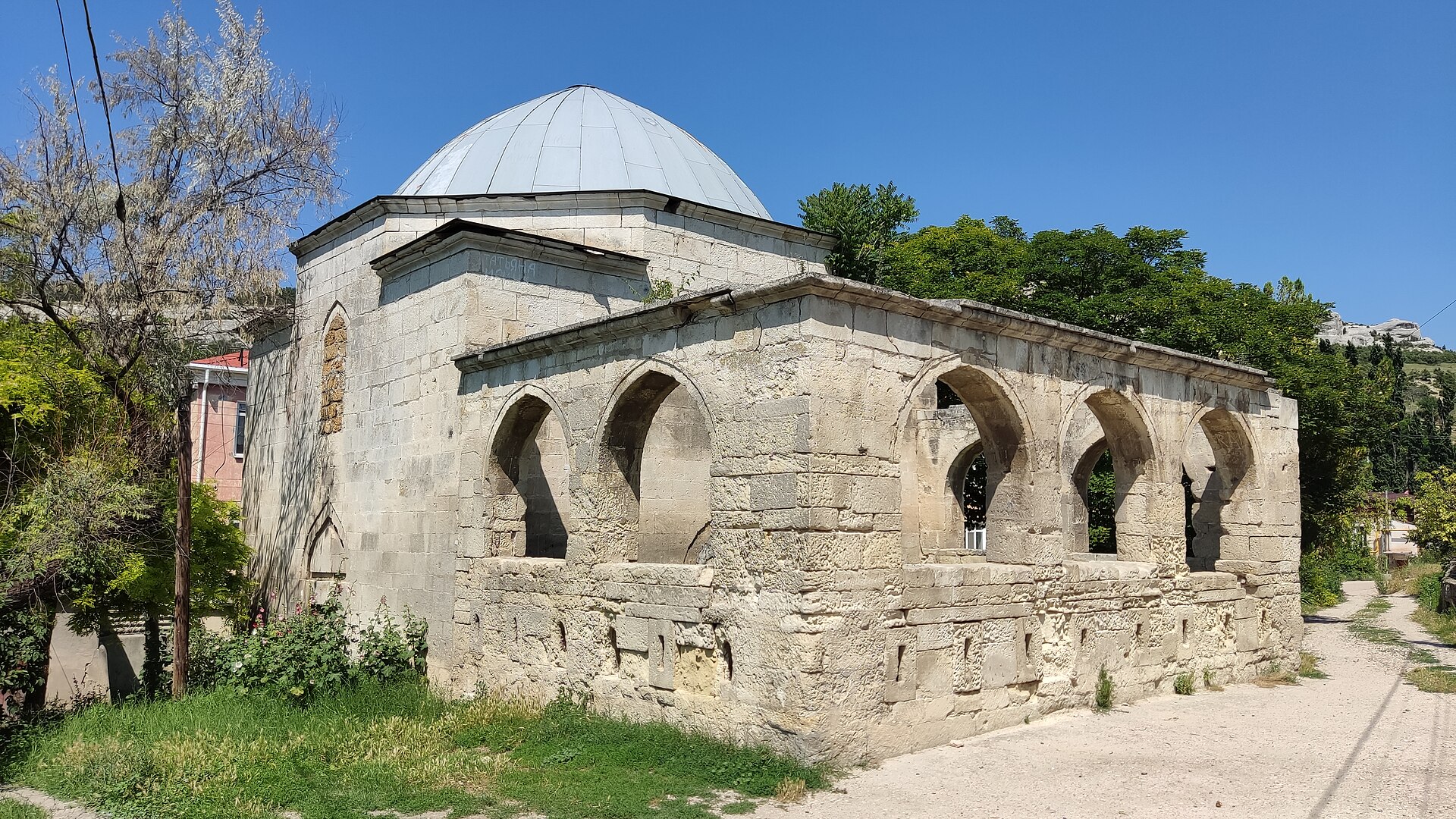
Perched on a quiet hillside on the edge of Bakhchisaray, Eski-Dürbe feels like a place where time has paused to catch its breath. This old mausoleum, built in the sixteenth century, stands where the boundaries of the Crimean Khanate’s capital once blurred into the surrounding lands. The name translates simply as the Old Tomb, though no one knows for certain who lies beneath its stone floor. Historians suggest it may have been a noble from the ruling Giray dynasty, someone whose name has since faded from memory but whose resting place still holds the weight of history.
The building itself is modest in scale yet striking in its proportions. An octagonal structure topped with a shallow dome, it follows the traditional Crimean Tatar style of the period, though with a few subtle differences. The walls are clad in local limestone, weathered by centuries of wind and rain, while the entrance is framed by a low arch that curves gently upward—a quiet nod to Islamic architectural traditions. Small windows punctuate the walls, allowing slivers of light to filter inside, softening the stone’s coolness. Once, the interior would have held ornate tombstones, but these have long since disappeared, leaving only bare walls and an echo of the past.
The location was never accidental. From this slight elevation, the mausoleum overlooks the valley where Bakhchisaray sprawls, its old streets winding toward the khan’s palace. In its day, this spot would have been a landmark for travelers approaching the city, a silent sentinel marking the way. Today, it remains a vantage point, though one largely forgotten by the crowds that flock to the more famous sites nearby. That neglect, however, is part of its charm. There are no tour groups here, no vendors hawking trinkets—just the rustle of leaves and the occasional murmur of visitors who’ve wandered off the beaten path.
Bakhchisaray was once the heart of the Crimean Khanate, a small but powerful state that shaped the region’s history for centuries. When the Russian Empire annexed Crimea in the late eighteenth century, much of the khanate’s legacy was erased or repurposed. Some monuments were demolished, others left to crumble. Eski-Dürbe survived, though not unscathed. Soviet-era restorations attempted to stabilize the structure, but in doing so, some of its original details were lost. Still, even with these changes, the mausoleum endures as a rare physical link to a time when Bakhchisaray was more than just a city—it was a capital, a crossroads of cultures, and a place where decisions that shaped the fate of the peninsula were made.
Nowadays, the mausoleum is as much a place of quiet reflection as it is a historical monument. A small park surrounds it, where locals sometimes gather for picnics or sit on benches beneath the trees. In summer, the air carries the scent of wild herbs and sun-warmed stone; in winter, snow dusts the dome, lending the building an almost otherworldly stillness. No one knows for sure who was buried here, and perhaps that mystery is part of why the place feels so compelling. It doesn’t demand attention—it simply exists, a silent witness to the passage of time.
For those exploring Bakhchisaray, Eski-Dürbe offers a counterpoint to the more crowded attractions like the Khan’s Palace or the cliffside Uspensky Monastery. There’s no grand spectacle here, no elaborate carvings or gilded interiors. Instead, there’s space to think, to imagine the voices that once filled this chamber, the footsteps of mourners who came to pay their respects. It’s the kind of place where you might linger a little longer than planned, drawn in by the stillness.
What makes Eski-Dürbe special isn’t its size or opulence, but its authenticity. It hasn’t been polished for tourists or dressed up to meet expectations. The stone is worn, the paint faded, and the silence unbroken by the usual hum of crowds. There’s a sense that the mausoleum has chosen to keep its secrets, revealing them only to those who take the time to look closely. In a region where history is often overshadowed by more dramatic landmarks, this unassuming structure offers something rarer—a moment of genuine connection with the past.
If you find yourself in Bakhchisaray, it’s worth making the short walk to Eski-Dürbe. The detour won’t take long, but it might leave you with something more lasting than a photograph. History isn’t always about grand gestures or famous names; sometimes, it’s about standing in a quiet place and feeling the weight of the centuries in the stones beneath your feet. This mausoleum doesn’t shout its stories—it lets them unfold slowly, for those willing to listen.