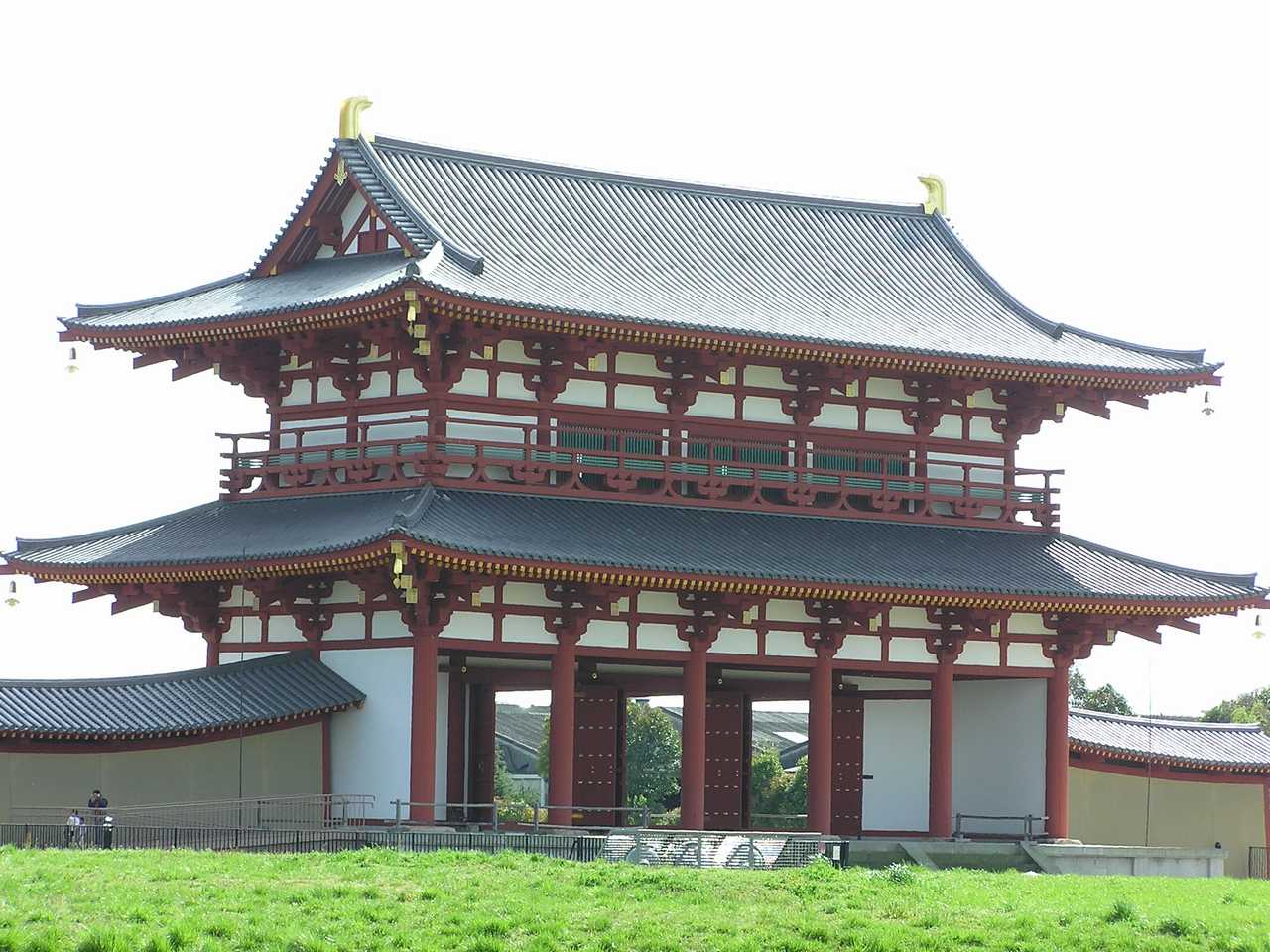
Japan’s first permanent capital took root here. In the eighth century, the plains beneath Mount Wakakusa became Heijō-kyō, a city that served as the political and cultural heart of the country for nearly a century. Today, only reconstructed buildings and open fields remain, but they suggest the scale of what was once the center of an empire.
The palace marked a new era. Japan adopted Chinese traditions in governance, architecture, and art. The main gate, Suzakumon, faced south and led to the emperor’s residence. Its size and symmetry mirrored Tang China’s ideals, though details already hinted at a distinct Japanese style. The gate has been restored using historical records and archaeological findings. It stands almost new, yet its shadow still carries the weight of the past.
The palace complex once included walls, moats, and buildings. At its center stood the Daigokuden, the throne hall, and the emperor’s private chambers. Here, envoys were received, ceremonies held, and laws drafted. When the capital moved to Kyoto, many structures were dismantled. Excavations and restorations began in the late twentieth century, slowly revealing the original layout.
The grounds are now a quiet park of wide paths, grassy mounds, and scattered trees. Wind rustles through the grass; visitors speak in low voices. In summer, the fields turn green; in autumn, leaves blaze gold; in winter, snow dusts the roofs of reconstructed pavilions. The scene feels suspended in time. You might forget you’re in a modern city and imagine standing at the imperial court.
Buddhism shaped the palace’s history. Religion and state were intertwined, with monastic communities influencing politics. Nearby stood major temples, including Tōdai-ji with its Great Buddha. Today, urban development separates these sites, but they once formed a single spiritual and political core. The palace wasn’t just a seat of power—it was part of a network of belief that defined early Japan.
The architecture of Heijō Palace blends Chinese elements with local traditions. Gray-tiled roofs resemble Chinese designs, but their curves and proportions are lighter, more Japanese. Carved columns and beams feature motifs that later became staples of Japanese art. The layout—with clear divisions between public and private spaces—set the standard for future imperial residences.
Today, Heijō Palace hosts festivals and reenactments. In spring, cherry blossoms draw crowds; in autumn, Noh theater performances fill the air; in summer, lantern festivals echo ancient rituals. On these days, the park hums with drums, voices, and the scent of street food. For locals, it’s a connection to the past; for visitors, a glimpse into old Japan.
The palace retains a distinct atmosphere. This was where Japan first defined itself as a unified state. The foundations of its culture were laid here. Walking the grounds, you sense that connection to a time when Japan was shaping its identity.
If you visit, you’ll find no crowds like in Kyoto, no urban rush. Just silence, space, and the chance to reflect on how a nation changes. Sometimes, at sunset, the sky turns pink and orange. Then even the reconstructed walls feel like more than just a museum exhibit.