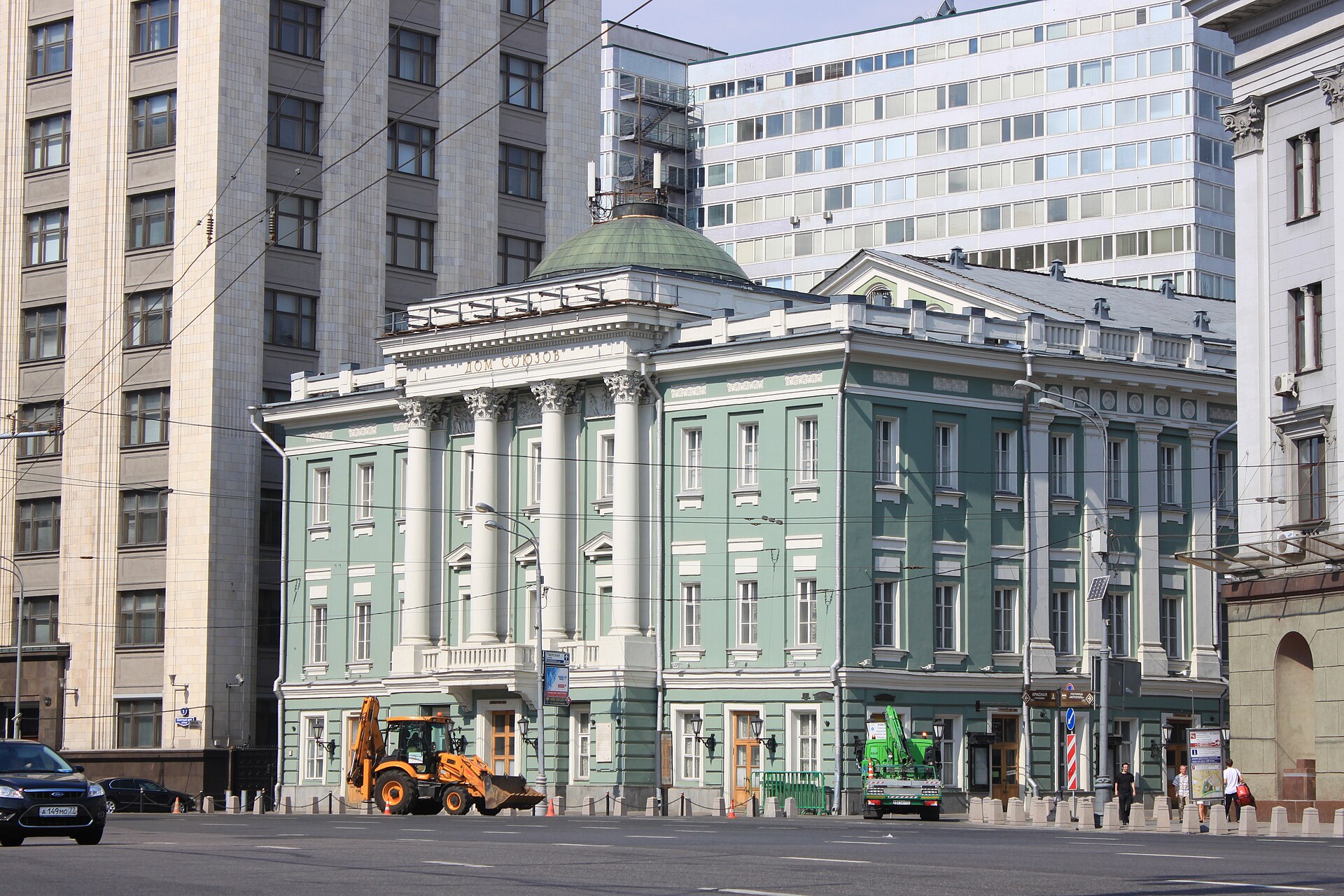
The House of Unions is one of those Moscow buildings that seem frozen in time, carrying the weight of different eras within its walls. Standing at the intersection of Okhotny Ryad and Bolshaya Dmitrovka, it has witnessed over two centuries of change—shifting owners, revolutions, and the ebb and flow of public life. Today, it’s best known for grand events, concerts, and official ceremonies, but its story runs far deeper than its modern reputation suggests.
Built in the late 18th century as the city estate of Prince Vasily Dolgorukov-Krymsky, a prominent figure of Catherine the Great’s reign, the house was originally a classic noble residence of its time—symmetrical, columned, and spacious. By 1784, however, it was purchased by the Noble Assembly, an organization of Moscow’s aristocracy, and entrusted to the architect Matvey Kazakov for reconstruction. Kazakov didn’t just expand the building; he transformed it into the stately structure we see today, blending grandeur with refined elegance.
The true masterpiece of Kazakov’s work lies inside: the Column Hall, which would become the House of Unions’ most iconic feature. With its towering white columns, soaring ceilings, and vast windows flooding the space with light, the hall was a marvel of its time. In the 19th century, it hosted Moscow’s elite—balls, concerts, and charity evenings where the city’s cultural and social life unfolded. The hall wasn’t just an architectural achievement; it was a stage for the era’s most significant gatherings.
The 1917 Revolution brought dramatic changes. The Noble Assembly was dissolved, and the building passed to the Central Council of Moscow Trade Unions, giving it the name it bears today. The Soviet period turned the House of Unions into a backdrop for history’s pivotal moments—party congresses, state receptions, and solemn farewells to national figures, from Lenin to Brezhnev. The Column Hall absorbed the weight of the 20th century, echoing with speeches, applause, and moments of silence.
Nowadays, the House of Unions remains a vibrant part of Moscow’s public life, though its role has evolved. Concerts, conferences, corporate events, and celebrations still take place within its walls, with the Column Hall retaining its status as one of the city’s most prestigious venues. Its acoustics are perfectly suited for classical music, and the hall’s imposing yet graceful atmosphere lends any event a sense of occasion. Yet the building hasn’t become a relic—it’s still very much in use, a living piece of the city’s fabric.
The architecture of the House of Unions tells its own story. The neoclassical facade, with its columns, pilasters, and clean lines, exudes harmony and order. Inside, the layout is designed to emphasize the significance of the events held there. The Column Hall, for instance, draws the eye toward the stage, while the natural light from the tall windows creates an atmosphere that is both airy and solemn. It’s a space where every detail serves a purpose, whether for celebration or reflection.
Beyond its physical beauty, the House of Unions is deeply intertwined with Moscow’s cultural and political history. In the 19th century, it was a gathering place for the city’s intellectual and artistic elite—writers, musicians, and public figures who shaped its development. During the Soviet era, it became a venue for decisions that shaped the nation’s fate. Today, it hosts everything from academic conferences to New Year’s balls, yet it retains a timeless quality, bridging past and present.
Visiting the House of Unions offers a chance to step into that continuity. Even if you don’t attend an event, walking through its halls or standing in the Column Hall can evoke the echoes of music, speeches, and the people who once filled the space. This isn’t just a historic building; it’s a living chapter of Moscow’s story, one that continues to unfold. It’s a reminder of how the city weaves together its past and present in ways that feel both grand and quietly intimate.