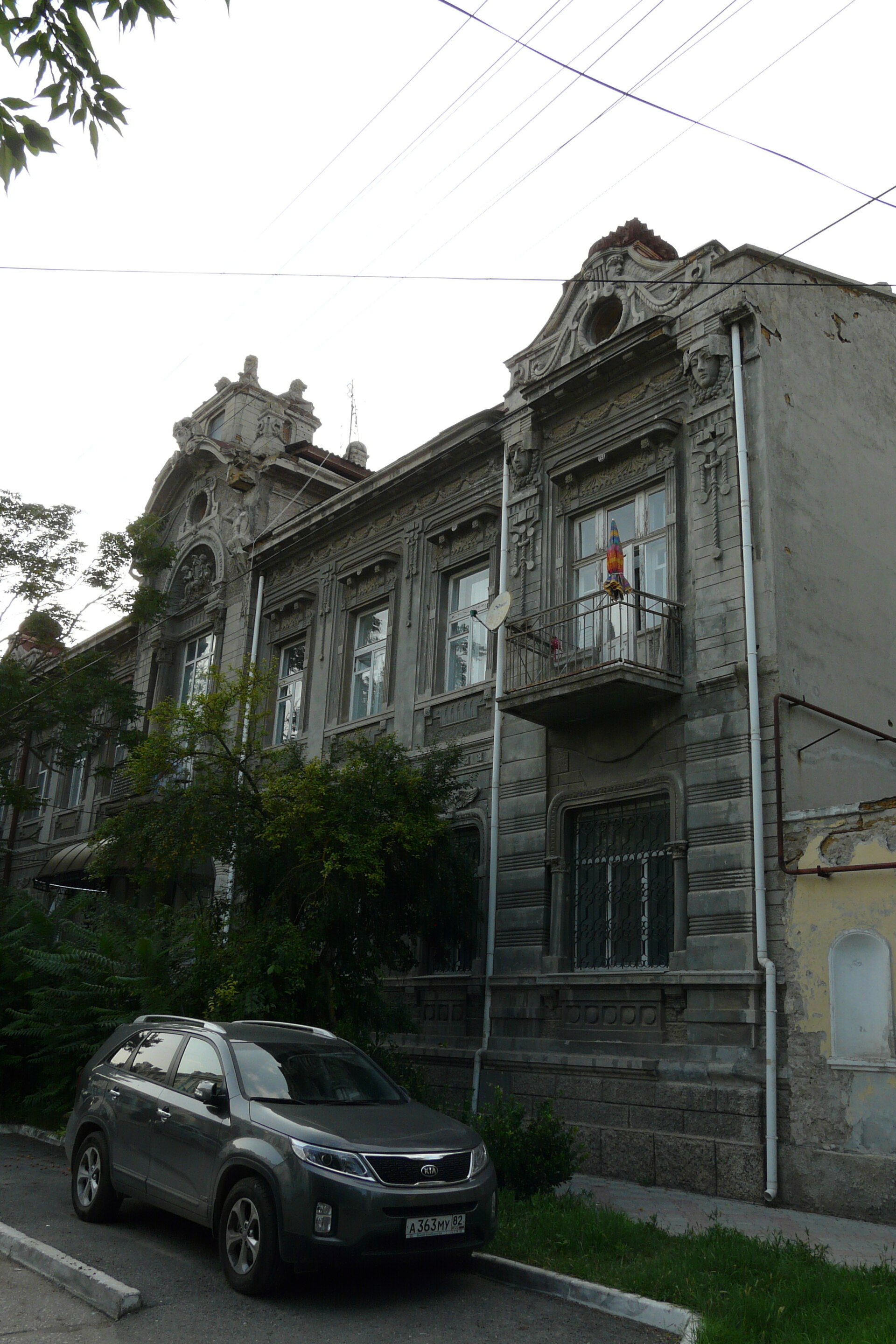
The Shapshal House in Yevpatoria is one of those rare places where time seems to have paused, preserving the spirit of a bygone era. Built in the early 20th century, this mansion once belonged to Seraya Shapshal, a prominent Karaite scholar and public figure whose influence extended far beyond Crimea’s Karaite community. Today, the house stands not just as an architectural landmark but as a living fragment of history, where culture, science, and personal destinies intertwine.
The building’s design reflects the eclectic tastes of its time, blending elements of Art Nouveau with neoclassical details. The facade is adorned with delicate stucco moldings, tall arched windows, and a balcony with an intricate wrought-iron railing. Inside, the original decor—parquet floors, carved wooden panels, fireplaces, and stained glass—hinted at a refined elegance. This was more than a private residence; it was a space for intellectual gatherings, where guests debated ideas, shared knowledge, and hosted cultural evenings.
Seraya Shapshal, the house’s original owner, was an extraordinary figure. Born in Lithuania, he studied in St. Petersburg and Istanbul, mastering several languages before dedicating his life to Karaite history, religion, and culture. He moved to Yevpatoria in 1915, when the city was already a center of Karaite life. Here, Shapshal continued his scholarly and communal work, turning his home into a kind of intellectual salon that attracted scientists, writers, and thinkers from different backgrounds.
At the time, Yevpatoria was a city where diverse cultures coexisted peacefully. Karaite, Crimean Tatar, Russian, Greek, and Armenian communities all contributed to the city’s development, and the Shapshal House stood at the crossroads of these influences. Discussions here weren’t limited to academic topics; they also touched on interfaith dialogue, the preservation of traditions, and adapting to a rapidly changing world. As a *hacham*—a spiritual leader of the Karaites—Shapshal believed in engaging with other cultures rather than isolating his own.
After the revolution and the establishment of Soviet rule, life in the house changed dramatically. Shapshal left Crimea, and the building became state property, housing everything from a kindergarten to government offices over the years. Despite these changes, the house retained much of its original structure and interior details. Today, it is under the care of local authorities, undergoing gradual restoration to revive its former appearance.
Walking through the Shapshal House, it’s impossible not to wonder about the stories these walls could tell. The house hosted not only scholars but also artists, musicians, and politicians. Perhaps some of the ideas that shaped the early 20th century were born within these rooms. The building witnessed the upheavals of revolution, war, and political shifts, yet its atmosphere still carries echoes of that era.
For Yevpatoria, the Shapshal House is more than just a historic building—it’s a piece of the city’s cultural legacy. The Karaite community, once one of the most influential in Crimea, has significantly dwindled, but its contributions to the region remain undeniable. The house serves as a reminder that Yevpatoria has always been a city open to different cultures and traditions, where Eastern and European influences blended to create a unique atmosphere that lingers to this day.
Though the house isn’t always open as a museum, it occasionally hosts exhibitions, lectures, and events dedicated to Karaite history and Yevpatoria’s past. Stepping inside, you can almost hear the voices of guests debating scientific discoveries or literary works. The carved banisters, high ceilings, and antique doors transport you to another time, offering a glimpse into how people lived and thought a century ago.
The Shapshal House is worth visiting not just for its architecture but for the stories it holds. It reminds us that every building has its own history, its own people, and its own ideas. Yevpatoria has many such places, but this mansion stands out for its unique atmosphere. Here, you can sense the passage of time and understand that history isn’t just about dates and events—it’s about the lives and choices of real people.