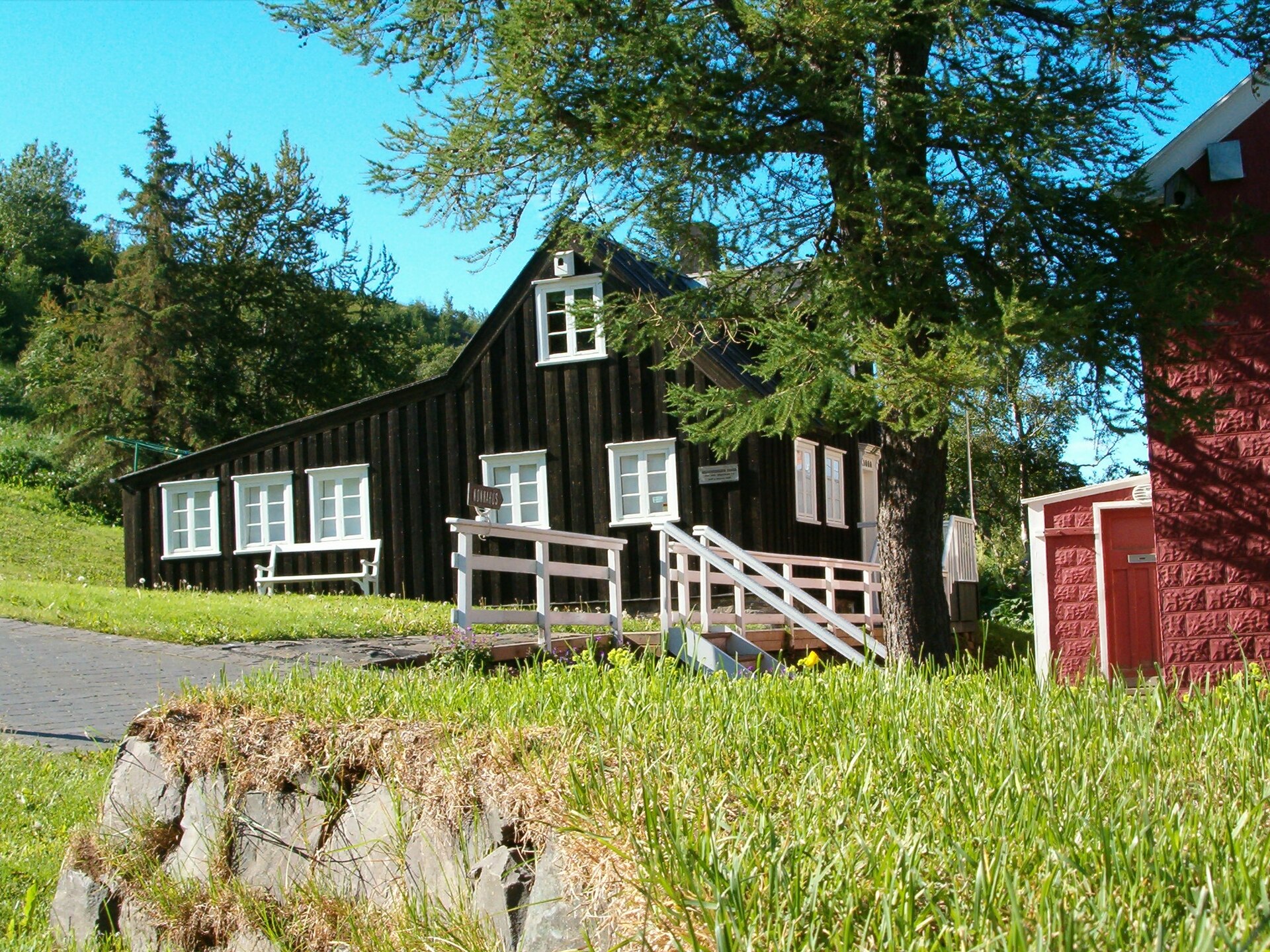
Akureyri is often called the capital of North Iceland, a quiet town where the Arctic Circle feels just a little closer. Among its colorful houses and steep streets, one building stands out not for its size or grandeur, but for the story it carries. Nonni’s House, or Nonnahús, is a modest wooden home that once belonged to Jón Sveinsson, better known by his childhood nickname, Nonni. Today, it serves as a small museum, offering a glimpse into the life of one of Iceland’s most beloved storytellers and the world he grew up in.
Jón Sveinsson was born in 1857 in a different part of Iceland, but his family moved to Akureyri when he was just a boy. The house where he lived from the age of nine until his early teens became a place where his imagination took root. Nonni later left Iceland to study abroad, eventually becoming a Jesuit priest and a writer. His most famous works are the twelve children’s books about his own adventures, written in German and later translated into multiple languages. These stories, filled with humor and warmth, made him a household name in Iceland and beyond, though his connection to Akureyri remained a quiet point of pride for the town.
The house itself is a typical example of 19th-century Icelandic architecture, built from timber and painted in a soft shade of green that blends with the surrounding landscape. Inside, the rooms have been preserved much as they were when Nonni lived there, with simple wooden furniture, a cast-iron stove, and personal belongings that belonged to his family. The museum doesn’t overwhelm with exhibits; instead, it feels like stepping into a lived-in space, where the past lingers in the creak of the floorboards and the faint scent of old wood. Visitors can see Nonni’s childhood bed, his schoolbooks, and even the small desk where he might have first tried his hand at writing.
What makes Nonni’s House special is not just its connection to a famous writer, but the way it captures a moment in Iceland’s history. The late 1800s were a time of change for the country, as it moved toward greater independence from Denmark and began to modernize. Akureyri, though still a small fishing town, was growing, and the house reflects the modest but hopeful life of a middle-class family during this period. The exhibits include photographs and documents that tell the broader story of the town and its people, making the museum as much about local history as it is about Nonni himself.
The atmosphere inside is quiet and reflective, almost as if the house is still waiting for the sound of children’s laughter or the scratch of a pen on paper. The rooms are small, with low ceilings and narrow windows that let in just enough light to create a cozy, intimate feel. Outside, the garden is simple but well-tended, with a few benches where visitors can sit and look out over the town. The view hasn’t changed much since Nonni’s time—the same hills rise in the distance, and the same fjord stretches out below, its waters shifting with the light.
For those who know Nonni’s stories, the house adds a layer of meaning to his writing. His books are full of vivid descriptions of Icelandic landscapes, weather, and daily life, and seeing the places that inspired him makes those scenes feel more real. Even for visitors who aren’t familiar with his work, the museum offers a chance to slow down and appreciate the small details of life in another era. There’s no grand narrative here, no dramatic events—just the quiet accumulation of moments that shaped a person and a place.
Akureyri itself is a town that rewards exploration, and Nonni’s House fits neatly into that experience. It’s not a destination that demands hours of your time, but it’s the kind of place that lingers in your memory. After visiting, you might find yourself wandering the nearby streets, imagining what the town looked like in Nonni’s day. The old wooden houses, the harbor with its fishing boats, the way the light slants across the hills in the evening—all of it feels like a continuation of the world he once knew.
The museum is run by volunteers, and the care they put into preserving the house is evident in every detail. There’s a warmth to the place that goes beyond its historical significance, a sense that this was someone’s home, not just a monument. That personal touch makes it feel more like a visit to a relative’s house than a traditional museum. It’s the kind of place where you might leave with more questions than answers, but that’s part of its charm.
Nonni’s House may not be the most famous landmark in Iceland, but it’s one of those quiet places that reminds you why travel can be so rewarding. It’s not about ticking off sights or chasing the extraordinary; sometimes, it’s about finding meaning in the ordinary. In a world that often feels rushed, a place like this invites you to pause, to look closely, and to remember that the smallest stories can leave the deepest impressions.