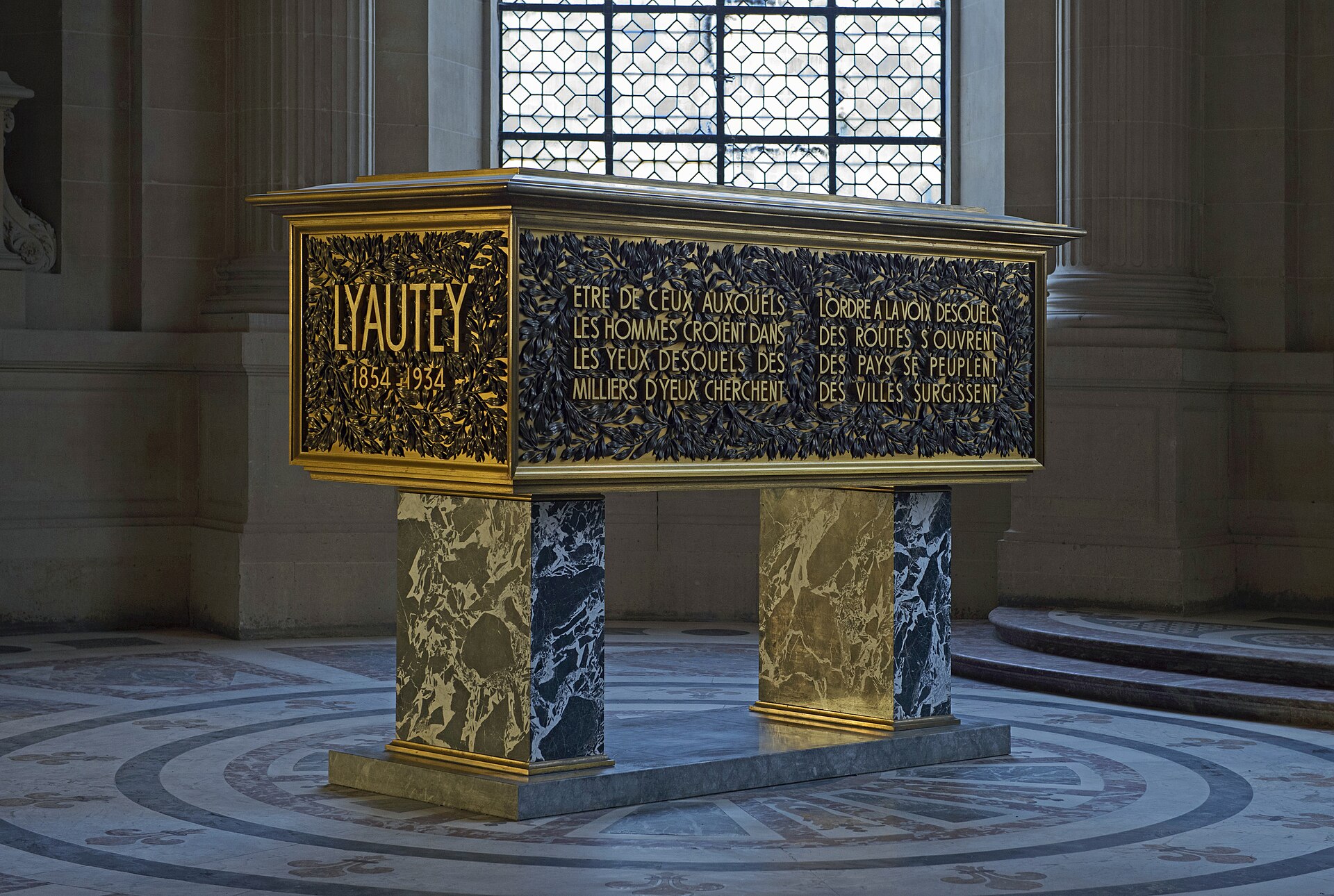
The Hôtel des Invalides began as a grand gesture of gratitude. In the 17th century, King Louis XIV ordered the construction of a refuge for soldiers who had returned from war broken in body and fortune. Before this, veterans were scattered across monasteries and garrisons, often left to fend for themselves. What emerged was not just a hospital or a shelter, but an entire self-contained city—complete with courtyards, a medical ward, workshops, and two churches, one for the soldiers and another for the king. The first veterans moved in during 1674, and while the complex still serves its original purpose as a retirement home for military personnel, much of it has since been repurposed into museums that tell the story of France’s martial past.
The most striking feature of the Invalides is its gilded dome, a shimmering landmark that dominates the Parisian skyline. Beneath it lies the royal church, where the most famous resident rests in a circular crypt. Napoleon’s red quartzite sarcophagus is visible only from above, framed by a low railing—an intentional design that forces visitors to look down upon it, as if paying homage. His remains were brought back from Saint Helena in 1840, though it took another two decades before they were finally interred beneath the dome. The effect is solemn, almost theatrical, as if the emperor’s final resting place were a stage set for history itself.
The Army Museum, housed within the complex, is one of the world’s largest military history collections. Its galleries span centuries, from medieval armor and weaponry to exhibits on the Napoleonic Wars and both World Wars. One of the more unusual displays is a series of intricate scale models of fortified cities, originally commissioned by Louis XIV to aid in siege planning. The museum is vast enough that spending half a day here is easy, though most visitors find it more manageable to focus on one or two sections rather than attempting to see everything at once.
The approach to the Invalides is as deliberate as its architecture. A long esplanade stretches out before the main building, offering a straight, unobstructed path from the Pont Alexandre III. The wide-open space feels almost ceremonial, as if designed for parades or processions. Once inside the courtyard, old cannons stand like silent sentinels, their bronze barrels weathered by time. The entrance to the church and Napoleon’s tomb is on the opposite side, facing Place Vauban, while a single ticket grants access to both the church and the museums.
The rhythm of the Invalides shifts with the seasons. In summer, the courtyards and esplanade stay open late into the evening, though the museums close by six, with the last entry half an hour before. It’s worth noting that on the first Monday of each month, some galleries may be closed, so checking ahead can save disappointment. The complex has a way of feeling both monumental and intimate—its grandeur is undeniable, yet there’s a quiet dignity to the way it honors those who served, whether in life or in memory. Walking through its halls, it’s hard not to feel the weight of history pressing in, not as something distant, but as something that still lingers in the stone and the silence.