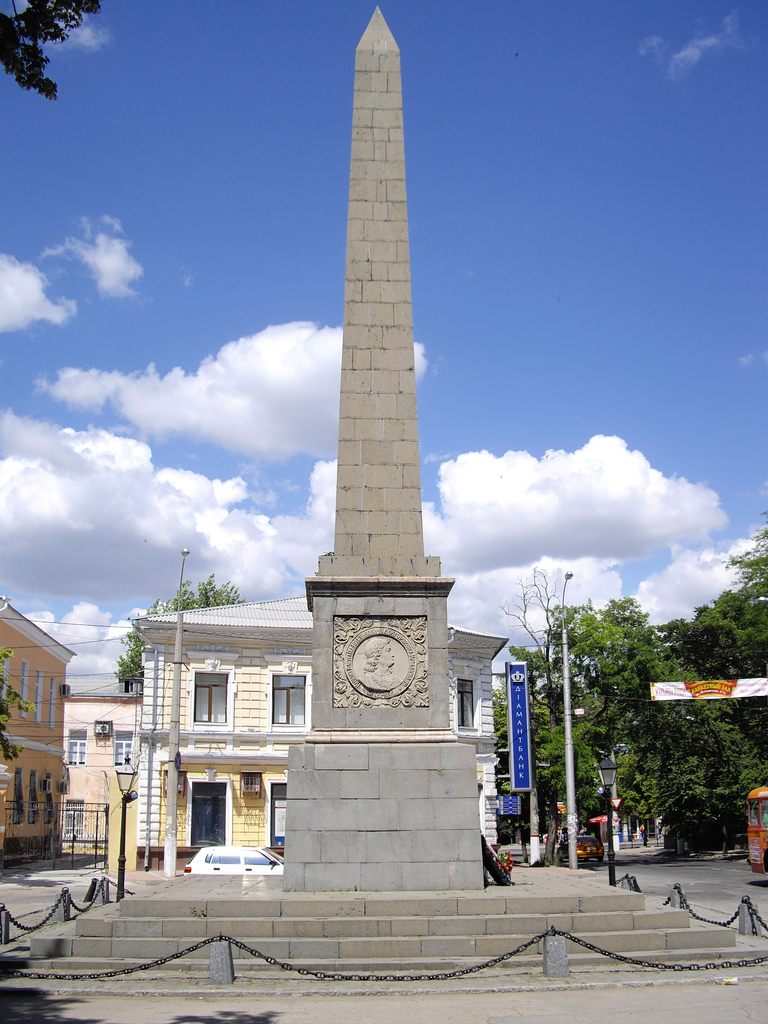
The Dolgorukov Obelisk doesn’t stand out at first glance. It sits on a small hill in the city center, half-hidden by trees and the noise of daily life. Yet for those who know its story, this modest stone pillar carries unexpected weight. It honors Prince Vasily Dolgorukov, a Russian military leader whose late 18th-century campaigns secured the peninsula for the empire.
The obelisk is simple—a tall, weathered column with the remnants of a bronze eagle at its top. Built in 1842, decades after the events it marks, the monument commemorates a key moment. In 1771, Dolgorukov led Russian forces across the Perekop Isthmus, breaking Ottoman resistance and setting the stage for Crimea’s annexation. For the empire, this was a strategic shift, turning the peninsula into a new frontier and Simferopol into its administrative center.
Once, the obelisk was part of something grander. Turkish cannons surrounded its base, and the eagle spread its wings in full bronze. Over time, the cannons disappeared, and the eagle lost its body—victims of neglect or Soviet-era removal. Today, the monument shows its age, yet that only makes it more compelling. It stands as proof of the changing tides of power and memory in Crimea.
The obelisk’s location was deliberate. It overlooks an old road from Simferopol to Bakhchisarai, positioned to be seen from afar—a symbol of imperial triumph. Now, the area is a small park where people walk or sit, often unaware of the history beneath them. The modern city has grown around it, but if you look closely, you can still picture 19th-century carriages pausing here, their passengers glancing up at the monument.
The obelisk marks more than Dolgorukov’s victory. Crimea’s annexation redrew political borders and reshaped the region’s culture and economy. Simferopol, founded in 1784, became a new hub, while the peninsula transformed into the Crimea we know today—a mix of resorts, vineyards, and layered identities. The obelisk is a quiet witness to that change.
Unlike Crimea’s famous landmarks, this one doesn’t attract crowds. No tour buses, no photo lines—just a quiet corner where the past lingers. During the Soviet era, it nearly vanished, like many imperial relics, though it lost much of its original design. What remains is a fragment of history, a tangible link to a time when Crimea’s fate was decided by distant forces.
For those who explore beyond the beaches, the obelisk offers a moment to consider how this land was shaped. Simferopol, now a quiet city, was once a frontier where empires clashed. The monument honors one man, but its meaning is broader—it symbolizes the sweeping changes that redefined Crimea.
You might walk past it without noticing. But if you stop and look, it’s more than a stone pillar. It’s a piece of history that has survived revolutions, wars, and time. The city moves around it, yet here, the past feels close. That’s the value of such places—they remind us history isn’t distant. It’s right beneath our feet.