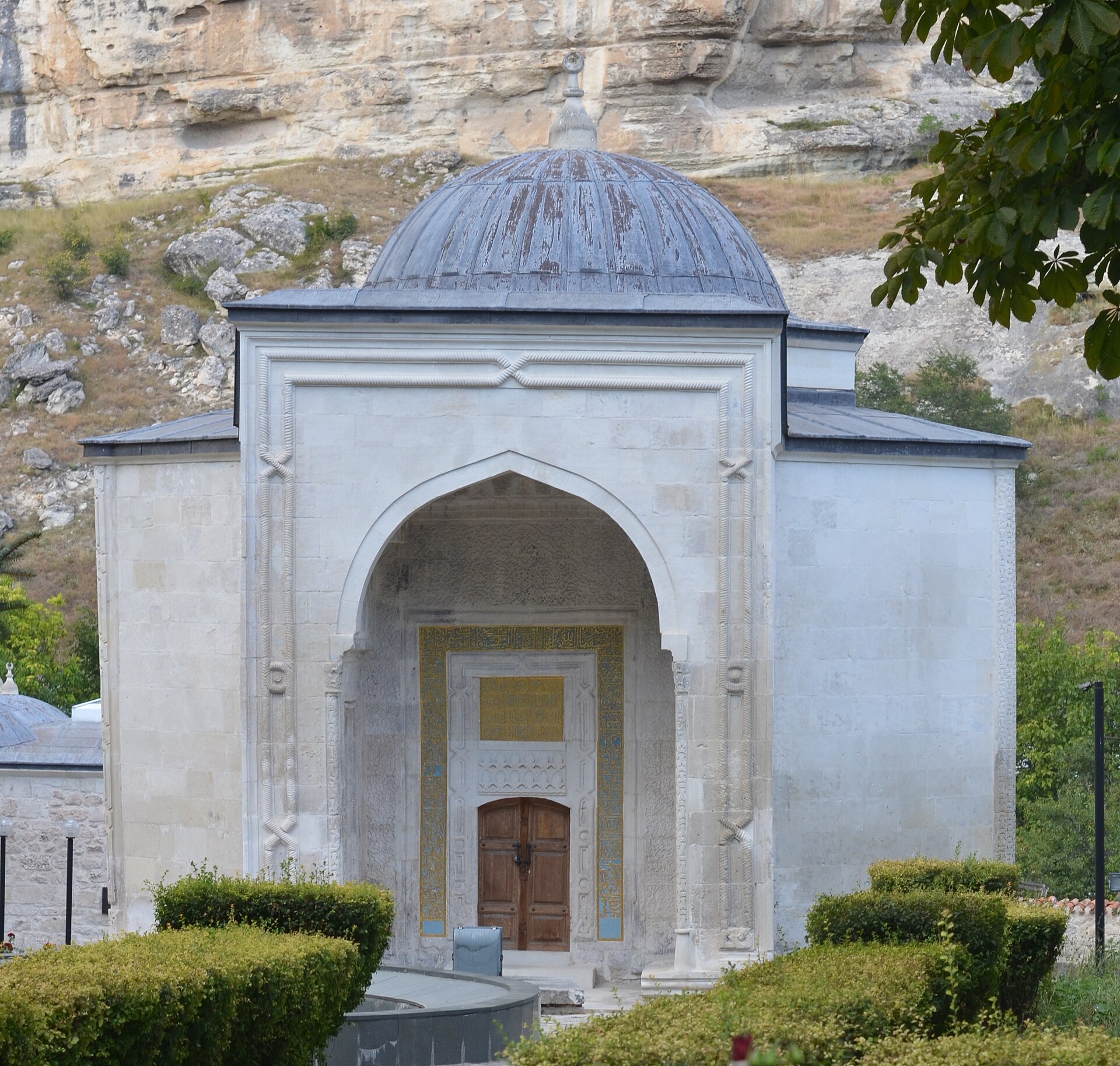
The Dürbe of Hacı Giray is one of those quiet corners of Bakhchisaray where time seems to slow down, as if the weight of centuries lingers in the air. Tucked away on the edge of the city, shaded by old trees, this modest yet striking structure holds the memory of the Crimean Tatar rulers who once shaped the fate of the peninsula. Built in the 15th century, the mausoleum became the final resting place for Hacı Giray, the founder of the Crimean Khanate, and his family. Today, it stands not just as a historical monument but as a silent witness to an era when Bakhchisaray was the heart of a powerful state, its influence stretching far beyond the Crimean hills.
The architecture of the mausoleum is a study in understated elegance, blending Islamic and medieval Crimean traditions. Its octagonal base rises into a dome, once adorned with glazed tiles that have long since faded, though traces of their former brilliance remain. The entrance is framed by a portal carved with intricate patterns, their delicate lines still sharp despite the passage of time. Inside, the space is open and airy, with niches in the walls where sarcophagi once stood. Now empty, the chamber feels even more poignant, as if the absence of the tombs only deepens the sense of history embedded in the stone.
Hacı Giray’s reign in the mid-15th century marked the beginning of the Crimean Khanate’s golden age. He united the scattered Crimean tribes and established an independent state, turning Bakhchisaray into a political and cultural center. After his death, his body was laid to rest here, and the mausoleum became a place of reverence for generations. Over time, other members of the Giray dynasty were buried nearby, transforming the site into a family necropolis. The mausoleum’s significance shifted with the fortunes of the khanate—once a pilgrimage site, it fell into neglect after Crimea’s annexation by the Russian Empire, only to be rediscovered and restored in the 20th century as interest in the region’s history revived.
Visiting the Dürbe of Hacı Giray is less about ticking off a tourist attraction and more about stepping into the past. The place is wrapped in a hush, broken only by the rustle of leaves or the occasional murmur of visitors. Unlike the bustling Khan’s Palace nearby, this spot offers solitude, a chance to pause and reflect. A small park surrounds the mausoleum, where benches invite you to sit and imagine the ceremonies that once took place here—the prayers, the processions, the voices of courtiers echoing through the centuries.
The mausoleum is more than just an architectural relic; it’s a fragment of a much larger story. Crimea has always been a crossroads of cultures—Byzantine, Golden Horde, Ottoman, and Russian influences have all left their mark here. The Dürbe of Hacı Giray is one such mark, a reminder that the peninsula’s history is far richer and more complex than it might seem at first glance. It speaks of a time when Crimea was a sovereign state, with Bakhchisaray as its beating heart, and the Giray dynasty as its guiding force.
Today, the mausoleum is open to visitors, and reaching it is straightforward. It lies a short walk from Bakhchisaray’s center, easily accessible on foot or by taxi. There’s no admission fee, but it’s worth remembering that this is a place of remembrance, and a respectful demeanor is fitting. The best times to visit are early morning or late evening, when the light is soft and the stones seem to glow, their textures brought to life by the gentle sun.
For those tracing the history of Crimea, the Dürbe of Hacı Giray is an essential stop. It complements the narrative told by the Khan’s Palace, the Uspensky Monastery, and other landmarks in Bakhchisaray. Each site adds a piece to the puzzle, and only by seeing them together can you begin to grasp the layers of this city’s past. The mausoleum, in its quiet way, offers one of the most evocative pieces—a tangible connection to the founders of Crimean statehood.
Like many historic sites, the mausoleum is surrounded by legends. Some say Hacı Giray was buried with treasures that have never been found. Others claim his spirit still lingers, guarding the resting place of his descendants. Whether these stories hold any truth is impossible to say, but they add a layer of mystery to the place. Even without them, the mausoleum feels alive with history, as if the past is just beneath the surface, waiting to be discovered by those who take the time to look.