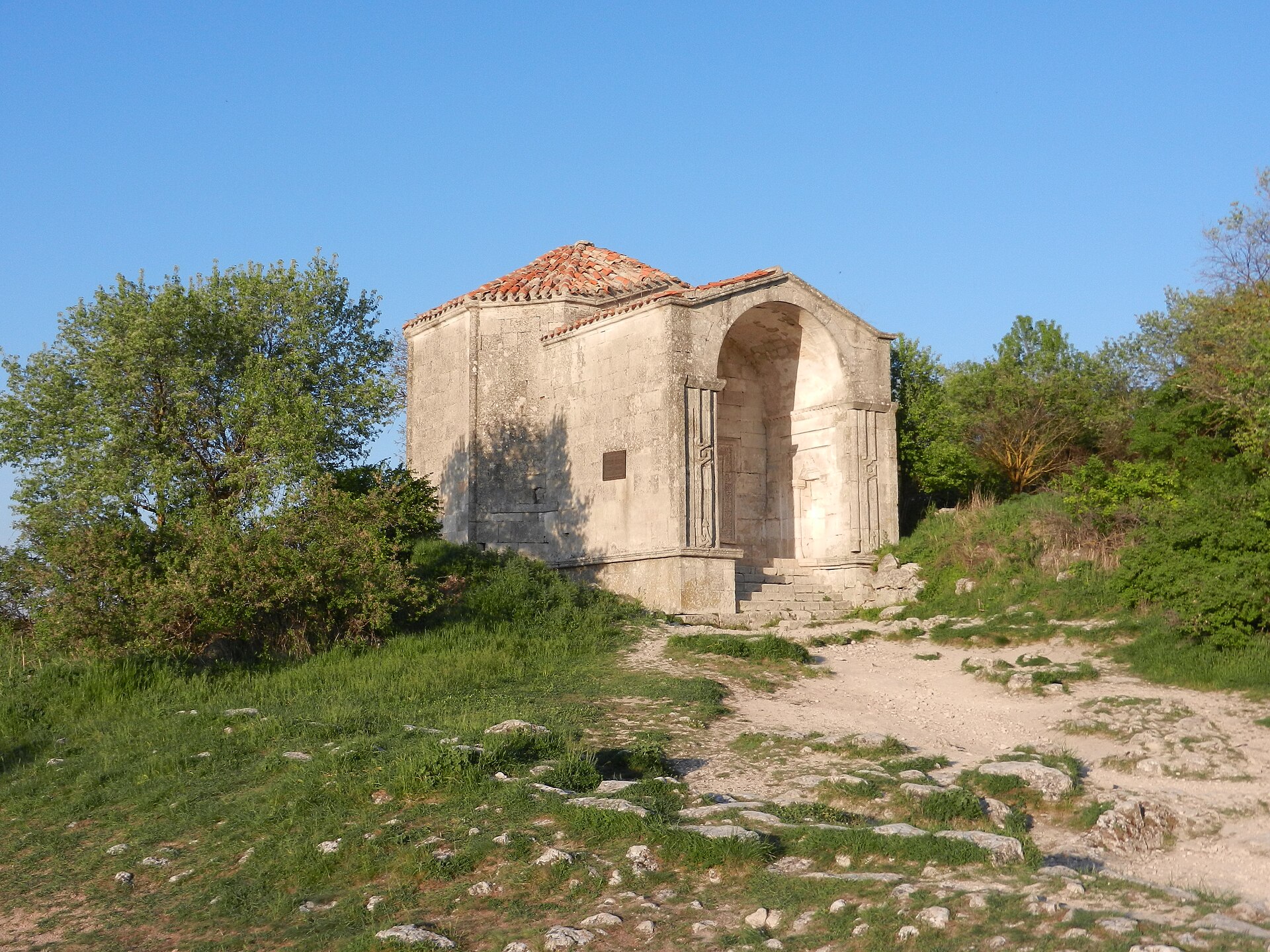
Bakhchisaray’s Janike-Khanym Mausoleum is one of those rare places where time seems to pause, as if the weight of history itself has settled into the quiet stone. Tucked within the grounds of the Khan’s Palace, this small but striking structure is more than just a tomb—it is a monument to a woman whose life became woven into the fabric of Crimea’s past. Janike-Khanym was the daughter of Tokhtamysh, the ruler of the Golden Horde, and her story is one of influence and mystery. Though details of her life are scarce, legends portray her as a figure of wisdom, whose counsel extended beyond the palace walls. The mausoleum built in her honor stands as a silent testament to an era when Bakhchisaray was the political and cultural heart of the Crimean Khanate.
The architecture of the mausoleum reflects the refined simplicity of Crimean Tatar design from the 14th and 15th centuries. Its octagonal form, crowned with a smooth dome, is understated yet elegant, with a modest but deliberate use of ornamentation. The entrance is framed by a graceful arched portal, lending the structure a sense of balance and lightness. Inside, the space is dimly lit, with narrow beams of sunlight filtering through small windows, casting shifting patterns on the stone walls. There are no lavish frescoes or gilded details—just the quiet presence of time-worn surfaces, evoking a sense of permanence.
The circumstances of Janike-Khanym’s death remain shrouded in uncertainty. Some accounts suggest she was poisoned by rivals, while others claim she fell in battle defending her homeland. Whatever the truth, her legacy endured, and the mausoleum became a place of reverence. Over the centuries, it has drawn not only Muslim pilgrims but also travelers and historians, all drawn to its quiet dignity. Visitors often leave flowers or stand in contemplation, as if the walls themselves hold echoes of the past.
The mausoleum is part of the larger Khan’s Palace complex, a sprawling ensemble that blends Ottoman, Persian, and local Crimean influences. Walking through its courtyards and chambers, one can sense the layers of history embedded in every arch and fountain. The Janike-Khanym Mausoleum, however, feels like the emotional core of the palace—a place where the weight of the past is most palpable. Nearby, other tombs, gardens, and water features create an atmosphere of serene reflection, as if the entire complex exists outside the rush of modern life.
The mausoleum changes with the seasons, each offering a different mood. In summer, its white stone gleams under the bright sun, while winter coats it in a delicate frost, softening its edges. Spring brings blooming flowers to the surrounding gardens, and autumn paints the courtyard in warm hues. Yet no matter the time of year, the place retains a quiet intensity, as if the stories it holds refuse to fade.
For many who visit, the mausoleum is more than a historical site—it is a moment of connection. There are no crowds here, no hurried tourists snapping photos. Instead, there is stillness, a chance to listen to the silence and imagine the lives that have passed through these walls. Perhaps that is why the place lingers in memory long after the visit ends. It offers a rare pause, a reminder that some things endure beyond the fleeting present.
Beyond its architectural significance, the mausoleum is a symbol of Crimean Tatar heritage. It stands as a reminder of the importance of preserving cultural identity, even when history has scattered a people across distant lands. Today, the Janike-Khanym Mausoleum is not just a relic of the past but a living part of a community’s story, a bridge between generations.
Standing before its walls, it’s impossible not to wonder about the countless lives that have intersected here. How many sought solace within these stones? How many prayers were whispered beneath its dome? The mausoleum doesn’t offer answers, but it invites reflection—a quiet acknowledgment of the fleeting nature of life and the enduring power of memory. That, perhaps, is why it continues to draw people in, long after the last light of day has faded from its walls.