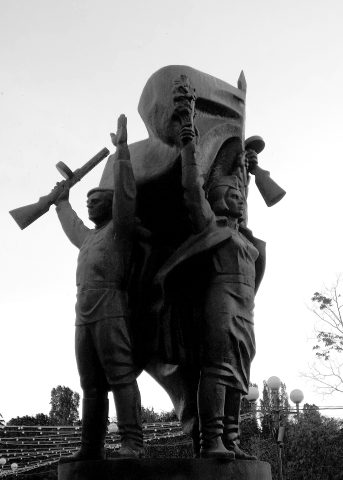
The Kursk Bulge Diorama in Belgorod isn’t just another museum exhibit—it’s a place where the history of the Great Patriotic War takes on weight and immediacy. Perched on the high banks of the Seversky Donets River, this massive panorama recreates one of the most pivotal battles of World War II, a turning point that shifted the war’s momentum irrevocably. The Battle of Kursk marked the beginning of the end for Nazi forces, and Belgorod, a city that bore the brunt of the fighting, became a symbol of Soviet resilience. The diorama captures that critical moment in the summer of 1943 when Soviet troops broke through enemy lines, changing the course of the war.
The building itself was constructed in the 1980s specifically to house the enormous canvas, painted by battle artists from the renowned Grekov Studio. Stretching over a thousand square meters, the panorama immerses visitors in the heart of the battle. You don’t just observe—you stand in the midst of it. Tanks charge forward, explosions light up the sky, smoke billows from burning fields, and soldiers move in frozen motion. Every detail, from the placement of trenches to the color of the sky, was meticulously researched using archival photographs, veterans’ accounts, and military maps. The artists didn’t just depict a battle; they reconstructed it with documentary precision.
Around the canvas, a raised platform seamlessly blends into a three-dimensional model of the terrain, complete with real artifacts from the era—shattered military equipment, fragments of fortifications, and weapons. These aren’t just props; they’re tangible pieces of history that pull you deeper into the scene. The lighting shifts to mimic the time of day, while sound effects—gunfire, shouted commands, the roar of engines—fill the space, making the experience feel almost real. It’s easy to forget you’re looking at a painting.
But the diorama isn’t just about military strategy or machinery. At its core, it’s a human story. The soldiers on the canvas aren’t faceless figures; they’re individuals with emotions, fears, and hopes. The artists captured the tension before an assault, the exhaustion after combat, the grief of loss. In the background, recordings of veterans’ voices play—testimonies recorded decades later but still raw with emotion. These voices remind you that behind every figure on the canvas was a real person who fought, suffered, and hoped to survive.
Adjacent to the diorama, a museum offers a deeper dive into the Battle of Kursk. Here, you’ll find documents, photographs, and personal belongings of those who fought. A significant portion of the exhibit focuses on Belgorod’s liberation on August 5, 1943, a moment celebrated as one of the first victory salutes of the war. The displays include weapons, medals, and letters from the front—artifacts that help visitors grasp the scale of the battle and the cost of victory.
The Kursk Bulge Diorama is more than a war memorial. It’s a place that preserves historical truth, even when that truth is painful. There’s no glorification or embellishment here—just facts, emotions, and a deep respect for those who defended their country. Many visitors leave with a new perspective on the war, a greater appreciation for the peace they take for granted. The diorama doesn’t just tell a story; it makes you feel it.
Belgorod was a natural choice for this monument. The city endured some of the war’s fiercest fighting and was nearly destroyed. Its liberation marked a crucial step in the Battle of Kursk, and today, the diorama stands as one of the most powerful reminders of that past. Other memorials and monuments dot the city, but this one is different—it doesn’t just commemorate; it immerses. Veterans, students, and tourists all come here to honor the fallen and to understand the price of victory.
A visit to the diorama isn’t like a typical museum tour. There are no glass cases or dry facts—just a living, breathing encounter with history. You can spend hours studying the details of the canvas, listening to guides, or poring over documents. Each time, something new emerges: a deeper understanding of the war, of the people who fought, or even of yourself. The experience lingers, prompting reflection on what courage truly means and why remembering it matters. This isn’t just a place to learn about history—it’s a place to feel it.