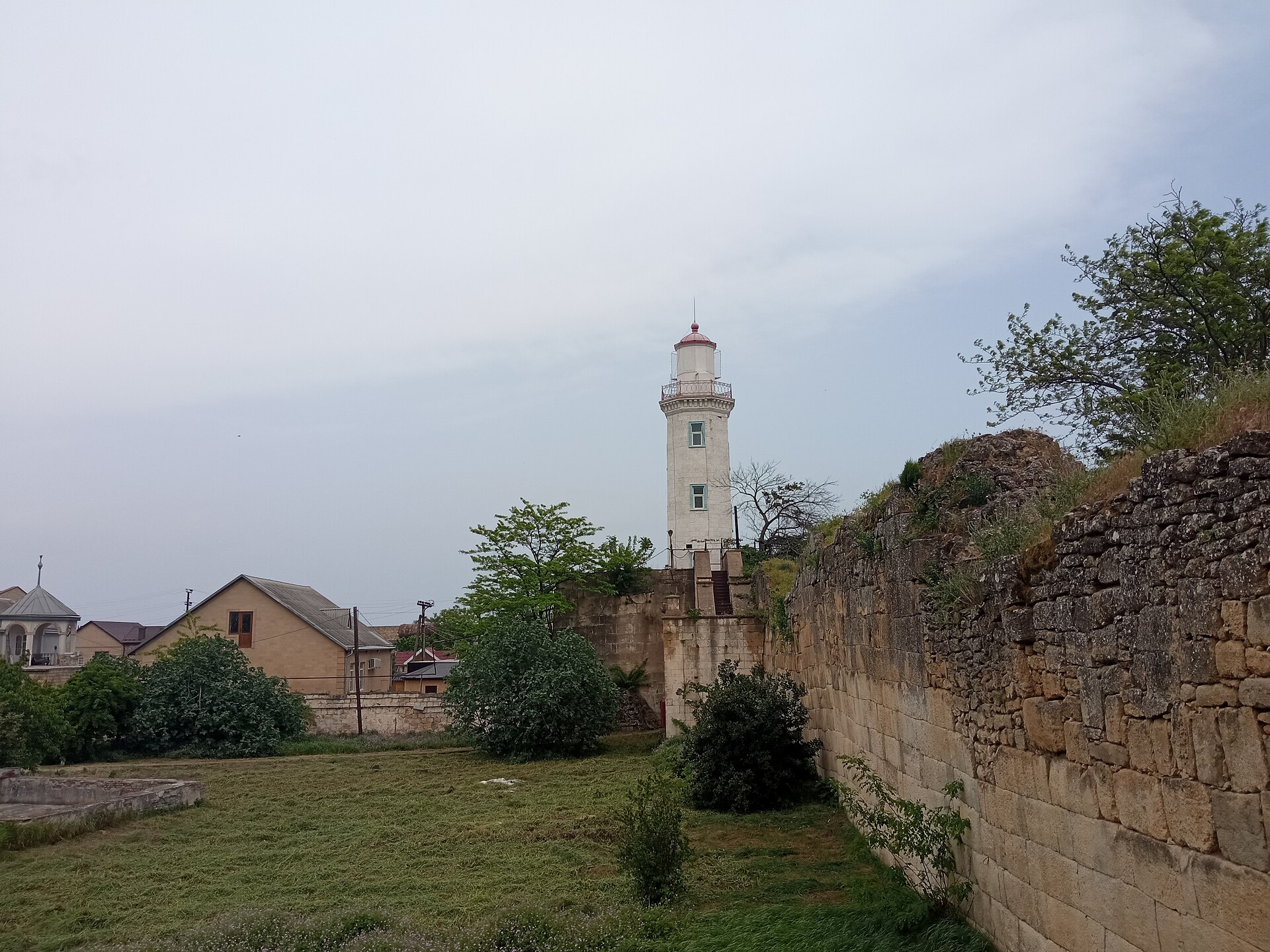
Perched at the edge of Derbent’s old town, where the Caspian Sea meets the ancient fortress walls, the lighthouse stands as a quiet sentinel. Its modest stone tower, pale against the rugged backdrop of the Caucasus Mountains, might seem unassuming at first glance. Yet this small promontory has been a meeting point for centuries—where seafaring traditions, local life, and history converge. Unlike the city’s older landmarks, the lighthouse is a relatively recent addition, but its presence feels inevitable. Derbent has always been a beacon of sorts, guiding merchants, sailors, and conquerors along the Caspian coast long before this tower was built.
The idea of a guiding light here dates back to antiquity. Ancient Greeks and Persians knew Derbent as a vital port and a key stop on the Silk Road, where trade routes intersected with maritime paths. Later, as the city became part of the Arab Caliphate and then Persia, its strategic importance grew. Fortifications like the Naryn-Kala fortress were built not just to defend the land but also the sea approaches. It’s likely that some form of signal—perhaps bonfires on the fortress towers—was used to warn ships of the treacherous coastline, though no records survive to tell us what those early beacons looked like.
The lighthouse we see today was constructed in the mid-19th century, when Derbent was already under Russian rule. This was a time of expansion along the Caspian coast, with trade flourishing and ports developing. The tower itself is unassuming—barely fifteen meters tall—but its elevated position ensured its light could be seen far out at sea. Originally powered by kerosene, it was later electrified, yet its design remained largely unchanged. Even during the Soviet era, when many older structures were demolished or modernized, the lighthouse retained its original form, perhaps because it never stopped serving its purpose.
Nowadays, the lighthouse is more than just a navigational aid; it’s woven into the fabric of the city. A narrow street winds its way through the old quarter, past houses with carved wooden balconies and courtyards where pomegranates and figs grow in the sun. Locals pass by on their daily routines, some stopping to show visitors the view. On clear days, the panorama from the lighthouse is striking—ancient fortress walls stretch out beside modern neighborhoods, while the Caspian shimmers below, its waters warm and inviting in this southern latitude.
The lighthouse is deeply tied to the Caspian’s maritime history. Over the centuries, this sea has been a trade route, a battleground, and a source of livelihood. Derbent was always one of its most important ports, and the lighthouse played its part. In the 19th century, when the Caspian Flotilla was based here, its light guided ships through dark and stormy nights. Centuries earlier, when the sea was just as busy but ships far less sturdy, the beacon warned sailors of hidden rocks and shallows. Even now, the lighthouse remains a functional part of the coast, though its surroundings feel untouched by time.
There’s something quietly poetic about the lighthouse’s current state. The paint on the tower is peeling in places, and there are no tourist signs or souvenir stalls in sight. Yet this lack of polish is part of its charm. Without crowds or commercial distractions, the place feels authentic—just the sound of waves, the salty breeze, and the sense that time moves a little slower here. You can sit on the stone steps at the base of the tower, watching fishing boats return with the morning catch or the sunset turning the water gold. In moments like these, it’s easy to see why Derbent has such a magnetic pull. This is a city where history isn’t confined to museums; it’s alive in the streets, the sea, and the very air.
The lighthouse also stands at a cultural crossroads. Derbent has always been a place where civilizations met—Persian, Arab, Turkic, and Russian influences have blended here over centuries. The lighthouse, though built during the Russian era, fits seamlessly into this tapestry, as if it has always belonged. Perhaps because its purpose is universal: a guiding light is needed by all, regardless of language or belief. In that sense, it’s a reminder that the sea has always connected people, even when land divided them.
Beyond its practical role, the lighthouse has become part of local folklore. Some say the tower is haunted by the ghosts of old keepers, while others believe its light helps lost travelers find their way home. These stories, whether true or not, add to the place’s mystique. After all, a lighthouse is more than just a structure—it’s a symbol of hope, a guide in the dark. The one in Derbent is no different.
If you ever find yourself in Derbent, make your way to the lighthouse. The best time to visit is in the late afternoon, when the sun dips toward the horizon and the sea shifts from blue to violet. Walk through the old town’s narrow streets, past mosques and caravanserais, past houses with intricately carved doors and courtyards where apricots dry in the sun. When you reach the lighthouse, take a moment to breathe in the history. Here, where land meets sea, past and present exist side by side, and the lighthouse stands as a silent witness to it all.