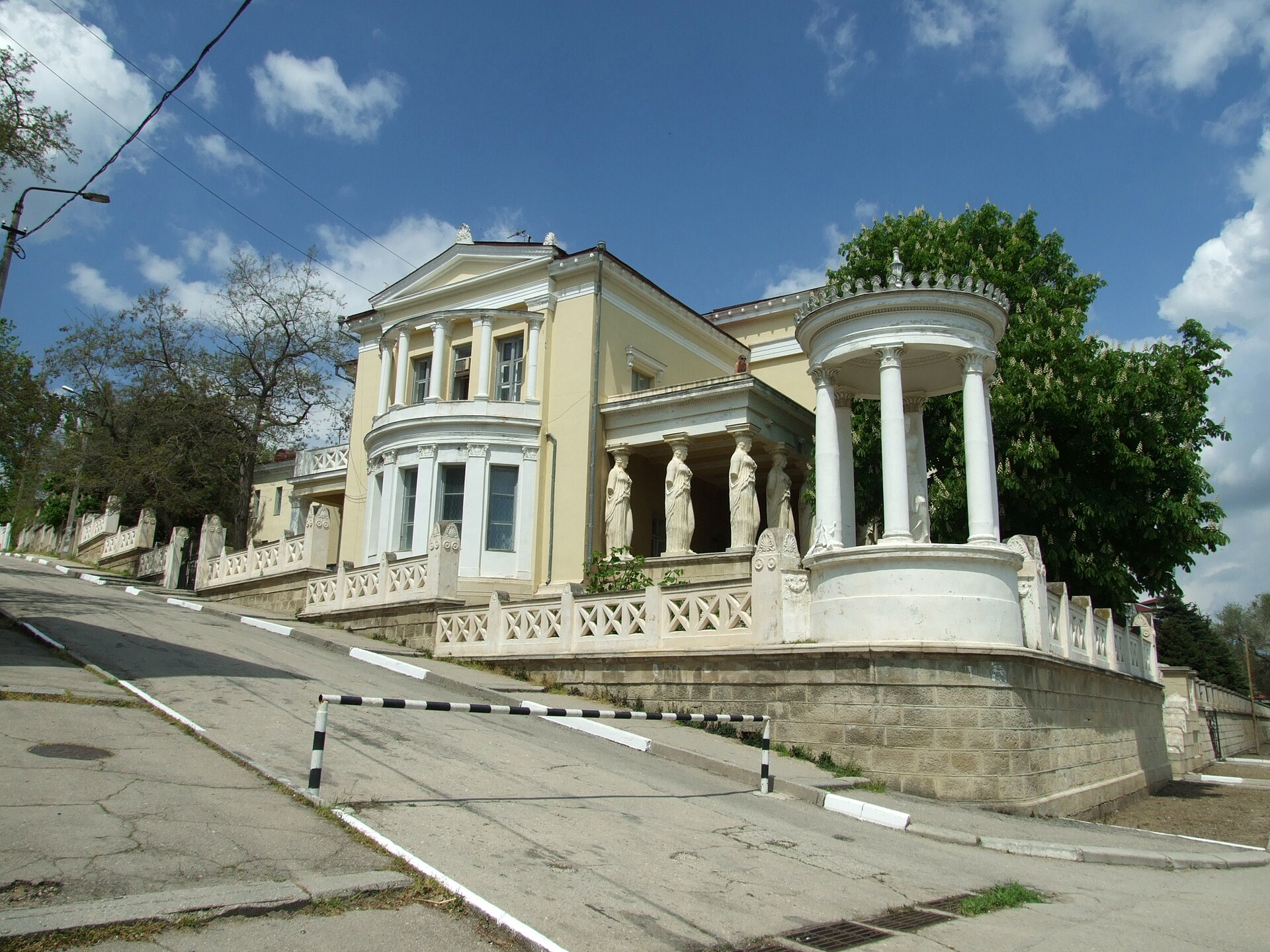
The Milos Villa in Feodosia is one of those rare places that seem frozen in time, preserving the spirit of a bygone era. Built in the late 19th century, it once belonged to Ivan Milos, a wealthy merchant of Greek descent who settled in Crimea and amassed his fortune through wine and tobacco trade. At the time, Feodosia was a fashionable resort, attracting artists, writers, and aristocrats, and the villa became more than just a country house—it was a symbol of luxury and hospitality. Today, the building looks much as it did over a century ago, though time and circumstances have left their mark.
The architecture of the villa reflects the eclectic tastes of southern Russia in that period. Elements of Art Nouveau blend with neoclassical details and even Eastern motifs, a nod to Feodosia’s rich and layered history. The facade is adorned with intricate stucco ornaments, tall arched windows, and balconies with delicate wrought-iron railings. The most striking feature is the corner tower with its glassed-in veranda, offering sweeping views of the sea and surrounding landscape. Inside, if the surviving photographs and descriptions are any indication, the interiors were lavish—parquet floors, carved wooden panels, fireplaces, and stained glass all spoke of refined taste.
The villa was once surrounded by a garden renowned for its exotic plants and fountains. Milos had a passion for botany and brought rare trees and shrubs to Crimea, some of which still grow here today. The garden descended in terraces toward the sea, allowing guests to stroll along paths scented with flowers while listening to the waves. Now, only fragments of that splendor remain—ancient cypresses, a few palms, and the crumbling stone steps leading to the shore. Yet even in its diminished state, the garden retains a certain magic, evoking the leisurely afternoons of a century past.
The Milos Villa was deeply intertwined with Feodosia’s cultural life in the early 20th century. Many notable figures visited its halls, including the artists Ivan Aivazovsky and Konstantin Bogaevsky, the poet Maximilian Voloshin, and local merchants and patrons. It’s said that Voloshin recited his poetry here, while Aivazovsky discussed plans for an art gallery in the city with the villa’s owner. After the revolution, the building was nationalized and passed through various hands—serving as a sanatorium, a children’s home, and later, administrative offices. Each new owner left their mark on the interiors, but the villa’s overall character remained intact.
Today, the Milos Villa stands in a state of semi-abandonment, though it is protected as an architectural monument. Restoration has been discussed from time to time, but so far, nothing has come of it. Even in its current condition, the villa draws the attention of tourists and history enthusiasts. Perched on a small hill, its silhouette is visible from the waterfront, impossible to miss. Those who venture into the courtyard often find a quiet, almost timeless atmosphere, as if the place exists outside the usual rush of life.
Feodosia itself is a city where the past lingers in every stone. Here, the cultures of Greeks, Armenians, Tatars, Italians, and Russians have intertwined over centuries. The Milos Villa is another piece of this mosaic, a reminder of an era when Crimea was a crossroads of East and West. Its history isn’t marked by grand events or revolutionary discoveries, but by something more enduring—authenticity. It’s not a museum exhibit but a living witness to the past, surviving against the odds.
If you find yourself in Feodosia, it’s worth walking past the villa and imagining what life was like here in its heyday. On summer evenings, music drifted through the garden, guests sipped wine from local vineyards, and the sea murmured beyond the trees. Today, the place is quiet, but if you listen closely, you might still catch echoes of that vanished world. Perhaps one day, the Milos Villa will once again become a gathering place for those who seek beauty and history, but for now, it remains a quiet corner of the past, waiting for its moment.