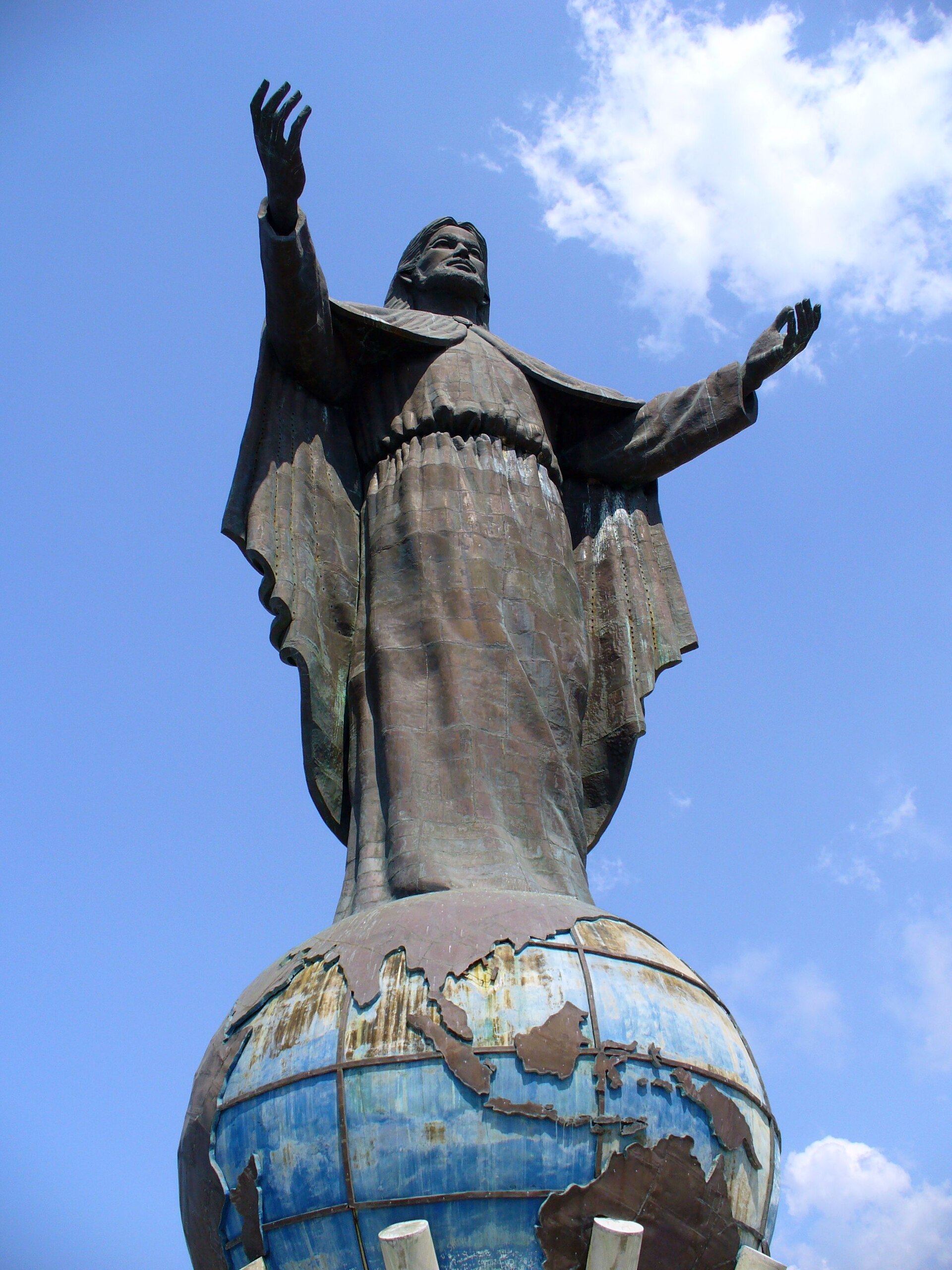
Perched on a gentle hill at the eastern edge of Dili, Cristo Rei is one of those places that feels both familiar and quietly mysterious. The statue of Christ stands with its arms outstretched, not in the usual gesture of blessing, but with one hand pointing downward, as if grounding itself in the earth below. It’s an unusual detail, one that gives the monument a sense of connection to the land rather than just the sky. The figure itself is classic in style, but the way it rests on a globe, which in turn sits atop a bronze lotus flower, adds a layer of symbolism that feels distinctly local. The whole structure rises nearly thirty meters, its metallic surface catching the sunlight so that it glows against the backdrop of the Timor Sea.
The statue was unveiled in 1996, a time when East Timor was still under Indonesian occupation. It was a gift from then-President Suharto, intended as a gesture of reconciliation. For many Timorese, though, the monument carried a different weight—it stood as a reminder of a painful chapter in their history. Yet over time, its meaning has shifted. After independence in 2002, there were discussions about removing it, but the statue remained. Today, it’s less a political symbol and more a part of Dili’s landscape, something people pass by or visit without much thought to its origins. It’s simply there, like the ocean or the hills in the distance.
Reaching the statue means climbing a long flight of steps that winds up the hillside. The path is lined with trees, and on weekends, you might find families picnicking in the shade or children playing near the base. The climb isn’t strenuous, but it’s long enough to make the view from the top feel earned. Once you reach the platform at the base of the statue, the city unfolds below—low-slung buildings, the sprawl of Dili’s streets, and the endless blue of the sea. On clear days, the horizon seems to stretch forever, and the city looks almost delicate from this height. It’s a quiet spot, one where the noise of the streets fades into the sound of waves and wind.
There’s something unassuming about Cristo Rei. It’s not a grand religious site, nor is it a major tourist attraction in the way that other landmarks are. There’s no grand cathedral beside it, just a small chapel at the foot of the hill. The statue itself isn’t particularly innovative in design, but its setting makes it special. It stands alone, surrounded by palms and shrubs, with no tall buildings to compete with its presence. The lack of crowds adds to the sense of calm—this isn’t a place where people come to be seen, but rather to see.
Mornings here are especially peaceful. The steps are empty, the air is cool, and the only sounds are the rustling of leaves and the distant crash of waves. By midday, a few visitors trickle in—some to take photos, others to sit on the benches and watch the ocean. In the late afternoon, as the heat eases, families and couples gather to watch the sunset. The statue is lit up at night, its silhouette sharp against the darkening sky. It’s a simple ritual, but one that feels timeless.
For locals, Cristo Rei is more than just a landmark. It’s a place to escape the chaos of the city, to breathe in the sea air, and to spend time with family. There are no tour buses or souvenir stalls, just a quiet corner where life moves at its own pace. Occasionally, small events are held here—concerts, religious gatherings, or art displays—but more often than not, it’s just a place to be still. The atmosphere is unpretentious, almost domestic, as if the statue has always been part of the neighborhood.
What makes Cristo Rei interesting isn’t its size or artistic brilliance, but its ordinariness. It doesn’t demand attention or awe; it just exists, a quiet presence in a city that has seen so much change. There’s no grand narrative here, no over-the-top symbolism—just a statue on a hill, overlooking a city that has learned to carry its past lightly. Maybe that’s why it feels so approachable. It’s not trying to be anything more than what it is: a place where people come to look at the view, to think, or to do nothing at all.