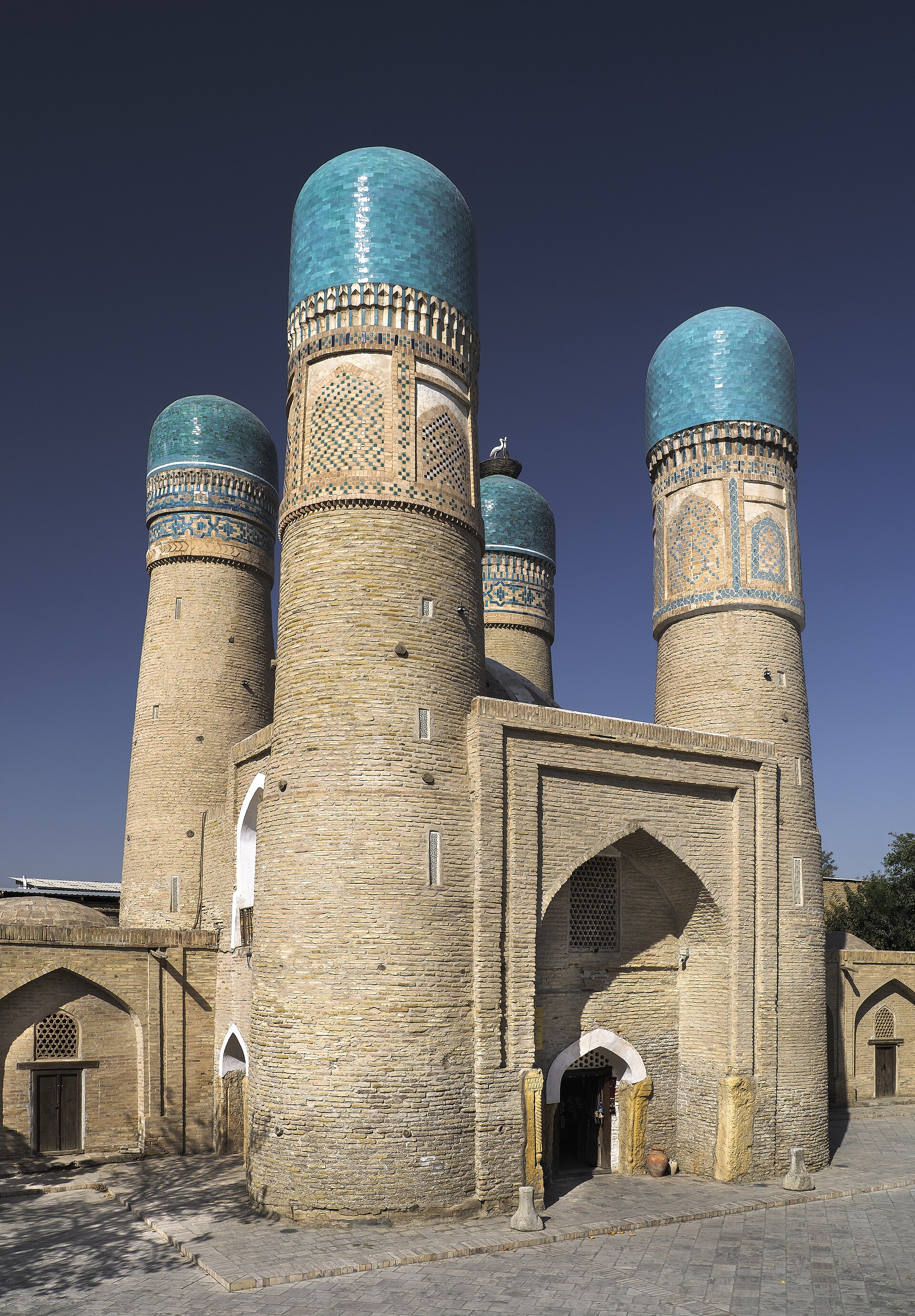
Chor-Minor stands quietly in the heart of Bukhara, a small but striking structure that feels plucked from the pages of an old Persian tale. Its four slender towers rise from a modest base, each crowned with a dome that curves in a way that defies expectation. The name translates to Four Minarets, though these are not the towering spires one might imagine—rather, they are decorative pillars, each unique in shape and ornamentation. Built in the early 19th century, the building once served as the gateway to a madrasa that no longer exists. Today, it stands alone, a whimsical anomaly amid the winding streets of the old city, its design unlike anything else in Bukhara.
The origins of Chor-Minor are wrapped in stories passed down through generations. One legend claims it was commissioned by a wealthy merchant of Turkmen descent, who wanted to honor his four sons. Each minaret, with its distinct form, may have represented one of them, their differences mirroring the varied paths of their lives. Another tale suggests the patron simply sought to create something extraordinary, a structure that would break from Bukhara’s traditional architectural conventions. Whatever the truth, Chor-Minor does feel like a deliberate departure from the norm—less rigid, more playful, as if its architect set out to bend the rules of Central Asian design.
The building’s architecture is a study in contrasts. The central pavilion, topped with a dome, serves as the foundation for the four towers, each adorned with intricate tilework. One minaret shimmers with blue and white geometric patterns, another winds with floral motifs, while a third seems draped in vines. The fourth, more restrained in its decoration, echoes the classic minarets of Bukhara. Inside, the space is sparse now, but it once may have housed a small prayer hall or meeting room. Though little remains of its original interior, the structure itself still captivates, its details revealing a careful balance between tradition and creativity.
Chor-Minor sits in one of Bukhara’s oldest neighborhoods, where time moves at a slower pace. Narrow stone streets wind past clay walls and centuries-old caravanserais, where merchants once rested on their journeys along the Silk Road. A small park surrounds the monument, offering shade and a quiet place to sit. Unlike the bustling squares near the city’s grand mosques and madrasas, this corner of Bukhara feels untouched by crowds. Visitors can linger on a bench, watching the sunlight shift across the domes, or wander the nearby alleys, soaking in the atmosphere of a city that has seen empires rise and fall.
Though modest in size, Chor-Minor holds a special place in Bukhara’s history. By the 19th century, the city was no longer a political powerhouse, but it remained a vibrant center of culture, trade, and craftsmanship. Wealthy patrons funded new constructions, not for grand political statements, but as personal legacies. Chor-Minor may have been one such project—a private monument that, by chance or design, became part of the city’s collective memory. It reflects an era when Bukhara’s identity was shaped as much by its merchants and artisans as by its rulers.
Today, Chor-Minor is more than just an architectural curiosity. It’s a place where the spirit of old Bukhara lingers. Unlike the imposing Timurid-era mosques or the vast madrasas, it doesn’t demand reverence or awe. Instead, it invites quiet appreciation. There are no strict rules for visiting—you can step close, trace the patterns in the tiles, or climb the small terrace for a view of the rooftops. Occasionally, the minarets are lit up during festivals, their domes glowing against the evening sky, as if momentarily brought back to life.
For many travelers, Chor-Minor is an unexpected delight. It doesn’t require a guided tour or deep historical knowledge to enjoy. A few minutes of quiet observation are enough to notice how effortlessly it blends tradition with innovation. Perhaps that’s why locals hold it in such affection—it doesn’t try to impress with scale or opulence. It simply exists, a small but enduring reminder that beauty doesn’t always need to be grand.
The area around Chor-Minor has its own rhythm. In the mornings, elderly men read newspapers under the trees, children dart between the trunks playing hide-and-seek, and vendors set up stalls with fresh bread and fruit. As the heat of the day fades, the park fills with voices—laughter, conversations, the occasional strum of a dutar. Sometimes, small concerts or art displays take place here, turning the space into a temporary stage. It’s a reminder that Chor-Minor isn’t just a relic; it’s a living part of the city, adapting to the present while rooted in the past.
Bukhara is a city where every stone seems to whisper a story, and Chor-Minor is no exception. It doesn’t tell tales of conquests or great kings, but that might be why it feels so intimate. Here, amid the quiet streets and crumbling walls, the layers of time feel tangible. Chor-Minor stands as a testament to the idea that history isn’t just about power—it’s also about the small, personal moments that shape a place. In its own unassuming way, it captures the essence of Bukhara: a city where the past and present coexist, and where beauty can be found in the most unexpected corners.