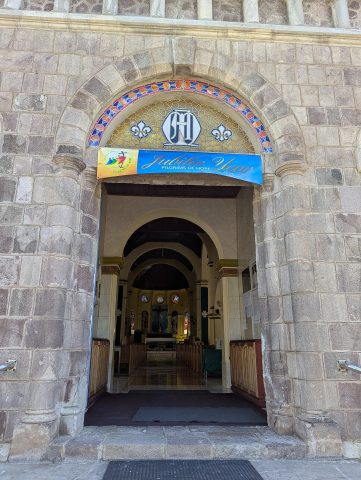
The Co-Cathedral of Immaculate Conception in Basseterre is one of those places that doesn’t demand attention at first glance, yet lingers in the mind long after you’ve left. Tucked away on a corner of East Independence Square Street, it sits quietly amid the low-slung colonial buildings and the hum of daily life in Saint Kitts and Nevis’ capital. From the outside, it’s unassuming—a whitewashed facade, a modest bell tower, nothing that would make a passerby stop in their tracks. But step inside, and the simplicity gives way to something deeper: a sense of history, faith, and the quiet resilience of a community that has shaped this island over centuries.
The cathedral’s origins trace back to the mid-1700s, when Basseterre was already emerging as a key trading and administrative hub in Britain’s Caribbean colonies. At the time, Catholicism was hardly welcome here. Protestant England kept a tight grip on religious life, and the idea of a Catholic church in a British stronghold was almost unthinkable. But the tides of history shifted. The transatlantic slave trade brought people from across the world to these islands, including Catholics from France, Portugal, and Spain. By the mid-19th century, their numbers had grown enough to warrant a proper place of worship. In 1856, a new church rose on the site of an older chapel, eventually earning the status of a cathedral—a quiet but significant milestone for the island’s Catholic community.
The architecture of the Co-Cathedral reflects both its European roots and the realities of life in the tropics. The exterior could easily belong to a small church in southern Europe, with its arched windows, simple pediment, and restrained ornamentation. Inside, though, the design adapts to the Caribbean climate. High ceilings allow air to circulate, while large windows let in light without trapping heat. The wooden pews, worn smooth by generations of worshippers, stay cool even under the midday sun. The altar is understated but dignified, adorned with statues of saints, stained-glass windows depicting biblical scenes, and carefully crafted details that speak of devotion rather than opulence. There’s no gilded grandeur here, no marble floors—just a space that feels lived-in, peaceful, and deeply human.
For much of its history, the cathedral was more than just a place of worship. In the 19th century, when Basseterre thrived as one of the region’s busiest ports, the church became a gathering point for sailors, merchants, and laborers from the plantations. For many Catholic immigrants, it was a lifeline—a piece of home in an unfamiliar land. Here, they celebrated feast days, baptized their children, exchanged vows, and mourned their dead. The cathedral bore witness to the rhythms of daily life, blending faith with the practicalities of survival in a colonial society. Even after several renovations in the 20th century, it retained its essence: a place where spirituality and everyday existence intertwined naturally, without pretense.
Today, the Co-Cathedral of Immaculate Conception remains an active church, though it’s not the kind of place that draws crowds of tourists. That’s part of its charm. There are no guided tours rushing through, no souvenir stands cluttering the entrance. Visitors can walk in, sit on a pew, and listen to the silence. The walls hold traces of the past—old photographs of parishioners, yellowed hymnals in the corner, the faint scent of candle wax lingering in the air. Occasionally, the sound of an organ fills the space during a concert, and for a moment, time seems to stand still. It’s a rare kind of quiet, the kind that invites reflection rather than distraction.
Outside, Basseterre pulses with life. The nearby market bustles with vendors selling tropical fruits, spices, and handmade crafts. Street cafés serve strong coffee laced with local rum, while colonial-era buildings—some now museums or boutique hotels—line the streets. But the moment you step through the cathedral’s doors, the city’s noise fades into the background. Inside, the air feels different. The wooden beams overhead, the worn prayer books, the flicker of candlelight—all of it carries the weight of history. This isn’t a place for those seeking spectacle or instant gratification. It’s for those who want to slow down, to feel the layers of time that have settled here like dust on an old bookshelf.
The cathedral has seen generations come and go. It has been a refuge for the weary, a starting point for the hopeful, and a final resting place in memory for those who have passed. It doesn’t try to impress with scale or splendor. Instead, its strength lies in its steadfastness—its ability to remain a constant amid the changes swirling around it. For locals, it’s still a place of solace and connection. For travelers, it’s a discovery, a reminder that some of the most meaningful places aren’t the ones that shout for attention, but the ones that wait patiently to be found.
In the end, the Co-Cathedral of Immaculate Conception is more than just a building. It’s a keeper of stories, a silent witness to the lives that have unfolded within its walls. It doesn’t need to be grand to matter. Its power lies in its quiet persistence, in the way it has endured without losing itself. Whether you come to pray, to ponder, or simply to sit in the stillness, it offers something rare: a moment of peace in a world that moves too fast. And sometimes, that’s enough.