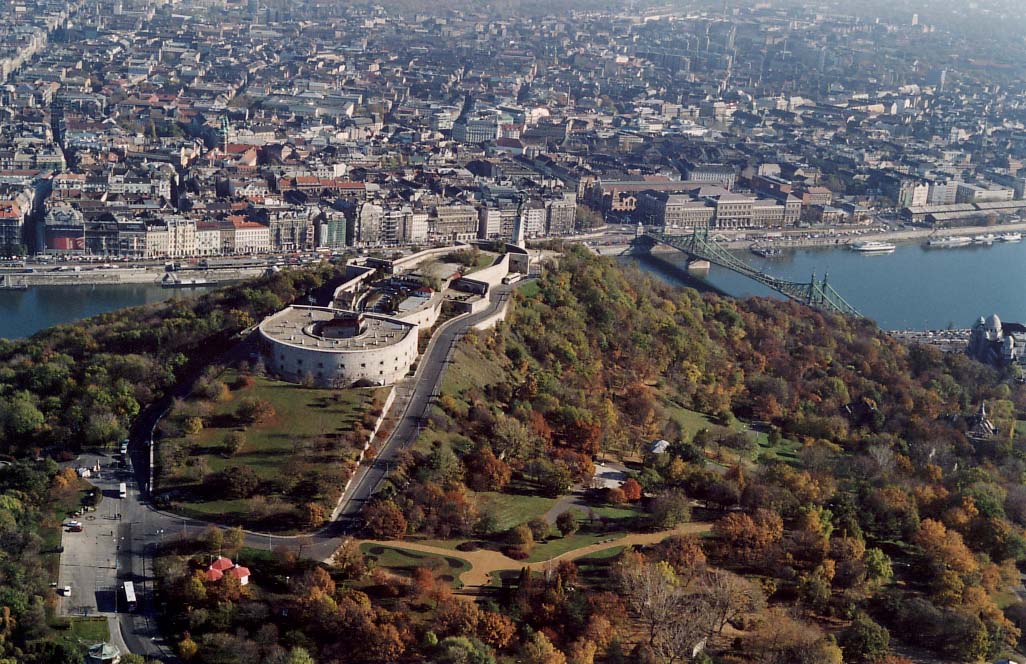
Perched on Gellért Hill, the Citadel stands as a quiet monument to Budapest’s turbulent past. Built in the mid-19th century, it was conceived not as a defensive stronghold against external threats, but as a means of control over the city itself. The Austrian Empire, wary of rebellion after the upheavals of 1848, erected these massive walls to keep both Buda and Pest under watch. The fortress was never tested in battle, yet its very existence served as a reminder of power—one that loomed over the city for decades. Today, the military purpose has faded, but the Citadel remains, its stone bulk a tangible link to the forces that shaped Budapest.
The architecture is unadorned, almost severe, reflecting its original function. Thick walls, narrow embrasures, and a wide moat were designed for endurance, not aesthetics. The fortress sprawls across the hilltop in an irregular polygon, its layout dictated by the terrain rather than symmetry. Inside, the barracks and storerooms still stand, though many have weathered with time. Some structures have crumbled, but the Citadel itself endures, a permanent fixture in the city’s skyline.
For years after its construction, the Citadel was a symbol of occupation. Austrian troops remained stationed here until 1897, long after the revolution had been suppressed. By the early 20th century, its military role had diminished, though it briefly regained strategic importance during World War II as an observation post and defensive position. After the war, it passed into Hungarian hands, and by the 1960s, parts of it were opened to the public. The transition from fortress to landmark was gradual, but inevitable.
What draws most visitors today isn’t the history alone, but the views. From the Citadel’s walls, Budapest unfolds in all directions—the Danube cutting through the city, the bridges connecting Buda and Pest, the Parliament’s Gothic spires, and the rolling hills beyond. The panorama is especially striking at dusk, when the lights of the city begin to glow and the river mirrors their reflection. Yet the Citadel offers more than just scenery. The old casemates, a small museum on the fortress’s history, and the quiet corners where visitors sit watching boats drift by all add layers to the experience.
Surrounding the Citadel is a park where locals and tourists alike come to escape the bustle below. In summer, the shade of the trees provides relief from the heat, while in winter, snow dusts the walls and branches, softening the fortress’s harsh lines. The space is often used for open-air events—concerts, exhibitions, or impromptu gatherings. Artists set up easels to capture the cityscape, and photographers linger at sunset, waiting for the perfect shot. The atmosphere is relaxed, almost removed from the city’s energy, as if time moves differently up here.
The Citadel is more than a historical site; it’s a place where the past and present coexist. It has witnessed shifting borders, changing regimes, and evolving ideologies, yet Budapest itself has remained constant in its beauty and resilience. Walking its grounds, it’s easy to imagine soldiers patrolling the ramparts, or the wary glances of citizens below. Today, children play where guards once stood, unaware of the weight of history beneath their feet. That contrast is part of the Citadel’s appeal—it bridges eras without losing its significance.
Reaching the Citadel on foot takes about twenty minutes from the base of Gellért Hill. The route can be leisurely, winding through the park and past the statue of Saint Gellért, or more direct, climbing steep stairs. Either way, the effort is rewarded with increasingly sweeping views as you ascend. For those who prefer not to walk, a bus stops near the entrance, offering a quick alternative to the climb.
The fortress hasn’t always been accessible. For much of its existence, it was a restricted military zone, and after World War II, it even served as a prison. It wasn’t until the late 20th century that the Citadel was fully repurposed as a public space, though its austere character was preserved. There are no grand interiors or interactive displays here—just stone, wind, and the quiet persistence of history.
Hungarians have mixed feelings about the Citadel. For some, it’s a reminder of difficult times; for others, it’s simply a scenic spot with unmatched views. But no one disputes its place in the city’s identity. Without it, Budapest would lose a defining feature, one that gives the capital its distinctive silhouette. Though it no longer serves its original purpose, the Citadel’s presence on Gellért Hill continues to shape the city’s atmosphere, grounding it in both its past and its present.