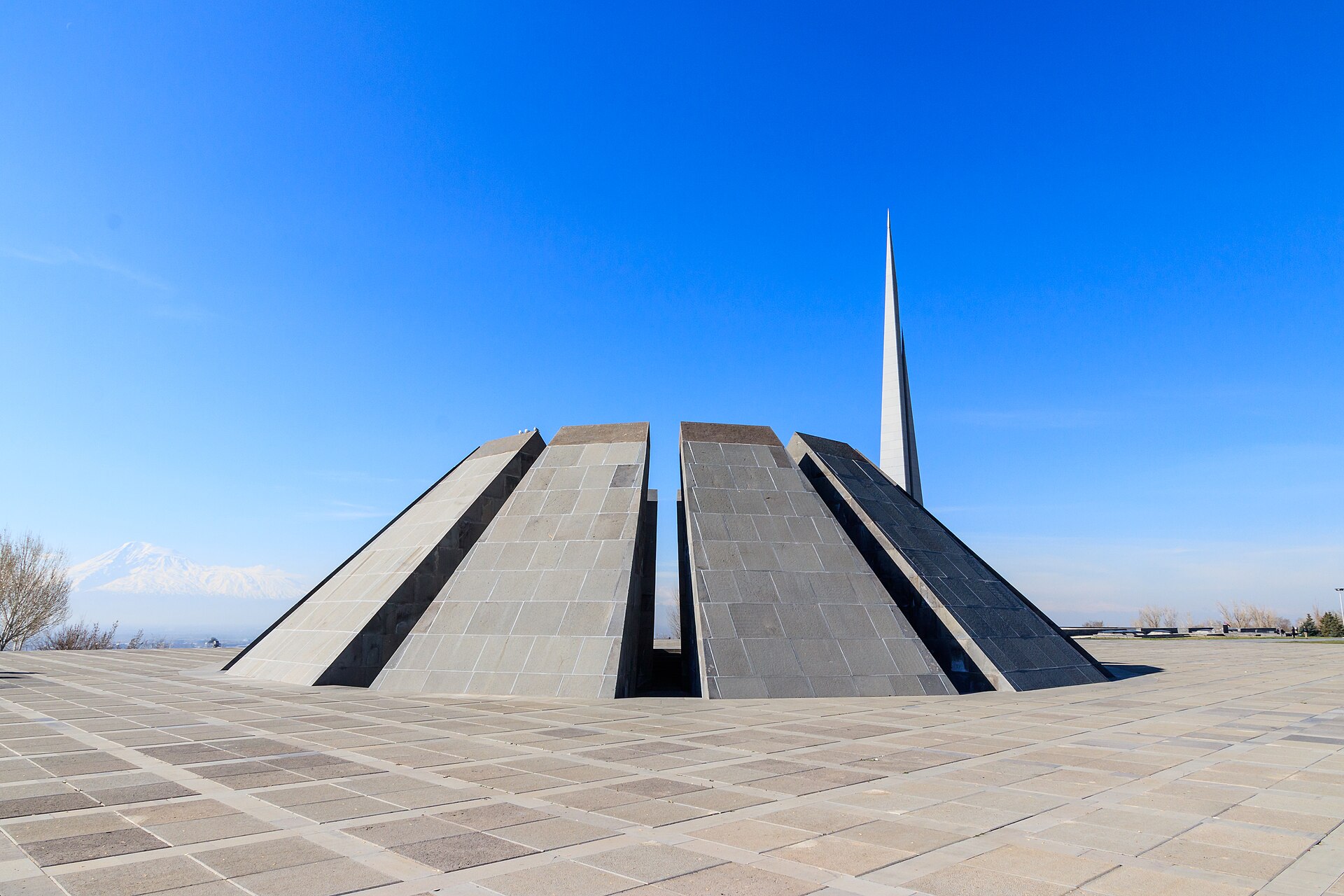
Tsitsernakaberd stands on a hill above Yerevan. The name means "Fortress of Swallows." It once belonged to an ancient past, but now it remembers the Armenian Genocide of the early 20th century. From here, you see the city spread below, with Mount Ararat in the distance—a symbol of Armenia, though it lies beyond its borders today.
The memorial opened in 1967. The Soviet Union still banned public talk of the genocide then. The Armenian diaspora and local advocates fought for years to create a place to honor the victims. Architects Artur Tarkhanyan and Sashur Kalashyan designed it. Twelve basalt slabs form a circle around an eternal flame. Each slab marks one of the lost provinces of Western Armenia. The flame sits within a ring of stones, like an Armenian *khachkar*—a cross-stone used to mark graves.
The memorial’s design is simple. Dark stone meets bright sky and green hillside. The centerpiece is a 44-meter stele, split in two—one half rising, the other buried. A long wall nearby lists towns and villages where massacres happened. Visitors leave flowers, photographs, and notes. The wall becomes a living tribute.
The Armenian Genocide Museum opened in 1995 next to the memorial. It holds documents, personal items, and firsthand accounts. You won’t find graphic displays. Instead, there are telegrams, newspaper clippings, and maps of deportation routes. The most moving artifacts are the testimonies of child survivors. Their words show the human cost of violence.
For Armenians, Tsitsernakaberd is a place of resilience. Every April 24th, thousands gather here. The procession starts at the memorial and moves up the hill. People carry flowers, candles, and the Armenian flag. Many come from abroad. On this day, the air smells of carnations and incense. The only sounds are footsteps and murmured prayers.
The hill has layers of history. It once held an ancient fortress and a settlement. Only fragments remain now. During the Soviet era, there were plans to build a television tower here. Public opposition saved it for the memorial. Today, it stands apart from the city’s noise.
Locals visit Tsitsernakaberd often. They come to walk, think, or meet friends. The view from the hill is one of Yerevan’s best. The city has endured wars, earthquakes, and hardships. Ararat on the horizon reminds Armenians of their ties to the land, even when borders change.
The memorial has no grandiosity. It doesn’t tell you how to feel. It asks you to think about peace and memory. For Armenians, it is sacred. For outsiders, it shows the weight of history. Few leave unchanged. You take something from this place—an understanding of what it means to remember.