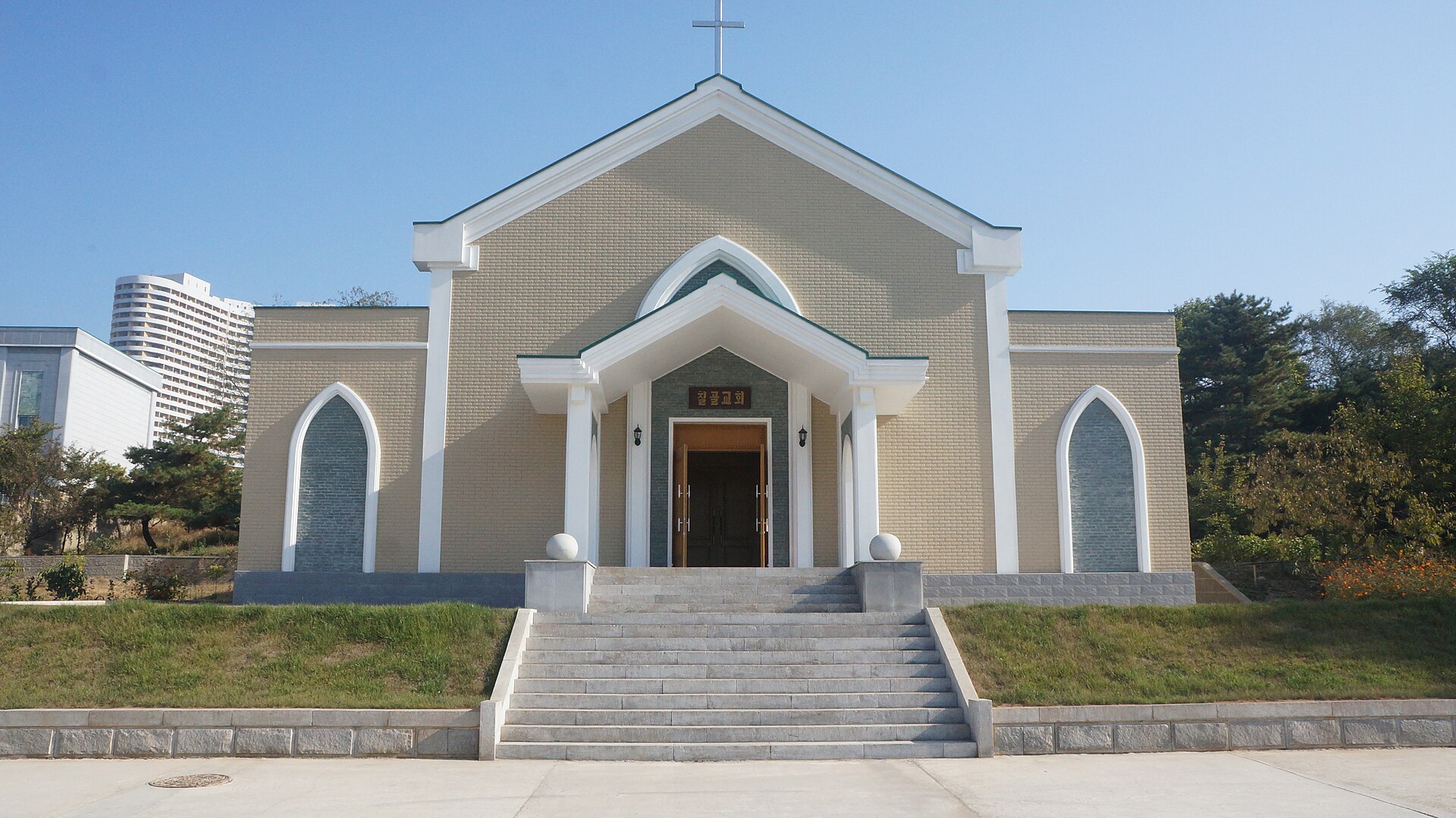
Chilgol Church stands as one of the few visible signs of Christianity in Pyongyang, a city where religion exists under the watchful eye of the state. The church is located in the Chilgol district, once a separate village but now absorbed into the capital’s urban sprawl. Its history is closely tied to Kang Pan-sok, the mother of Kim Il-sung, who, according to official accounts, was a devout Christian and played a role in the construction of an earlier church here in the early 20th century. That building is long gone, replaced in 1989 by the current structure, which serves not only as a place of worship but also as a carefully curated symbol of the government’s stance on religion.
The architecture is unassuming, much like many Protestant churches around the world. A modest building with a cross on its facade, it houses a bright, simple interior with wooden pews, a pulpit, and an organ. There is no grandeur here, just a quiet, functional space where services are held on Sundays. The congregation is small, and while the church remains one of the few places where foreigners can observe religious life in North Korea, its role is as much about perception as it is about faith.
For most North Koreans, Christianity is a rarity. The state ideology of *juche*, which emphasizes self-reliance, leaves little room for religion, particularly one with ties to the West. Yet Chilgol Church endures, not as a testament to religious freedom but as a political gesture—a controlled display of tolerance. Services are often attended by diplomats and foreign visitors, while local worshippers are typically selected by authorities. The whole scene can feel like a performance, where faith is staged as part of a larger narrative.
Pyongyang has a handful of other religious sites, including the Changchung Catholic Cathedral and the Holy Trinity Russian Orthodox Church, built in 2006 for the city’s small Russian community. Like Chilgol, these places exist to project an image of religious openness, though in reality, they operate under strict oversight. The government permits their existence as long as they align with its broader political messaging, reinforcing the idea that North Korea respects religious rights—even if the reality is far more complicated.
The Chilgol district itself is a typical Pyongyang neighborhood, with its wide boulevards, high-rise apartment blocks, and ubiquitous portraits of Kim Il-sung and Kim Jong-il. There are no tourists here, save for those visiting the church, which makes the area an interesting contrast to the more polished parts of the capital. The streets are clean but quiet, shops operate on a schedule, and people move with purpose. The church, in this setting, feels like an anomaly—a small pocket of difference in a city where uniformity is the norm.
Services at Chilgol are conducted in Korean, though occasional tours with translations are arranged for foreign visitors. The atmosphere during worship is subdued, almost intimate, with congregants singing hymns, praying, and listening to sermons. Yet there is an unspoken awareness that every action is observed, ensuring nothing steps outside the boundaries set by the state. For locals, this is simply how things are. For outsiders, it can feel unsettling, a reminder of how deeply control shapes even the most personal aspects of life.
The church also carries echoes of a time when Christianity was more widespread in Korea. In the early 20th century, Pyongyang was even nicknamed the "Jerusalem of the East" for its many churches. Today, that legacy survives only in fragments, with Chilgol Church as one of the few remaining links to a past that has otherwise been erased or repurposed by history.
Visiting Chilgol offers a rare glimpse into how religion functions within North Korea’s tightly managed society. Here, faith and ideology intertwine, creating a sense of contradiction. The church is not just a place of worship; it is a carefully constructed element of the state’s narrative, where even devotion is shaped by the demands of politics. For those who step inside, it is an experience that lingers—not just for what it shows, but for what it leaves unsaid.