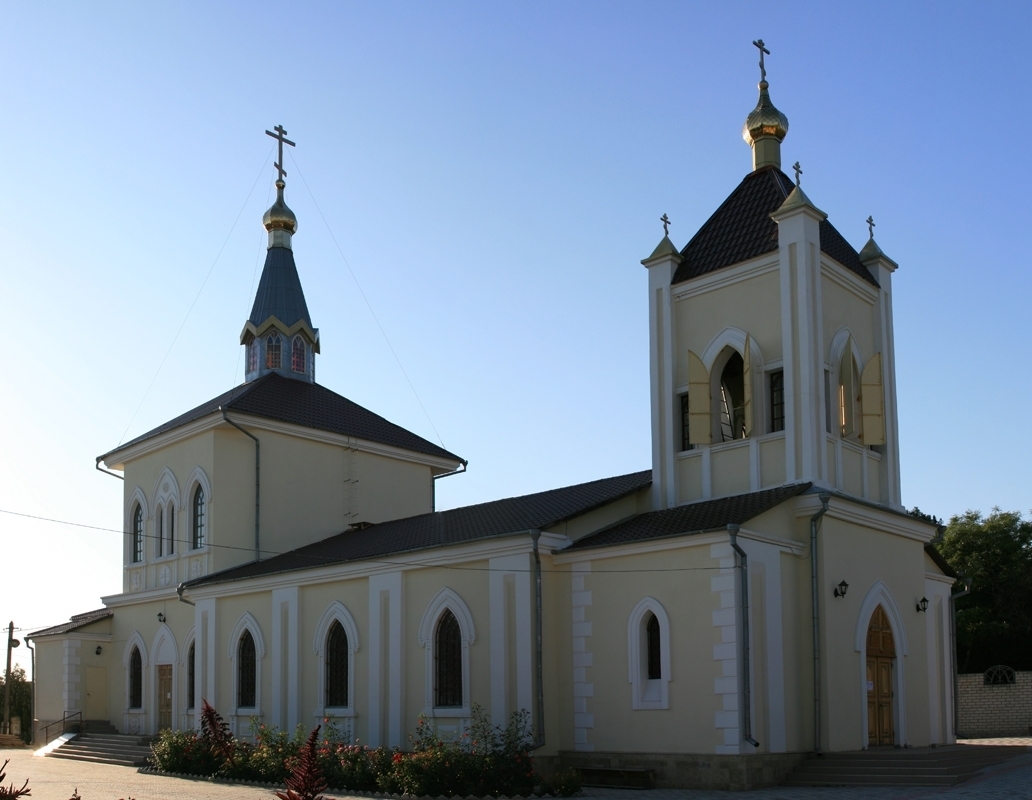
Perched on a gentle hill in Feodosia, the Church of All Saints feels like a quiet witness to the city’s layered past. Built in the mid-19th century, it overlooks the rooftops and the distant sea, as if bridging the ordinary with something deeper. The church is small, but its modest size doesn’t diminish its presence—it has been a steady part of life here for generations, a place where history, faith, and daily routines have intertwined over time.
The architecture is unassuming, much like many provincial churches of its era. Whitewashed walls, a low dome, and a bell tower with arched openings give it a light, almost weightless appearance. Inside, there’s no grand iconostasis or elaborate frescoes, just the quiet play of light through narrow windows and the faint scent of candle wax. It’s the kind of place where people come not for spectacle, but for a moment of stillness, where the simplicity itself feels like an invitation to pause.
Feodosia has always been a city of contrasts, shaped by Genoese traders, Ottoman rule, and later, Russian influence. The Church of All Saints arrived when the city was already part of the Russian Empire but still carried the marks of its southern character. It was built for local residents, many of whom had come from other parts of Russia, yet it absorbed something of the region’s rhythms—its warmth, its slower pace, the way different cultures had left their traces here over centuries.
The church wasn’t just a place of worship; it was also a keeper of memories. Over the years, it held icons and relics tied to the city’s history, like those donated after the Crimean War, when Feodosia, like the rest of the peninsula, endured hardship. During the Soviet era, the building was repurposed, its religious life interrupted. But even then, locals didn’t forget it. When the church was returned to the faithful in the late 20th century, it didn’t take long for it to regain its place in the community.
Today, the Church of All Saints remains an active parish, drawing both worshippers and visitors curious about Feodosia’s past. Unlike the crowded cathedrals of bigger cities, it offers a sense of quiet. You can stand by the icons, listen to the soft chime of the bells, or sit on a bench outside, watching the sea stretch toward the horizon. On feast days, the church comes alive with singing and the murmur of prayers, a reminder that this place is still very much part of people’s lives.
Feodosia is a city where history lingers in its streets and buildings, and the Church of All Saints is no exception. It stands where different eras meet, a small but enduring presence in a landscape shaped by time. For some, it’s just another church; for others, it’s a place where the past feels close enough to touch. Either way, it leaves an impression—not of grandeur, but of something quieter, more personal. A place where the weight of years doesn’t press down, but instead, settles gently, like dust on an old windowsill.