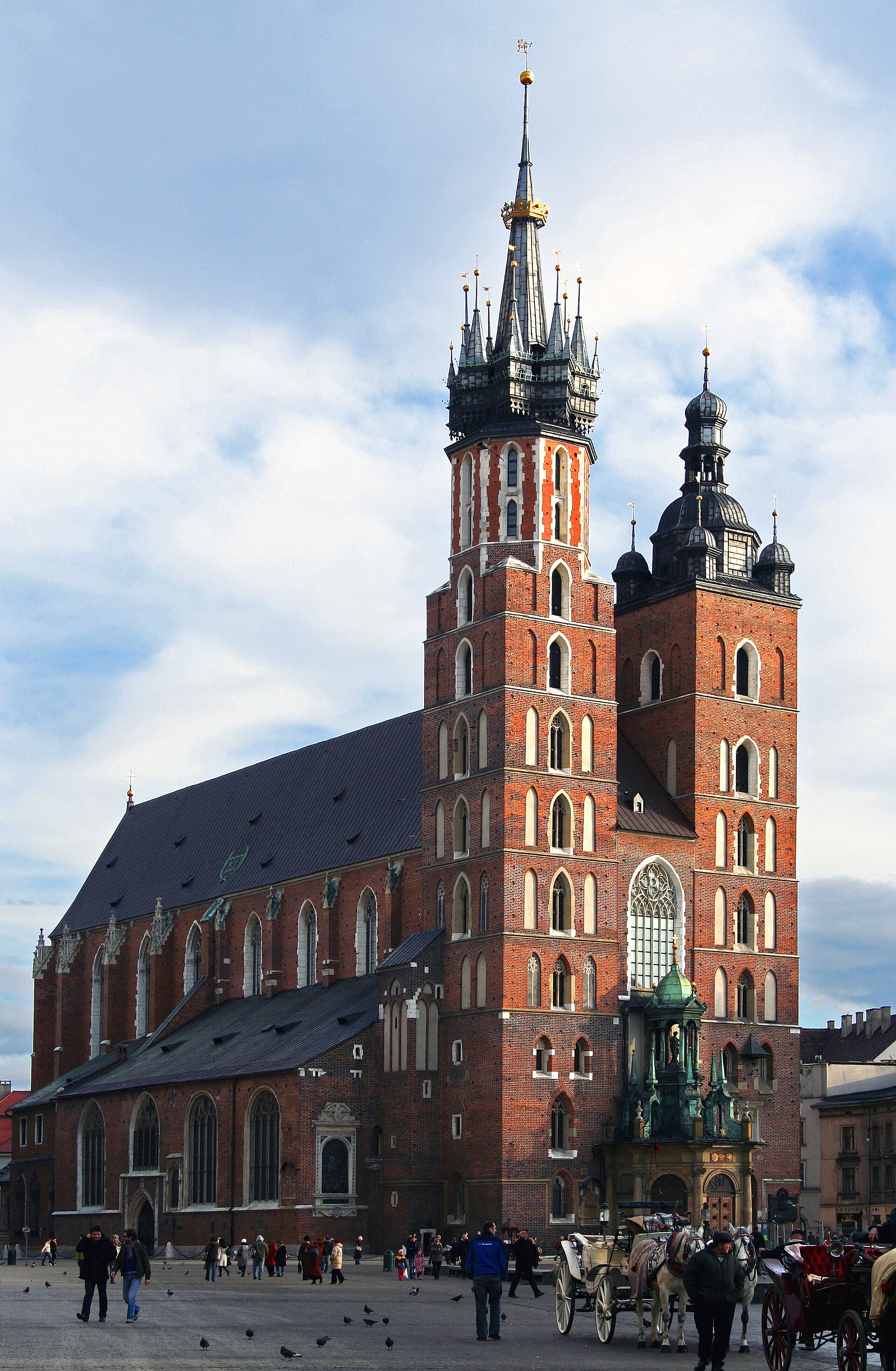
St. Mary’s Basilica stands at the heart of Kraków’s Main Market Square, its mismatched towers rising above the city like a pair of silent sentinels. For centuries, these twin spires have been more than just a landmark—they’ve been a symbol of the city itself, a constant presence in the ever-changing life of Kraków. The church we see today is a Gothic masterpiece, but its story began much earlier, in the 13th century, when a Romanesque structure first occupied this spot. Little remains of that original building; time, fires, and reconstructions reshaped it into the soaring, red-brick edifice that now dominates the square. The pointed arches, ribbed vaults, and flying buttresses are textbook Gothic, yet there’s something uniquely Kraków about the way the light catches the weathered stone, as if the city itself has left its mark on the walls.
Step inside, and the grandeur of the interior is impossible to ignore. The centerpiece is the High Altar, a monumental work of art carved by Veit Stoss in the early 16th century. At over 13 meters tall, it’s one of the largest Gothic altarpieces in the world, a riot of gilded wood and intricate detail. The altar depicts scenes from the life of the Virgin Mary, its figures so lifelike they seem to breathe. Most days, the altar’s wings remain closed, revealing only a fraction of its splendor, but on Sundays and feast days, it unfolds like a sacred triptych, revealing the full depth of Stoss’s craftsmanship. The effect is mesmerizing—angels hover, saints gesture, and the entire composition feels alive with movement, as if the wood itself has been imbued with spirit.
One of the church’s most enduring traditions is the hejnał, a trumpet call that rings out from the taller of the two towers every hour, on the hour. The melody is simple, almost haunting, and it always cuts off abruptly mid-note. The story behind this tradition is as old as the church itself. According to legend, a trumpeter in the 13th century was sounding the alarm during a Mongol attack when an arrow struck him through the throat, silencing the call. The interrupted melody has been played ever since, a tribute to the fallen guard and a reminder of Kraków’s resilience. Today, the hejnał is broadcast live on Polish radio, a daily ritual that connects the city’s past with its present.
Beyond its famous altar and trumpet call, St. Mary’s is a treasure trove of sacred art. The walls are lined with medieval frescoes, their colors still vibrant after centuries, while the side chapels hold relics, sculptures, and paintings that tell the story of Kraków’s spiritual life. One of the most revered is the wooden statue of the Madonna and Child, known as the *Mater Misericordiae*, which has been venerated for its supposed miraculous powers. The church’s stained glass windows, some dating back to the 14th century, cast a kaleidoscope of light across the stone floors, their biblical scenes unfolding in jewel-like hues. Even the pews are works of art, carved with intricate patterns that reflect the skill of Kraków’s medieval craftsmen.
The church’s architecture is just as fascinating as its art. The two towers, though similar at first glance, are strikingly different. The taller northern tower, with its slender profile, was once used as a watchtower, offering panoramic views of the city and the surrounding countryside. Visitors can still climb its narrow staircase for a bird’s-eye perspective of Kraków’s rooftops. The shorter southern tower, broader and more solid, houses the church’s bells. The asymmetry wasn’t intentional—originally, the towers were meant to be identical, but after one collapsed during construction, the builders adapted, giving the church its distinctive silhouette. This quirk of history has only added to its charm, making St. Mary’s instantly recognizable among Europe’s Gothic churches.
St. Mary’s has always been more than just a place of worship. It has witnessed coronations, royal weddings, and funerals, its walls echoing with the voices of kings and commoners alike. During times of war, it served as a sanctuary, its thick stone walls offering protection from invaders. Even today, it remains a living part of Kraków’s daily life. Masses are held regularly, and the church’s acoustics make it a popular venue for organ concerts, where the music of Bach or Mozart fills the vaulted space. In the summer, the square outside buzzes with tourists, while in winter, the church becomes the centerpiece of Kraków’s famous Christmas market, its towers looming over stalls selling mulled wine and handmade ornaments.
Visiting St. Mary’s is like stepping into a different era. The narrow streets of the Old Town, the Gothic facades of the surrounding buildings, and the hum of café conversations all contribute to a sense of timelessness. Inside the church, the cool air and hushed atmosphere create a stark contrast to the bustle of the square. The weight of history is palpable here—every stone, every carving, every flicker of candlelight seems to whisper stories of the past. Even those who aren’t religious can’t help but feel the pull of something greater, something that transcends the centuries.
St. Mary’s isn’t just a tourist attraction to be checked off a list. It’s a place where Kraków’s history comes alive, where the past isn’t just remembered but felt. Some come to see the Veit Stoss altar, others to hear the hejnał, and still others simply to sit in silence and soak in the atmosphere. Whatever the reason, leaving the church feels like stepping back into the present, carrying with you a piece of the city’s soul. In a place where every corner has a story, St. Mary’s stands as a testament to Kraków’s enduring spirit—a monument not just of stone, but of memory.