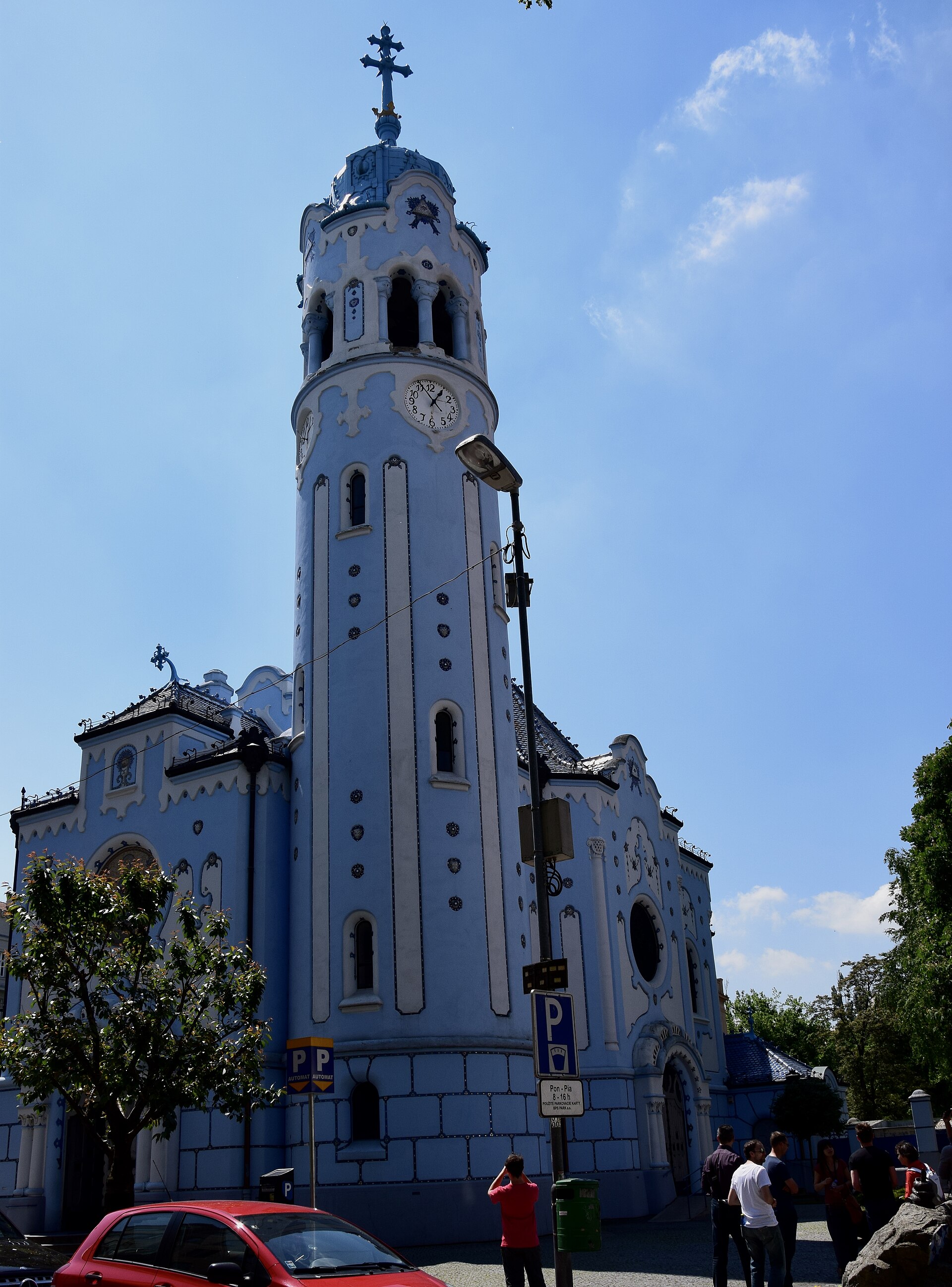
The Church of St. Elizabeth in Bratislava, better known as the Blue Church, is one of those rare places that lingers in the memory long after the first glance. Its soft blue facade, delicate and almost whimsical, stands out against the more austere buildings of the city, as if plucked from the pages of a storybook. Tucked away in the eastern part of the Old Town, the church occupies a quiet corner where the early 20th century still feels alive. There’s no tourist bustle here, no crowds jostling for the best view—just a sense of stillness, as if time has settled into a gentler rhythm.
Built in 1913, the church was designed by Ödön Lechner, a Hungarian architect who played a pivotal role in shaping the Secessionist movement, the Central European counterpart to Art Nouveau. Lechner was a visionary, blending traditional Hungarian motifs with the flowing, organic forms of the era. The result is a building that feels both timeless and strikingly modern. The Blue Church isn’t just a place of worship; it’s a statement of artistic ambition. Lechner’s use of ceramic tiles wasn’t merely decorative—it was structural, a bold innovation for its time. The tiles, glazed in shades of blue, wrap around the building like a delicate shell, their glossy surface catching the light in unexpected ways.
From the outside, the church appears almost doll-like in its proportions, yet there’s nothing fragile about its presence. The facade is adorned with intricate mosaics and stucco work, while the dome, covered in the same blue glaze, evokes the domes of Eastern architecture, adding a touch of the exotic. Step inside, and the effect is just as striking. The interior is a study in lightness—pale hues, graceful curves, and stained-glass windows that filter the sunlight into soft, colored pools. There’s no clutter here, no heavy ornamentation. Every detail, from the slender columns to the subtle carvings, serves a purpose, creating a space that feels both sacred and serene.
The church is dedicated to St. Elizabeth of Hungary, a figure revered for her devotion to the poor and the sick. Her image appears throughout the church, a quiet reminder of compassion and humility. In Slovakia, Elizabeth holds a special place in the hearts of many—she was born in these lands, and her life of service has made her a symbol of local faith and tradition. A statue of the saint stands near the altar, drawing visitors who come not just to admire the architecture, but to reflect on her legacy.
Beyond its religious significance, the Blue Church is a piece of Bratislava’s cultural heritage, a relic of a time when the city was known as Pressburg and was part of the Austro-Hungarian Empire. The early 20th century was a period of artistic flourishing here, with architects like Lechner pushing boundaries while staying rooted in tradition. The church embodies that spirit—a bridge between the old and the new, between the familiar and the unexpected. It’s a reminder that even in a city with a long and layered history, there’s always room for something fresh and daring.
Today, the church remains an active place of worship, but it also welcomes those who come simply to appreciate its beauty. A small park surrounds the building, offering benches where visitors can sit and take in the view. The best times to see the church are early in the morning or as dusk falls, when the blue of the facade deepens, almost glowing against the fading light. On sunny days, the tiles shimmer, turning the building into a beacon that draws photographers and passersby alike.
Despite its fame, the Blue Church has managed to avoid the crowds that flock to Bratislava’s more central attractions. Perhaps it’s because it sits just off the beaten path, or maybe it’s because its charm doesn’t need fanfare. There are no long lines here, no rush—just the quiet pleasure of stepping into a space that feels both intimate and grand. You can light a candle, wander the nearby streets lined with early 20th-century houses, or simply stand outside and let the building’s gentle presence wash over you.
What makes the Church of St. Elizabeth so special is its ability to surprise. It’s a place that defies expectations—small yet striking, traditional yet innovative, solemn yet playful. There’s something almost dreamlike about it, as if it belongs to a world where beauty is effortless and history feels close enough to touch. It’s no wonder that both locals and visitors hold it in such affection. In a city full of grand cathedrals and historic landmarks, the Blue Church stands out not for its size, but for its soul. It’s a reminder that sometimes, the most memorable places are the ones that feel like a secret, waiting to be discovered.