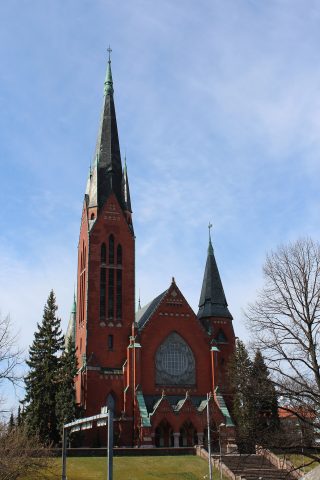
Perched on a quiet hill in the Kakskerta district of Turku, St. Catherine’s Church feels like a place where time has gently paused. Built in the 13th century, it stands apart from the city’s bustle, its sturdy granite walls and steeply pitched roof giving the impression that the masons might have just laid down their tools. The surrounding area, with its old wooden houses and winding lanes, adds to the sense that this is a corner of Finland where the past lingers. There are no crowds here, only the occasional chime of the church bells and the rustle of leaves when the wind picks up.
The church is a fine example of Gothic architecture as it took root in Finland, brought by Catholic missionaries. Its thick stone walls, narrow arched windows, and vaulted ceilings were designed not just for worship but for protection—during the Middle Ages, such buildings often served as refuges during raids. Inside, faint traces of 14th-century frescoes remain, their biblical scenes worn by centuries of damp and time. Though barely visible now, they offer a quiet reminder of how deeply faith shaped life in this region.
Before the Reformation, St. Catherine’s was a Catholic church, dedicated to Saint Catherine of Alexandria, the patron saint of scholars and philosophers. This dedication hints at a time when the church was not only a place of prayer but also a center of learning. When Finland came under Swedish rule and Lutheranism spread, the building underwent changes—altars and statues were removed, and the interior became more austere. Yet the structure itself endured, surviving fires, wars, and restorations, a silent witness to the shifting religious landscape of the region.
The church’s surroundings are as evocative as the building itself. Kakskerta is one of Turku’s oldest districts, where 18th- and 19th-century houses still line narrow, cobblestone streets. These lanes lead down to the Aura River, where trade once thrived along the waterfront. In summer, the area is lush with gardens and walking paths, a favorite spot for locals to stroll or sit by the water. Winter transforms it into a quieter scene, with snow blanketing the ground and the church’s dark walls standing stark against the white landscape, as if plucked from an old tale.
Despite its age, St. Catherine’s remains a living part of the community. Services are held on Sundays, and on weekdays, visitors can step inside to see the old gravestones embedded in the floor or simply sit in the hush of the stone interior. During the summer, occasional organ concerts fill the space with music, the sound echoing through the vaulted ceilings. For those interested in history, the church offers a tangible connection to Finland’s past—from its medieval Catholic roots to the austerity of Lutheranism and beyond.
Turku is a city rich in history, and St. Catherine’s is one of its quieter treasures. Unlike the more famous cathedral or castle, it doesn’t draw crowds or tourist shops. Instead, it offers something rarer: a sense of stillness and continuity. There’s no fanfare here, just the weight of centuries in the stones and the quiet rustle of the wind through the trees. If you find yourself in Turku, it’s worth taking the time to climb the hill, stand by the church’s walls, and listen. In that moment, you might begin to understand why this place holds such meaning for those who call it home.