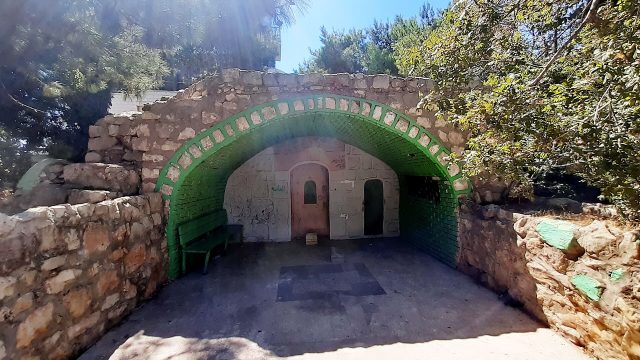
Perched on a quiet hillside in the heart of Galilee, the Church of St. John the Baptist feels like a place where time has settled into stillness. The air here carries the dry warmth of the region, and the surrounding hills, dotted with olive groves, stretch out in gentle waves. It’s easy to imagine this landscape unchanged from the days when John the Baptist walked these very paths, his voice echoing across the valleys as he called people to repentance. The church itself is a modest structure, its stone walls blending seamlessly into the terrain, as if it has always been part of the land.
The architecture is simple, almost austere, reflecting the unadorned faith it represents. Thick walls of local stone rise up to support a low ceiling, while small windows filter the sunlight into soft, diffused pools on the floor. Inside, the space is intimate, with columns of the same pale stone holding up the vaulted arches. The altar is unassuming, free of elaborate decoration, as if to remind visitors that the true significance of the place lies not in grandeur but in its quiet spirituality. Even the flickering candlelight seems to belong here, adding to the sense of calm that fills the air.
This corner of Galilee has long been tied to the story of John the Baptist. According to tradition, he began his ministry in these hills, baptizing followers in the waters of the Jordan River, which lies just a short distance away. Nearby Ein Karem is revered as the site of his birth, while the river itself is where he baptized Jesus. The church in Ma’ale Iron feels like a natural extension of that legacy, a place where the past lingers in the very stones underfoot. Though the modern building dates only to the mid-20th century, the land itself carries centuries of devotion, and it’s not hard to believe that earlier structures once stood here.
Galilee has always been a crossroads of cultures and beliefs, and Christian communities have thrived here since the earliest days of the faith. The church in Ma’ale Iron was built at a time when the region was taking on new significance, its construction a quiet assertion of continuity in a land shaped by change. While there’s no definitive archaeological evidence of an ancient chapel on this spot, the atmosphere of the place makes it easy to suspend disbelief. The silence, the way the light falls through the windows, the weight of history in the air—all of it suggests a connection to something far older than the building itself.
Unlike the crowded pilgrimage sites of Jerusalem or Bethlehem, the Church of St. John the Baptist offers a rare sense of solitude. There are no tour groups here, no jostling for space, no hurried guides reciting facts. Instead, visitors can sit on one of the benches outside, gaze out at the rolling hills, and let the stillness settle over them. The landscape hasn’t changed much in two thousand years, and in moments like these, it’s possible to feel the weight of that continuity. The only sounds are the rustle of olive leaves in the wind and the occasional cry of a bird circling overhead.
Inside, the church is dimly lit, with just a few candles casting a warm glow over the icons on the walls. Among them is the familiar image of John the Baptist—gaunt, intense, a figure of unwavering conviction. There’s no opulence here, no gilded altars or ornate frescoes, just a sense of authenticity that’s often missing in more famous holy sites. Perhaps that’s why those who come here, whether locals or pilgrims, find something deeply personal in the experience. It’s a place for reflection, for prayer, or simply for being still.
Ma’ale Iron itself is far from the usual tourist trail, and that’s part of its charm. The village moves at its own unhurried pace, with quiet streets and houses tucked among gardens. The church isn’t just a landmark here; it’s woven into the fabric of daily life. For some, it’s a place of worship. For others, it’s a reminder of the past, a tangible link to the stories that have shaped this land. But for everyone who visits, it offers a moment of connection to something larger than themselves—a history that isn’t just recorded in books but lives in the stones, the air, and the silence.
If you find yourself in Galilee, it’s worth stepping off the well-trodden path to visit Ma’ale Iron. There are no crowds, no ticket lines, no scripted tours. Just the church, the hills, and the quiet rhythm of time. In a region so often defined by its significance to millions, this small, unassuming place offers a different kind of understanding—one that comes not from grand monuments or famous relics, but from the quiet persistence of faith and history in the most ordinary of landscapes.