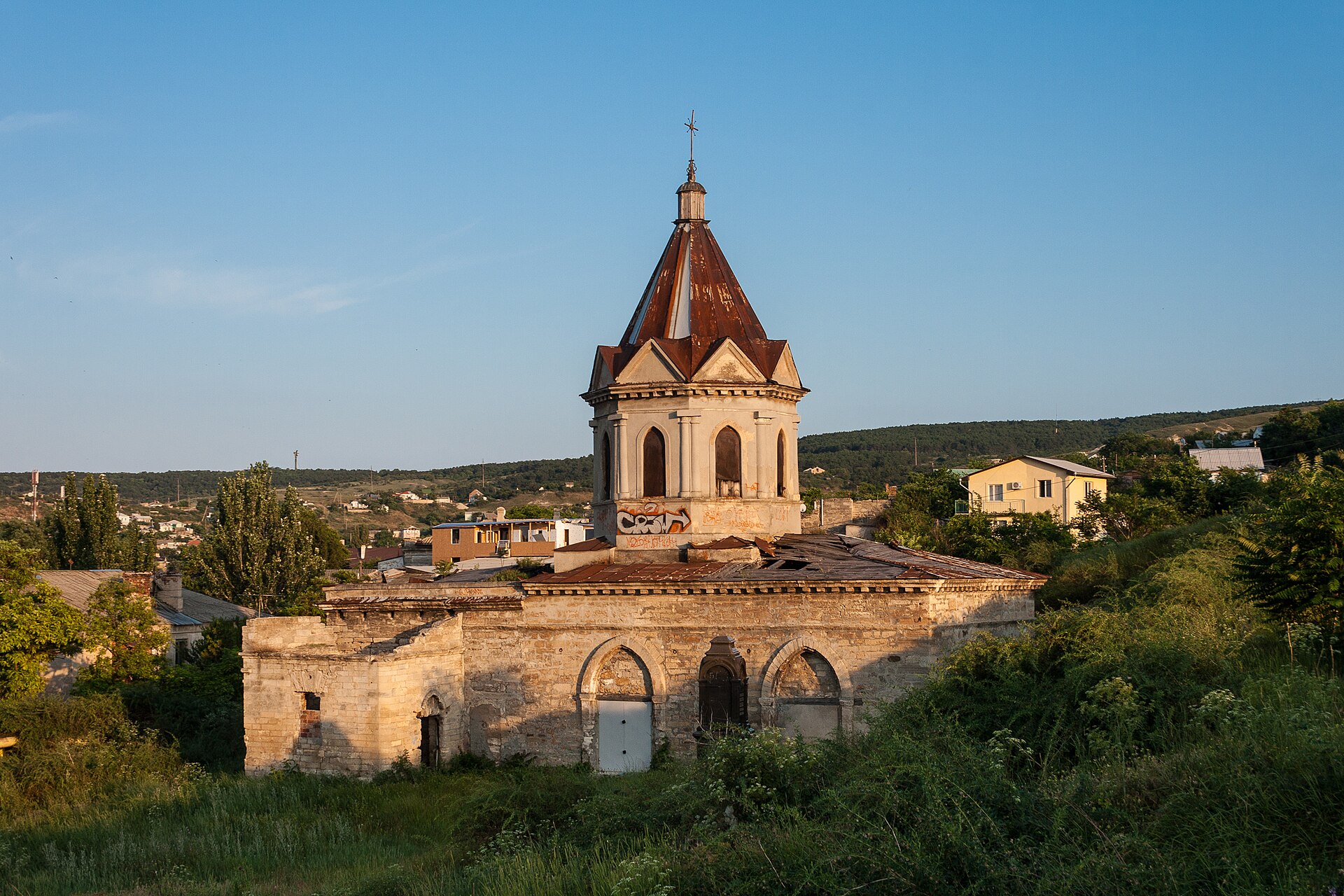
St. George’s Church in Feodosia is one of those quiet places that seem to hold the weight of centuries within their walls. Perched on a gentle hill in the old part of the city, it overlooks the rooftops of Feodosia and the distant curve of the coastline. The church itself is modest in size, but its whitewashed walls, dome, and bell tower stand out against the surrounding buildings. This was always a crossroads—where trade routes intersected, where merchants, sailors, and travelers brought their own traditions, languages, and beliefs.
The history of St. George’s stretches back to the Middle Ages, when Feodosia was known as Caffa, a key Genoese port on the Black Sea. The first records of the church date to the 14th century, though its exact origins are unknown. For nearly two hundred years, the Genoese ruled here, constructing Catholic churches across the city. When the Ottomans took control in the late 15th century, many of those buildings were destroyed or repurposed. St. George’s, however, survived. After the Russian Empire annexed Crimea in the late 18th century, the church was reconsecrated as an Orthodox place of worship.
The architecture of the church reflects its layered history. Originally, it was a typical Genoese structure, with narrow windows, pointed arches, and thick walls—elements of Gothic design common in Italian maritime colonies. Over time, as the church changed hands, new features were added. The dome, a hallmark of Byzantine tradition, appeared later, as did the bell tower, constructed in the 19th century. Inside, the changes are just as evident. The austere Catholic interior gave way to the Orthodox iconostasis that stands today. Yet traces of the past remain, like fragments of old murals peeking through layers of plaster.
Stepping inside, the atmosphere is hushed. Light filters through small windows, casting a soft glow over the icons and the worn surfaces of the walls. The details tell their own stories—the wooden iconostasis, the faded inscriptions on the walls, the old tombstones near the entrance, some with Greek letters, others with Cyrillic. The most intriguing remnants are the fragments of frescoes that still cling to the plaster. They hint at a time when the church was filled with scenes from the lives of saints, though now only scattered patches remain.
St. George’s has witnessed much of Feodosia’s history. It stood through the trade of Genoese merchants, the prayers of Orthodox worshippers, and the chaos of war. During the Crimean War, the church suffered damage from shelling but was later restored. In the Soviet era, it was closed, repurposed as a warehouse, and left to decay. It wasn’t until the late 20th century that the church was returned to the faithful, restored, and reopened for services.
Today, it remains an active place of worship, drawing both locals and visitors. Unlike tourist spots along the coast, St. George’s offers quiet reflection. You can linger by the entrance, reading the names on the old tombstones, or step inside to take in the stillness. The best times to visit are early in the morning or on weekdays, when the church is empty.
Feodosia is a city of overlapping histories, and St. George’s is one of its most tangible symbols. Here, the layers of the past aren’t hidden—they’re on full display. The Genoese arches, the Ottoman influences, the Russian Orthodox additions all coexist, each era leaving its mark without erasing what came before. The church doesn’t present a single narrative; it invites you to piece together the story for yourself.
If you find yourself in Feodosia, stop by, even if just for a few minutes. Stand in the quiet, touch the walls that have seen so much change, and think about how much history can be contained in one small building. These are the places that make travel feel meaningful—not because they’re grand or famous, but because they connect us to something larger.