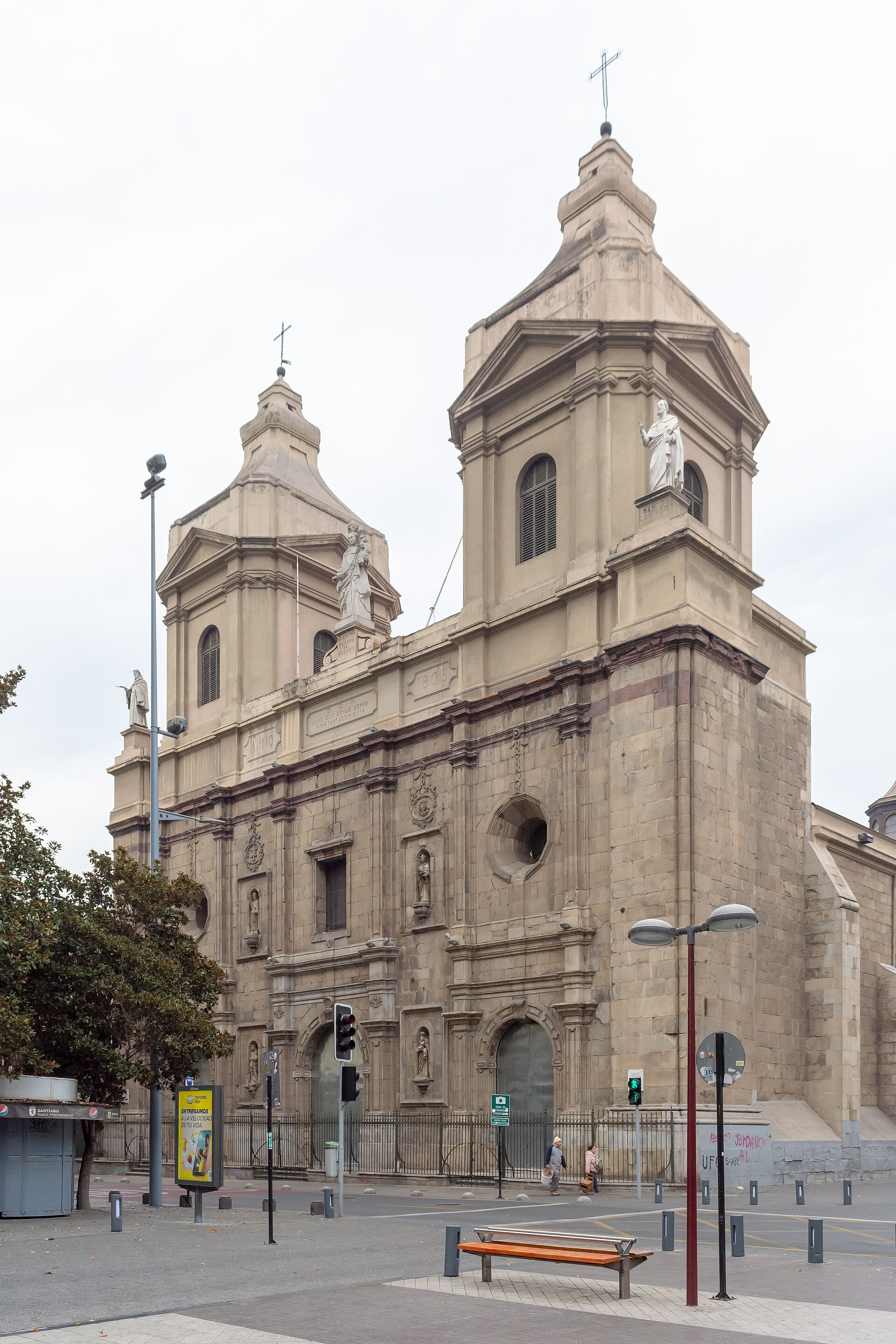
This church doesn’t demand attention but stays with you after you leave. It sits at the corner of Alameda and Bandera, in the center of the city, a quiet spot amid Santiago’s constant motion. Outside, the streets hum with life; inside, the walls hold centuries of history tied to the Dominican Order, one of Chile’s oldest.
Construction started in the mid-18th century, when Santiago was still a small colonial town. Joaquín Toesca, the Italian architect behind La Moneda, designed it. But progress was slow—money ran short, and earthquakes kept interrupting. By the 19th century, when it finally stood complete, the original Baroque plan had mixed with neoclassical details.
The building shows its age. The façade, with its symmetrical towers, looks European. Inside, the space feels Latin American. High ceilings, faded frescoes, and stained glass turn sunlight golden. The main altar, gilded and ornate, stands out against the simpler walls, a sign of the devotion behind it.
Santo Domingo has seen Chile’s history unfold. It held services for independence and sheltered the wounded during civil conflicts. Earthquakes have damaged it, but each time, it’s been repaired, keeping its original character. Today, it’s still a place of worship, drawing both the faithful and those curious about the past.
Inside, you’ll find the statue of Our Lady of the Rosary, the patroness of the Dominican Order and one of Chile’s most revered figures. Her feast day brings thousands of pilgrims. The church also holds colonial paintings and sculptures—some from Europe, some made locally—each with its own story.
What stands out is the quiet. Unlike tourist sites, it doesn’t feel crowded, even on feast days. Maybe because it’s not on most itineraries, the people who come are looking for something different. On weekdays, you might see a priest preparing for mass and a few worshippers praying, the silence broken only by footsteps.
The small park outside offers shade and a place to sit. Nearby, old mansions once belonging to Chile’s aristocracy line the streets, their faded elegance adding to the sense that this part of Santiago moves slowly.
Visiting isn’t just about the architecture. There are no guided tours or crowds, just the weight of history in the stones and the light on the murals. If you want to see Chile’s colonial past, this church is a place to start.