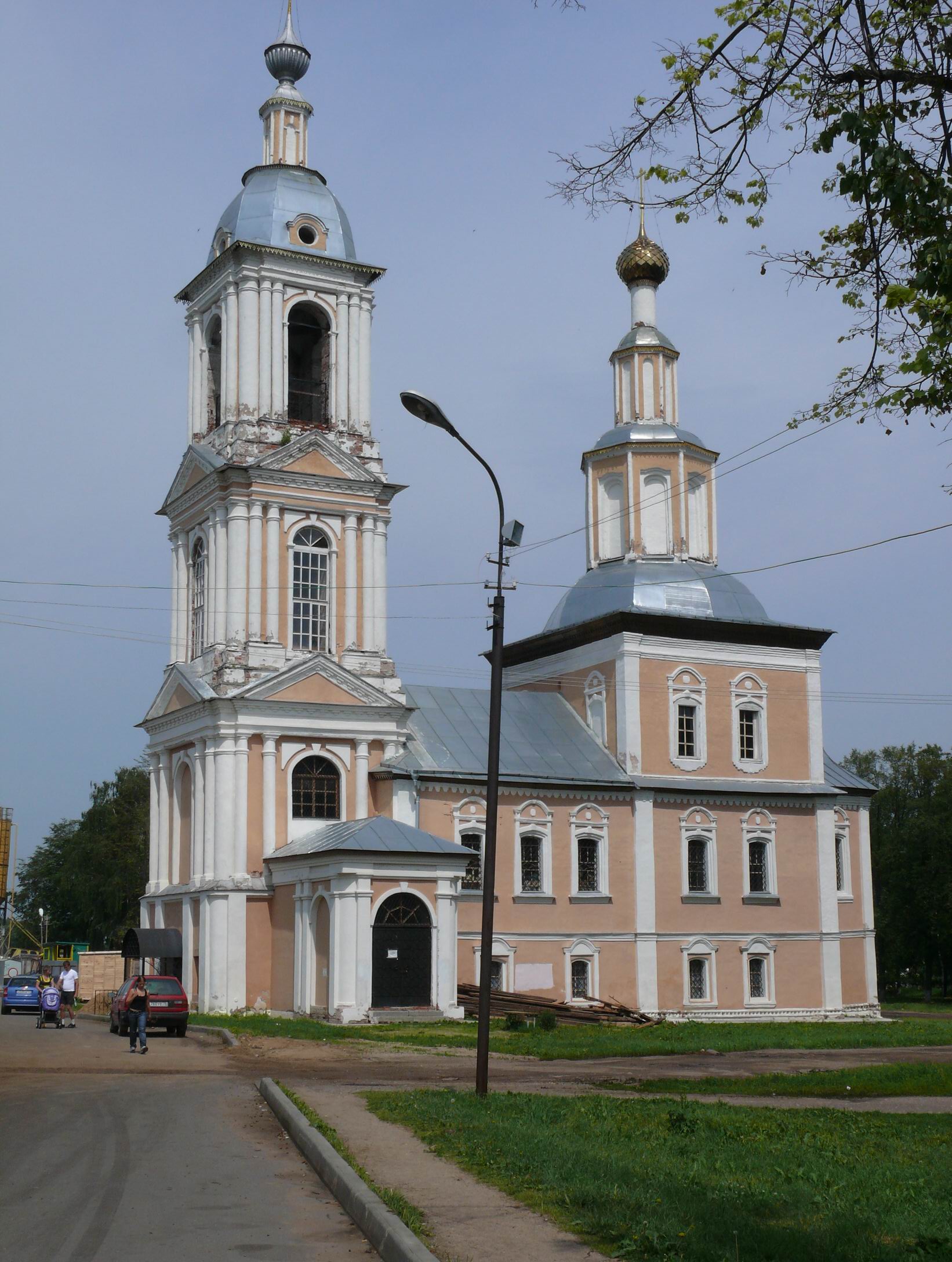
The Church of the Kazan Icon of the Mother of God in Uglich is one of those rare places that seem frozen in time, preserving the quiet dignity of Russia’s provincial past. Built in the early 18th century, it stands on the banks of the Volga, a silent witness to an era when Uglich was more than just a dot on the map—it was a vital spiritual and commercial hub. Back then, the city thrived with merchants bringing goods from distant lands, pilgrims seeking local shrines, and the river serving as the main artery connecting northern and southern Russia. The church was funded by its parishioners, and its architecture reflects the spirit of the age: restrained yet elegant, with the subtle grace of Russian Baroque.
The building itself is modest in scale, its white-stone walls and understated decoration designed more for prayer than for spectacle. The facades are adorned with simple window frames, and the structure is crowned by an octagonal drum topped with a traditional onion dome. Inside, the space is small but bright, with low vaults that create an intimate, protective atmosphere. The iconostasis, though no longer in its original state, still bears traces of its former splendor—carved patterns, gilding, and icons painted in the old style.
The church’s bell tower, though not particularly tall, is well-proportioned, with an open belfry that once carried the call to prayer across the city. In the 18th century, the sound of bells wasn’t just a religious signal—it marked the rhythm of daily life, warning of fires, invasions, or celebrations. Uglich’s bells were said to ring with exceptional clarity, their echoes carrying across the Volga. Today, the tower stands empty, but on a windy day, it’s easy to imagine the faint resonance of its long-silent voices.
This church is deeply tied to Uglich’s history, a city that has known both triumph and tragedy. It was here, on the banks of the Volga in 1591, that Tsarevich Dmitry, the youngest son of Ivan the Terrible, met his death—a turning point that plunged Russia into the Time of Troubles. Uglich struggled to recover, but faith helped its people endure. The church, built later, became a symbol of revival, not just for the city’s spirit but for its very survival. Within its walls, icons believed to hold miraculous power were kept, and parishioners gathered to pray for peace and prosperity.
Like many churches, it suffered during the Soviet era. It was repurposed as a warehouse, then a workshop. Icons vanished, frescoes faded, and the bells were removed. For a time, it seemed the church had lost its purpose forever. But in the 1990s, it was returned to the faithful, and a slow restoration began. Today, it remains an active place of worship, though far simpler than in its heyday. Inside, the scent of wax and incense lingers, the walls are adorned with new frescoes, and oil lamps flicker softly in the corners. On Sundays, locals gather—older parishioners, but also young families—coming to pray or simply to stand in silence.
Uglich is a city where history lingers in every corner, and the Church of the Kazan Icon is one of those places where the past feels tangible. Unlike the more famous Uglich Kremlin or the Church of Dmitry on the Blood, it doesn’t draw crowds of tourists. That’s part of its charm. There’s no hustle, no pushy guides, no souvenir stalls—just the river, old houses, the distant chime of bells, and the sense that time moves differently here. You can visit at dawn, when mist still clings to the Volga, and watch the first light touch the church’s white walls, or stay until evening, when the sunset bathes everything in gold.
This isn’t just an architectural monument—it’s a living place, where prayers and memories still resonate. It doesn’t shout its history, but if you listen closely, you can hear the whispers of the past: the voices of merchants, the weeping of women, the pealing of bells that once announced joy or sorrow. There’s nothing ostentatious about it, which is precisely why it matters to those who know it. It’s a place to pause, to breathe, to feel a connection with those who walked these streets centuries ago. And perhaps that’s why people keep returning—not for grand experiences, but for the quiet and peace that are so hard to find these days.