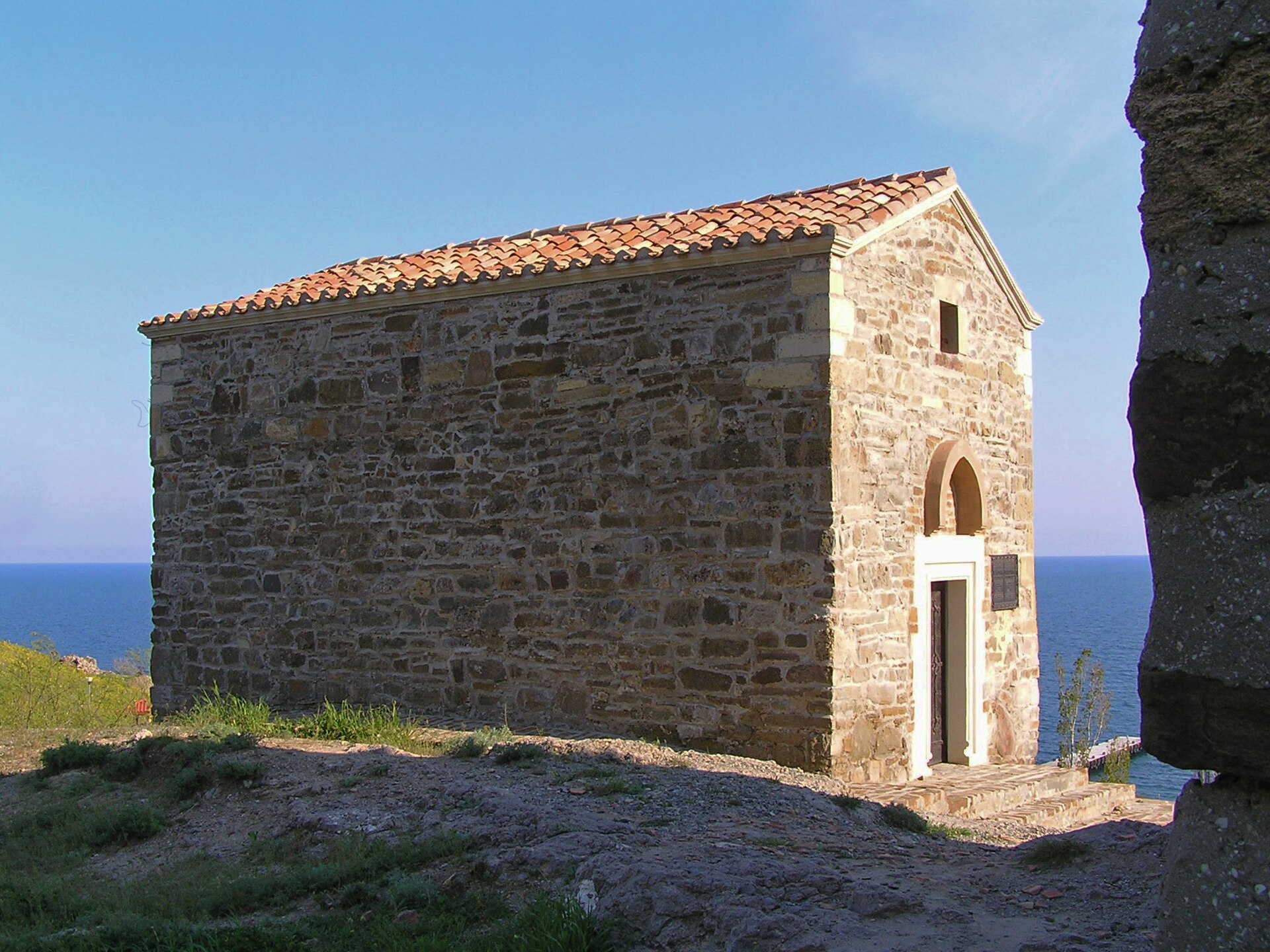
Photo: Denis Vitchenko, CC BY-SA 3.0
Church of the Twelve Apostles
out of 5 0 ratingsPerched on a gentle hill overlooking Sudak and the shimmering Black Sea, the Church of the Twelve Apostles feels like a quiet guardian of time. Its unassuming stone walls, worn smooth by centuries, don’t demand attention the way grand cathedrals do. Instead, they invite you to step closer, to notice the way the light catches the rough edges of the masonry or how the sea breeze carries the scent of salt and wild herbs through the narrow arched windows. This isn’t a place built to impress; it’s a place that has simply endured, bearing the marks of those who once gathered here in prayer—Genoese merchants, Orthodox worshippers, and generations of locals who found solace within its modest walls.
Sudak, known in medieval times as Soldaia, was a crossroads of trade and culture, and the church stands as one of the few tangible links to its Genoese past. When the Italian city-state established its Black Sea colonies in the 13th century, it brought more than just commerce—it brought its faith, its architecture, and its way of blending into the landscape rather than dominating it. The Church of the Twelve Apostles likely dates to the 14th century, though its exact origins remain a subject of debate. What’s certain is that it was never meant to be a showpiece. Its purpose was practical: a place for the Catholic community to worship, a marker of Genoese presence in a region where Orthodox, Muslim, and Latin traditions intersected. The building’s simplicity reflects that era—no soaring vaults or ornate carvings, just a sturdy, functional space where people could seek refuge from the uncertainties of life in a frontier outpost.
The architecture is classic Genoese Crimea: a small rectangular structure with a semicircular apse, built from local limestone that has weathered to a soft, golden hue. The facade is plain, almost austere, with none of the decorative flourishes that later became fashionable in church design. The windows are narrow, designed more for defense than for beauty, and the entrance is framed by a simple arched portal. Inside, the space is even more restrained. The walls are bare, the vaults supported by unadorned arches, and the only light comes from those slender windows, casting long, shifting patterns across the stone floor. There’s a sense of stillness here, as if the building itself is holding its breath, waiting for the next person to step inside and break the silence.
When the Genoese lost control of their Crimean colonies in the late 15th century, the church didn’t fall into ruin—it simply changed hands. Orthodox Christians took it over, and over the centuries, it became a part of the local fabric, adapting to the rhythms of the community. It weathered neglect and revival, serving as a place of worship through Ottoman rule, Russian annexation, and the turbulent 20th century. In the 1800s, when Crimea became part of the Russian Empire, the church underwent restoration, but the work was done carefully, preserving its original character. A small bell tower was added then, a slender structure that still rises above the surrounding houses, its chime drifting over the rooftops on quiet evenings.
Today, the Church of the Twelve Apostles is one of those rare places that feels untouched by the rush of modern tourism. It doesn’t have the crowds of Livadia Palace or the dramatic cliffs of Kara-Dag, and that’s precisely what makes it special. Visitors who wander here often do so by accident, stumbling upon it while exploring Sudak’s backstreets or following the scent of blooming jasmine from the nearby gardens. Inside, the air is cool and slightly damp, carrying the faintest hint of incense and old wood. The light filters in softly, illuminating the icons on the walls—some ancient, some newer, all bearing the quiet devotion of those who left them behind. There’s no grand narrative here, no sweeping historical drama—just the sense that this place has always been, and always will be, a refuge.
The church is surrounded by a small courtyard, where gnarled trees provide shade and flowerbeds burst with color in the warmer months. Locals sometimes sit on the benches, chatting or enjoying the breeze that carries the sound of waves from the shore. Tourists who find their way here often linger, struck by the contrast between the church’s humble appearance and the depth of history it contains. It’s not a place that tries to be anything more than it is—a small, enduring fragment of the past, standing quietly amid the changing tides of time.
In recent years, efforts have been made to preserve the church, with restorations carried out carefully to avoid altering its character. Occasionally, it hosts small concerts of sacred music or exhibitions on Sudak’s history, but these events are rare and understated. Mostly, it remains a place of quiet reflection, where the only sounds are the rustling of leaves, the distant cry of seagulls, and the occasional murmur of visitors. There’s no need for grand gestures here; the building speaks for itself, its stones whispering stories of the people who built it, prayed in it, and kept it alive through centuries of change.
What makes the Church of the Twelve Apostles truly remarkable is how seamlessly it weaves together different layers of history. The Genoese foundation, the Orthodox additions, the subtle Russian influences—all coexist without clashing, creating a sense of continuity rather than conflict. The limestone walls bear the marks of countless hands, the icons tell stories in multiple languages, and the courtyard feels like a bridge between the past and present. It’s a place where you can sit for a while and imagine the voices that once filled the air—Latin hymns sung by Genoese sailors, Orthodox chants echoing through the nave, the quiet conversations of locals who have come here for generations to light a candle or say a prayer.
If you visit Sudak, it’s worth seeking out this unassuming church, not for the sake of ticking off another landmark, but for the chance to step into a space where time moves differently. There’s no fanfare here, no grand revelations—just the quiet assurance that some places are meant to endure, not as monuments to the past, but as living threads in the fabric of the present. The Church of the Twelve Apostles doesn’t need to shout its history; it’s enough that it’s still here, waiting for those who are willing to listen.
Day around this place
Where else to go on the same day
Building the day…
Where it is
44.84002, 34.95349