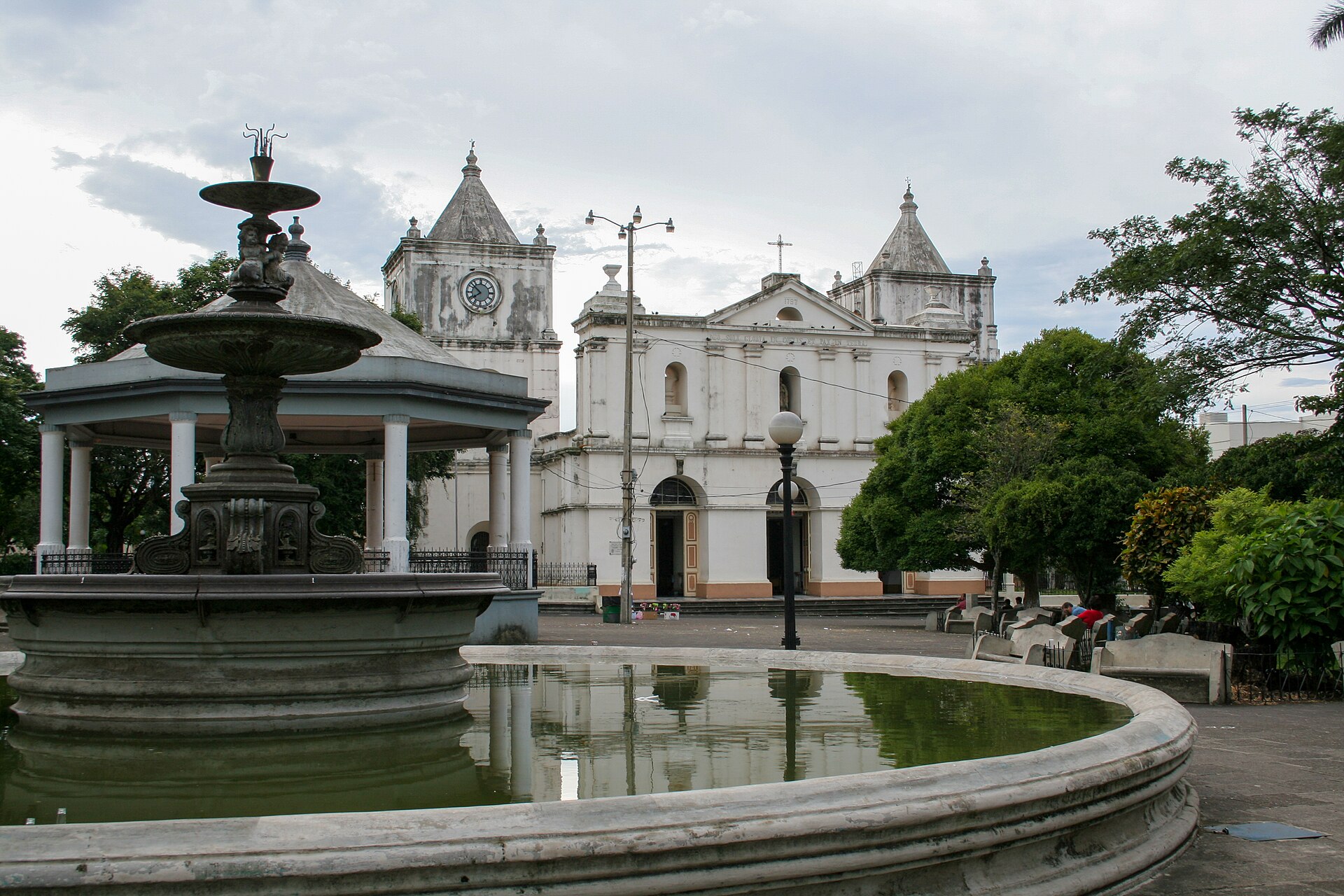
Heredia’s Central Park is one of those places where the city’s past and present quietly overlap, a square that has seen generations come and go without ever losing its rhythm. Unlike the grand plazas of San José or the tourist-heavy parks of the coast, this one feels lived-in, almost unassuming in its role as the heart of a provincial capital. The park sits at the intersection of Avenida Central and Calle Central, framed by low-slung buildings that have stood here for over a century. It’s not the kind of place you’d travel across the country to see, but if you find yourself in Heredia, it’s where you’ll end up sooner or later—whether to wait for a bus, meet a friend, or simply watch the day unfold.
The park’s layout is simple, almost symmetrical, with wide walkways converging at a central gazebo. That gazebo, a white wooden structure with a peaked roof, is the park’s most recognizable feature, though it’s not the original. The first one was built in the late 19th century, when Heredia was still a small agricultural town known for its coffee fincas. Back then, the park was little more than a dusty square where farmers and merchants gathered to trade goods and gossip. The current version dates to the 1920s, a time when the city was modernizing but still clung to its colonial roots. It’s been repaired and repainted over the years, but the design remains largely unchanged—a nod to an era when public spaces were built to last.
Surrounding the park are some of Heredia’s oldest and most important buildings. On the north side stands the Basilica of the Immaculate Conception, a neoclassical church with a pale yellow facade and twin bell towers. It was completed in 1879, replacing an earlier adobe structure that had been damaged by earthquakes. The basilica’s interior is surprisingly bright, with white walls and simple wooden pews, a contrast to the more ornate churches you’ll find in other parts of the country. Across the street, the old city hall, now home to the municipal government, occupies a stately two-story building with arched windows and a red-tiled roof. It’s not open to the public, but the architecture alone tells a story of Heredia’s evolution from a sleepy town to a regional hub.
The park itself is shaded by tall, broad-canopied trees, many of them planted in the early 20th century. The most striking are the ceibas, their thick trunks and sprawling branches providing shelter from the sun. In the dry season, their leaves turn a muted gold, while in the rainy months, the ground beneath them becomes a patchwork of fallen blossoms. Benches line the walkways, some occupied by elderly men playing dominoes, others by students scrolling through their phones. On weekends, vendors set up stalls selling coconut water, empanadas, and fresh fruit, their voices blending with the hum of passing cars and the occasional church bell.
Heredia doesn’t have the same tourist infrastructure as other Costa Rican cities, and that’s part of the park’s charm. There are no guided tours here, no plaques explaining the history of every tree or bench. Instead, the park’s significance is woven into the daily life of the city. It’s where schoolchildren gather after class, where couples stroll in the evenings, where old men argue about soccer under the gazebo. The rhythms are slow, unhurried—the kind of place where time seems to stretch just a little longer than it does elsewhere.
That’s not to say the park is stuck in the past. Heredia has grown around it, and the square now sits at the edge of a bustling commercial district. The streets leading away from the park are lined with small shops, cafes, and offices, their signs advertising everything from cell phone repairs to legal services. Yet even as the city modernizes, the park remains a constant, a place where the old and the new coexist without much fuss. The basilica still holds mass every Sunday, the gazebo still hosts the occasional concert or political rally, and the trees still drop their leaves onto the same benches where people have sat for decades.
If you visit, don’t expect anything grand or dramatic. There are no sweeping views, no Instagram-worthy backdrops—just a quiet square where life unfolds in small, unremarkable moments. The best time to come is in the late afternoon, when the light softens and the heat of the day begins to fade. Find a bench under one of the ceibas, order a *casado* from a nearby *soda*, and watch the city go by. You might see a group of teenagers practicing dance moves near the gazebo, or a street musician tuning his guitar. You might hear the distant roar of a soccer match from the stadium a few blocks away, or the clatter of dishes from a family-run restaurant.
Heredia’s Central Park isn’t the kind of place that makes it onto postcards, but that’s precisely why it feels real. It’s a reminder that even in a country known for its natural wonders, some of the most interesting places are the ones where people simply live their lives. The park doesn’t ask for much—just that you pause for a moment, take in the details, and let the city reveal itself in its own time. And if you do, you might leave with a sense of Heredia that goes beyond the guidebooks, a place where history isn’t just preserved in buildings but lived out in the everyday.