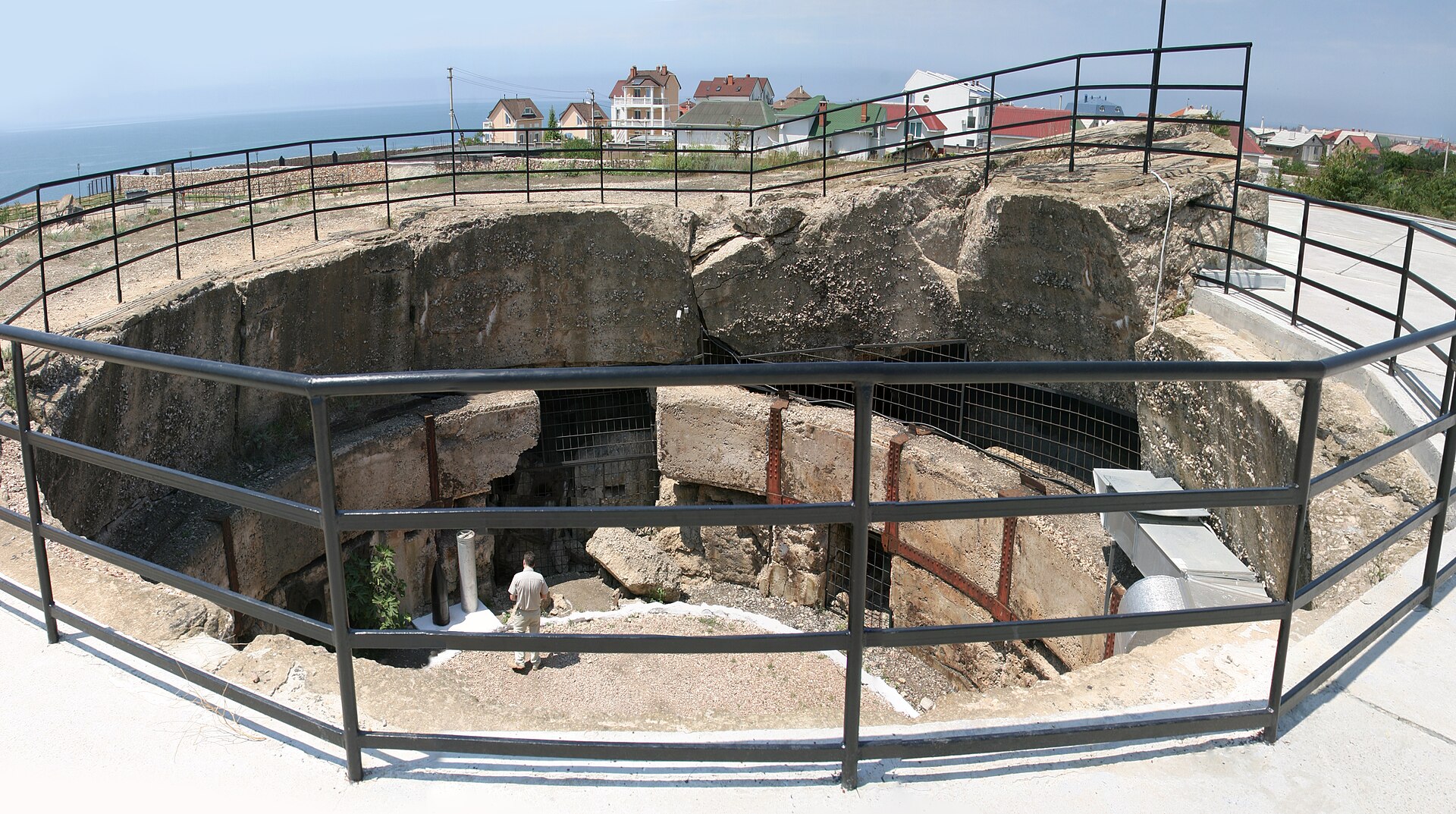
Fortress Battery 35 stands on the edge of Sevastopol, where the past isn’t just remembered—it lingers in the salt air and the weight of the stones beneath your feet. Built in the late 19th century as part of the Black Sea Fleet’s coastal defenses, it was positioned on Cape Chersonese, a strategic point overlooking the sea and the approaches to the city. The location wasn’t chosen by accident; this was where the empire’s military engineers could watch for threats on the horizon, where the land juts into the water like a sentinel. Today, the battery feels like a relic of another era, its thick walls pockmarked by time, its rusted mechanisms still hinting at the power they once wielded.
The two armored turrets were engineering marvels of their day, each weighing close to a thousand tons. They housed 305-millimeter guns, capable of firing shells that could reach targets miles away. Inside, the narrow corridors twist and turn, leading to chambers where the original aiming mechanisms, ventilation systems, and even fragments of early electrical wiring remain. It’s rare to find such well-preserved industrial details from this period, and walking through them feels like stepping into a time capsule. The air is damp, the light dim, and the silence is broken only by the distant crash of waves against the shore. It’s easy to imagine the clatter of boots during drills, the shouts of orders, the tension of a battle alert.
When Battery 35 was constructed, it represented the cutting edge of military technology. The Russian Empire spared no expense, equipping it with hydraulic systems, electric drives, and armored plates designed to withstand direct hits from heavy artillery. By the early 20th century, however, the rapid pace of military innovation had already begun to outstrip its capabilities. The battery was still a formidable presence during World War I, but its role in coastal defense was gradually diminishing. By the time the Great Patriotic War began, it was a relic of an earlier age, though one that would soon prove its worth in ways its builders never anticipated.
The battery’s final chapter was written in the summer of 1942, during the brutal siege of Sevastopol. As German forces closed in, Battery 35 became one of the last lines of defense. For days, its guns fired relentlessly, even as the city fell around it. The crew fought until their ammunition ran out, until there was nothing left to do but hold the position. When the end came, it was quiet—no grand surrender, no retreat, just the silence of a battle finally lost. The ruins still bear the scars of that time, though the sea and the wind have softened them over the decades.
After the war, the battery was left to decay. Nature and neglect took their toll, eroding the concrete and rusting the metal. It wasn’t until the 2000s that efforts were made to stabilize the structure, though much of it remains as it was—raw, unpolished, and unmistakably real. There are no glossy exhibits here, no interactive displays or guided tours. What you find instead is something far more powerful: the unfiltered weight of history. The walls are bare, the floors uneven, and the only narration comes from the wind whistling through the empty corridors and the occasional cry of a gull overhead.
The graffiti left by soldiers is still visible in some of the chambers—names, dates, short messages scratched into the concrete. Some are barely legible, worn away by time, but others stand out with a stark clarity. They’re simple, unadorned, the kind of marks people leave when they know they might not return. There’s no grand poetry in them, just the quiet, human impulse to be remembered. It’s these small details that make the battery feel alive, as if the past isn’t just preserved here but still breathing.
Cape Chersonese has always been a crossroads of history. Long before the battery was built, it was home to the ancient Greek colony of Chersonesus, a city that thrived for centuries before fading into ruin. The layers of the past are visible everywhere—beneath the battery’s foundations lie remnants of antiquity, while the land around it bears the scars of 20th-century warfare. Standing here, it’s impossible not to feel the weight of time, the way history stacks upon itself, each era leaving its mark before giving way to the next.
Visiting Battery 35 isn’t like touring a museum. There’s no prescribed path, no scripted experience. You wander at your own pace, exploring the abandoned chambers, climbing into the turrets, and peering out at the sea through the same gun ports that once scanned the horizon for enemy ships. On clear days, the view stretches to the Chersonesus Lighthouse and the curve of the bay, a scene that hasn’t changed much in a century. On stormy days, the wind howls through the corridors, and the waves crash against the cliffs below, a reminder of the relentless passage of time.
This place is a memorial, though not in the way most are. There are no polished plaques or manicured gardens, no solemn ceremonies held here. Instead, the battery stands as it always has—unadorned, unyielding, a silent witness to the events that shaped it. It’s easy to picture the final days of 1942, the smoke hanging in the air, the distant sound of gunfire, the men who knew they were fighting a losing battle but refused to stop. The battery doesn’t romanticize war or glorify sacrifice. It simply endures, a testament to the past in all its complexity. And perhaps that’s why it feels so alive—because history isn’t just something that happened here. It’s something that still lingers, waiting to be discovered by those who take the time to look.