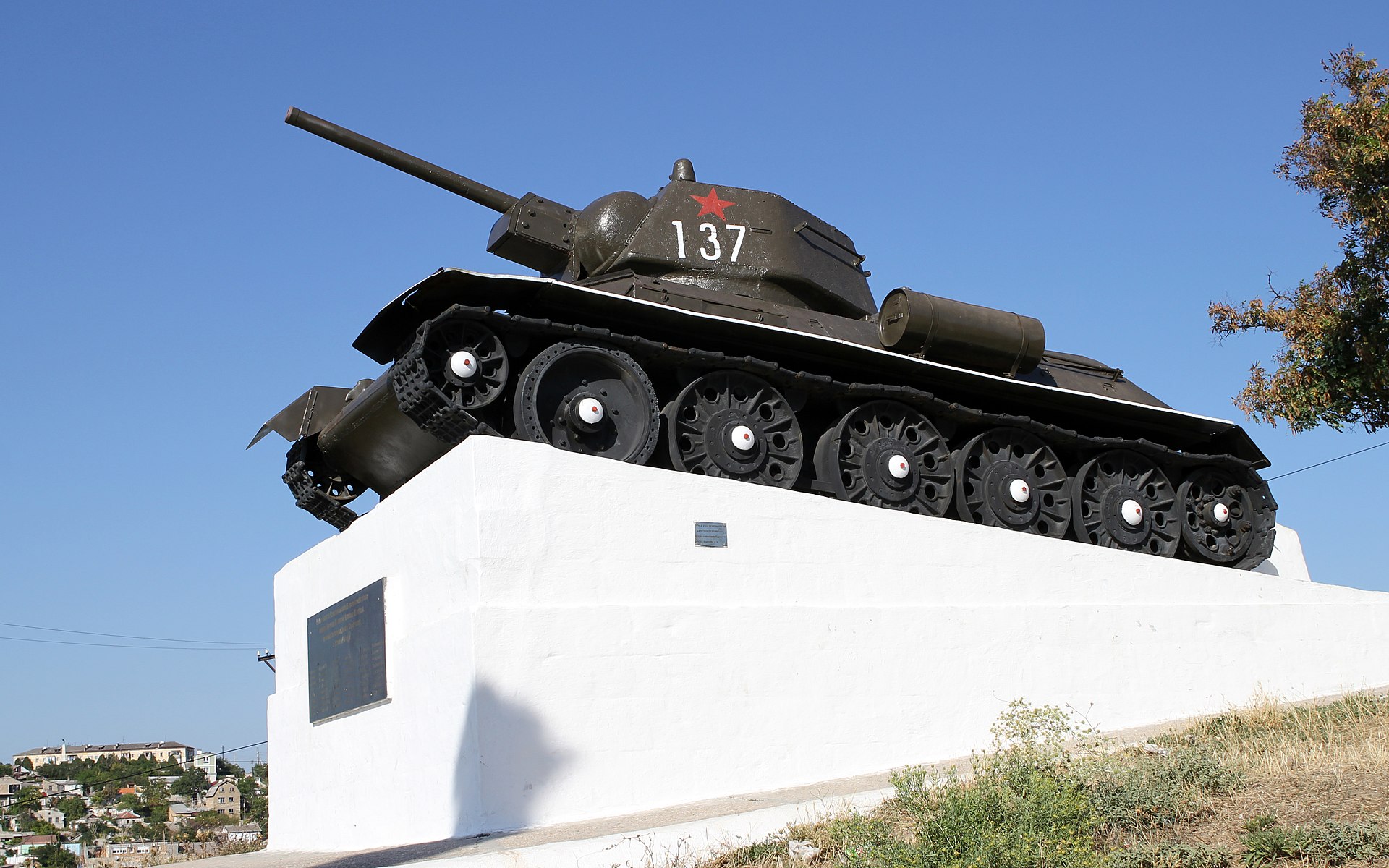
The Tank Crews' Brotherhood Grave in Sevastopol is a quiet corner where the weight of history feels tangible. Tucked away on the city’s outskirts, it marks the spot where fierce battles raged in May 1944 as Soviet forces fought to reclaim Crimea from German occupation. This isn’t a grand monument, but its significance runs deep—here lie the crews of tanks that never made it through the final days of the city’s defense. Their sacrifice, like so many others, became part of Sevastopol’s story, a reminder of the courage that shaped its past.
The memorial itself is unassuming yet striking. At its center stands a T-34 tank, mounted on a low pedestal as if frozen mid-battle. This machine, an icon of Soviet armor, was one of the war’s most effective weapons, and its presence here isn’t just symbolic—it’s a direct link to the men who operated it under fire. The tank’s weathered hull and rusted tracks tell their own story, one of relentless combat and the harsh realities of war. Flanking it are granite slabs etched with names, though many remain blank, a silent acknowledgment of the unknown soldiers who fell alongside their comrades.
The events of spring 1944 were pivotal for Sevastopol. After nearly two years under occupation, the city became the focus of a massive Soviet offensive. The tank crews buried here were part of that push, tasked with breaking through heavily fortified German lines. Their mission was brutal: navigate minefields, endure relentless artillery and airstrikes, and press forward against entrenched defenses. Many didn’t survive the assault, but their efforts helped turn the tide, paving the way for the city’s liberation. The battles here were chaotic, close-quarters affairs, where every advance came at a cost.
What makes this memorial powerful is its simplicity. There’s no grand architecture or elaborate design—just the tank, the names, and the quiet. The T-34 isn’t a museum piece behind glass; it’s a raw, unfiltered relic of war, evoking the noise, the smoke, and the sheer physical strain of combat. The granite slabs are equally understated, bearing only names and, in some cases, brief inscriptions about the crews’ actions. There’s no need for embellishment. The facts speak for themselves: these were young men, many barely out of their teens, who fought and died in a place that would later bear their memory.
The atmosphere here is different from larger war memorials. There are no crowds, no formal ceremonies—just a sense of stillness that invites reflection. In summer, the trees around the site bloom, and in winter, snow dusts the tank’s turret, but the place never loses its solemnity. Visitors often leave flowers, especially on Victory Day or the anniversary of Sevastopol’s liberation. Sometimes you’ll see school groups, their teachers pointing out the names, or soldiers in uniform pausing to pay their respects. The memorial doesn’t demand attention; it earns it through its quiet dignity.
Sevastopol is a city steeped in military history, and this site is just one of many where the past feels immediate. But there’s something particularly poignant about the Tank Crews' Brotherhood Grave. Perhaps it’s the youth of those buried here—many were in their twenties, their lives cut short on the outskirts of a city they were trying to save. Their stories are fragments of a larger narrative, one that’s easy to reduce to dates and strategies but far harder to grasp in human terms. This memorial bridges that gap, reminding visitors that war isn’t just about maps and maneuvers; it’s about people.
Over time, the physical traces of war fade, but places like this keep the memory alive. They serve as a connection between generations, a reminder that peace and freedom come at a price. For Sevastopol, that lesson is especially resonant. The city has repeatedly found itself on the front lines, its history defined by resilience and sacrifice. The memorial doesn’t need grand speeches or elaborate explanations. It stands as a testament to those who fought, and its message is clear without words.
There are no signs pointing the way here, no tourist plaques with detailed histories. The memorial doesn’t seek visitors—it simply exists, as it has for decades, a fixed point in a changing city. Around it, Sevastopol grows and evolves, but this place remains untouched by time. It’s a quiet counterpoint to the noise of modern life, a space where the past isn’t just remembered but felt. History, after all, isn’t just about events; it’s about the people who lived through them, and the places that keep their memory alive.