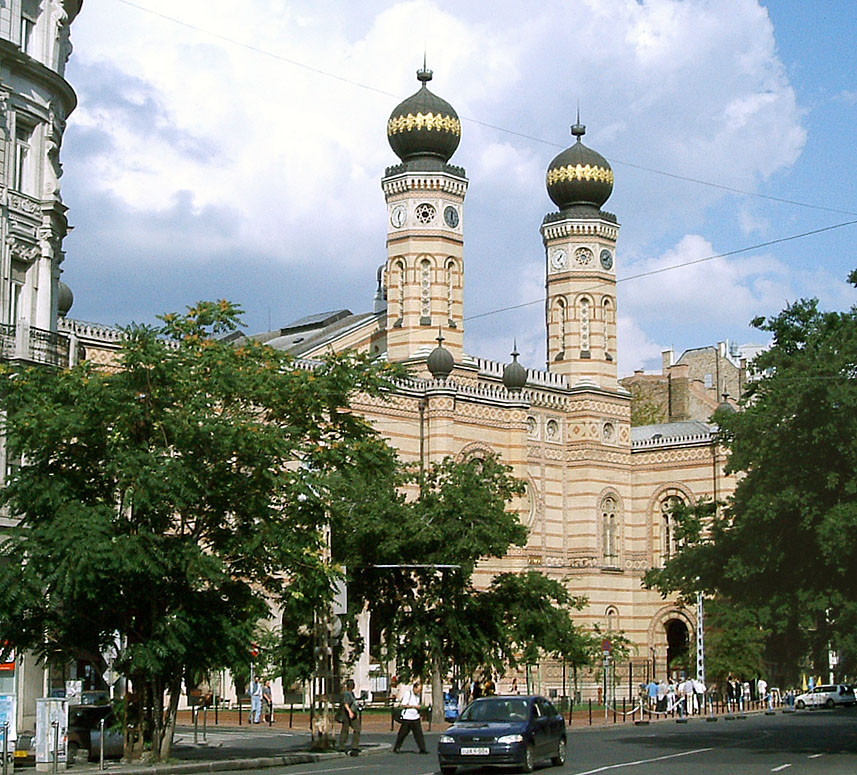
The Dohány Street Synagogue stands as one of Budapest’s most striking landmarks, a place where history, architecture, and human resilience converge. It isn’t just a house of worship but a monument to the Jewish community’s enduring presence in Hungary, a testament to both triumph and tragedy. Built in the mid-19th century, it remains the largest synagogue in Europe and the second-largest in the world, its grandeur leaving an impression even on those who don’t share its faith.
Budapest was flourishing when the synagogue took shape, a city eager to assert itself as a cultural capital. The design came from Ludwig Förster, a German architect who won a competition for the project. Construction began in 1854 and lasted five years. Förster chose a Moorish-Byzantine style, drawing inspiration from the Alhambra and medieval Spanish synagogues. This wasn’t just an aesthetic choice—it was a nod to the golden age of Jewish culture on the Iberian Peninsula, when Muslim, Christian, and Jewish traditions coexisted, however briefly, in relative harmony.
The exterior is impossible to ignore. The facade’s red-and-white striped brickwork gives it a distinctive, almost rhythmic pattern, while the twin towers capped with domes echo the forms of minarets. The central entrance is framed by three arches, above which a vast circular window glows with stained glass. Inside, the scale is even more overwhelming. The main hall can hold up to three thousand people, its vaulted ceilings supported by iron columns painted to resemble marble. The organ, installed in 1859, was one of the largest in Hungary at the time. Its presence sparked debate among Orthodox Jews, who traditionally avoided instrumental music in synagogues, but over time it became an integral part of services.
The synagogue’s history is inseparable from the horrors of the 20th century. During World War II, Budapest was one of the last strongholds of Nazi occupation in Europe, and its Jewish community suffered immensely. The synagogue found itself at the heart of the ghetto, where thousands endured appalling conditions. After the war, the building fell into disrepair, its significance fading until a major restoration in the 1990s brought it back to life. Today, it serves not only as a place of worship but as a venue for concerts, exhibitions, and memorial events, bridging the past and present.
Adjacent to the synagogue, the Jewish Museum offers a deeper look into the community’s history. Its collections include religious artifacts, documents, and photographs that trace the Jewish experience in Hungary across centuries. A particularly moving section is dedicated to the Holocaust, a stark reminder of the lives lost. Nearby, the Raoul Wallenberg Memorial honors the Swedish diplomat who saved thousands of Jews from deportation. His story stands as a rare beacon of courage in an otherwise dark chapter.
Behind the synagogue, a quiet garden serves as a memorial to Holocaust victims. At its center stands a metal weeping willow, its leaves inscribed with the names of the dead. The space is solemn, inviting reflection. Beside it lies a mass grave for those who perished in the ghetto from hunger and disease. Each year, memorial ceremonies draw people of all backgrounds, a shared moment of remembrance.
More than just a monument, the Dohány Street Synagogue is a living cultural hub. Classical and Jewish music concerts fill its halls, while lectures and guided tours offer insights into its history and architecture. Visitors can explore its ornate interior year-round, from the intricately carved wooden pews to the gilded chandeliers and mosaic floors. The Aron Kodesh, the ark holding the Torah scrolls, is especially striking, adorned with stained glass and delicate woodwork.
This is a place where different eras and stories intersect. It reminds us of the importance of preserving memory, even when that memory is painful. The synagogue’s walls have witnessed both celebration and sorrow, its architecture a silent witness to the lives that have passed through its doors. For Budapest, it’s more than just a landmark—it’s a piece of the city’s soul, a reflection of its complex and layered history. To visit is to step into that history, to walk through halls that have seen joy and despair, and to pause in the garden where the past lingers, waiting to be acknowledged.