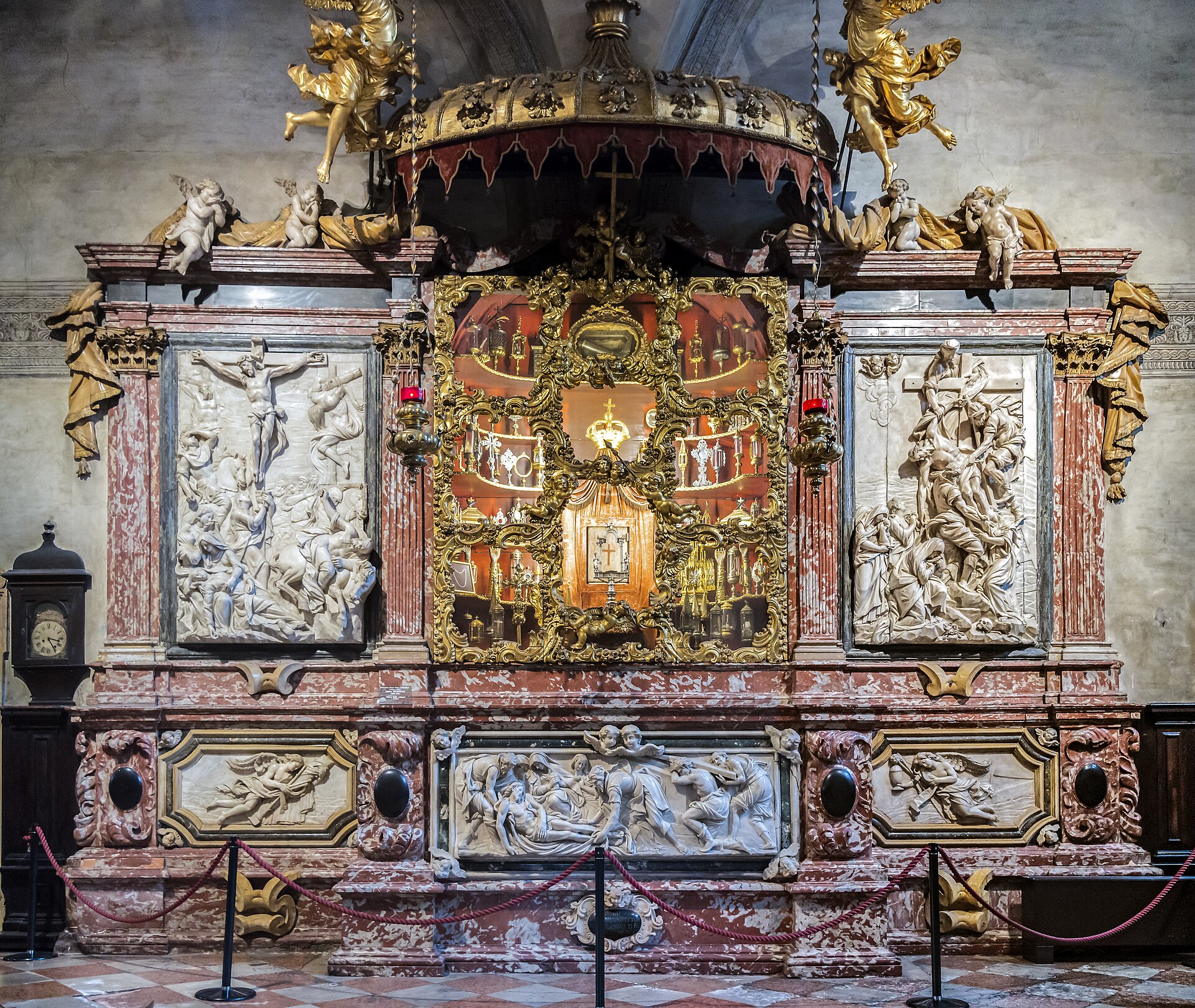
Santa Maria Gloriosa dei Frari stands apart in Venice, not for its grandeur or the crowds it draws, but for the quiet way it holds time within its walls. Unlike the dazzling Basilica of San Marco, which commands attention with its golden mosaics and ceaseless tourist bustle, the Frari offers something far more subtle—a place where the weight of centuries lingers in the cool air, where footsteps echo softly against stone floors, and where the stories of Venice unfold without fanfare. This is not just a church; it is a repository of the city’s soul, where art, history, and faith intertwine in a way that feels both intimate and vast.
The origins of the Frari trace back to the early 13th century, when Franciscan monks settled in Venice and were granted land in the San Polo district. Their first church was modest, little more than a wooden structure, but by the 14th century, it became clear that neither the growing influence of the Franciscan order nor the ambitions of the Venetian Republic could be contained within such humble walls. Construction of the present basilica began in 1338 and stretched over nearly a century, finally completed in 1442. The result is a building that bridges two architectural eras: the soaring Gothic lines of its early design give way to the more measured, Renaissance-influenced proportions of its later additions. The facade, with its pointed windows and rounded arches, reflects this evolution, while the sturdy buttresses lend the structure a sense of permanence, as if anchoring Venice itself against the passage of time.
Step inside, and the scale of the Frari becomes immediately apparent. It is one of the largest churches in Venice, its vast nave supported by towering columns that create an unusual sense of openness for a Venetian church. Many of the city’s sacred spaces are dense with ornamentation, but here, the simplicity of the architecture allows the eye to wander—up toward the high vaulted ceiling, across the warm glow of stained glass, and along the walls adorned with paintings and frescoes. There is no blinding gold leaf, no overwhelming opulence, just a quiet dignity that invites contemplation. The light filtering through the windows seems to carry the whispers of the past, making the space feel alive with history rather than frozen in it.
The Frari’s art collection is one of its greatest treasures, and among its masterpieces, Titian’s *Assumption of the Virgin* commands attention. Painted between 1516 and 1518, the altarpiece is a triumph of composition and emotion, its figures arranged in a dynamic ascent that feels almost cinematic. The Virgin Mary, robed in crimson, rises toward heaven, while the apostles below reach upward in awe, their gestures full of urgency. Titian, a native of Venice, is buried in the basilica, his grave marked by a simple stone slab near the entrance. Nearby lies another artistic giant, the sculptor Antonio Canova, whose neoclassical pyramid tomb stands as a stark contrast to the Gothic surroundings. These graves are more than memorials; they are reminders that Venice has long been a city where genius and mortality intersect.
Another remarkable work within the Frari is Donatello’s wooden crucifix, housed in a side chapel near the choir. Less celebrated than his bronze *David* or the *Gattamelata* equestrian statue, this piece reveals a different side of the sculptor’s skill. The figure of Christ, carved with a raw, almost unsettling realism, seems to breathe with suffering rather than merely depict it. The crucifix is set against the backdrop of the basilica’s choir stalls, intricately carved in the 15th century with scenes from the lives of saints and allegories of virtue. The craftsmanship is astonishing, each detail a testament to the patience and devotion of the artisans who created them.
The Frari has always been more than a place of worship; it is a living chronicle of Venetian history. The church served as a burial site for doges, nobles, and artists, its walls adorned with works commissioned by the city’s most powerful families. The Pesaro Chapel, for instance, was funded by the Pesaro dynasty, a family that produced several doges and admirals. Their legacy is etched into the very fabric of the basilica—heraldic crests, epitaphs, and tombs that speak of a time when the church was as much a civic institution as a spiritual one. Even the floor is a mosaic of history, with grave markers bearing the names of those who shaped Venice’s destiny.
Today, the Frari remains an active church, and that continuity is palpable in its atmosphere. Unlike the crowded tourist hotspots of Venice, it offers a respite from the constant hum of visitors. Here, you can wander through the side chapels, pausing to study a fresco or trace the inscription on a tomb, without the pressure of time or the distraction of crowds. Occasionally, the basilica hosts classical music concerts, and when the notes of an organ or a violin fill the air, the space transforms. The music seems to breathe life into the ancient stones, creating a moment where past and present merge seamlessly.
Venice is a city of contrasts—where splendor and decay exist side by side, where beauty is both celebrated and fragile. The Frari embodies this duality, but in a way that feels harmonious rather than jarring. There is no ostentatious display of wealth here, no gilded excess, just a quiet sense of history unfolding at its own pace. It is a place where you can stand beneath the high vaulted ceiling and feel the weight of centuries pressing gently against your shoulders. For those who seek more than postcard views in Venice, the Frari offers something far more profound: a connection to the city’s true essence, where art, faith, and time converge in silence.