The Basilica of Our Lady of Guadalupe is one of Mexico’s most sacred sites, drawing pilgrims from across Latin America and beyond. It isn’t just a church—it’s a spiritual heart tied to one of the country’s defining legends. According to tradition, in 1531, the Virgin Mary appeared to an Indigenous man named Juan Diego on Tepeyac Hill, leaving behind an image on his cloak that remains enshrined here to this day. For millions, this place symbolizes the fusion of Indigenous beliefs and Christianity, a testament to Mexico’s complex identity. For others, it’s a striking historical and architectural landmark, a quiet witness to centuries of faith and upheaval.
The basilica complex is a layered story told through its buildings. The old basilica, completed in the 18th century, now stands modestly among newer structures. Its stone and brick walls, adorned with colonial-era stucco, speak of a time when Spanish missionaries sought to establish their faith on these lands. But the soft earth beneath it has caused the building to sink, and today, metal supports keep it from tilting further. Inside, the air is thick with the scent of wax and old wood, the flicker of candles casting shadows on the worn pews. Whispers of prayers fill the space, a reminder of the generations who have knelt here before.
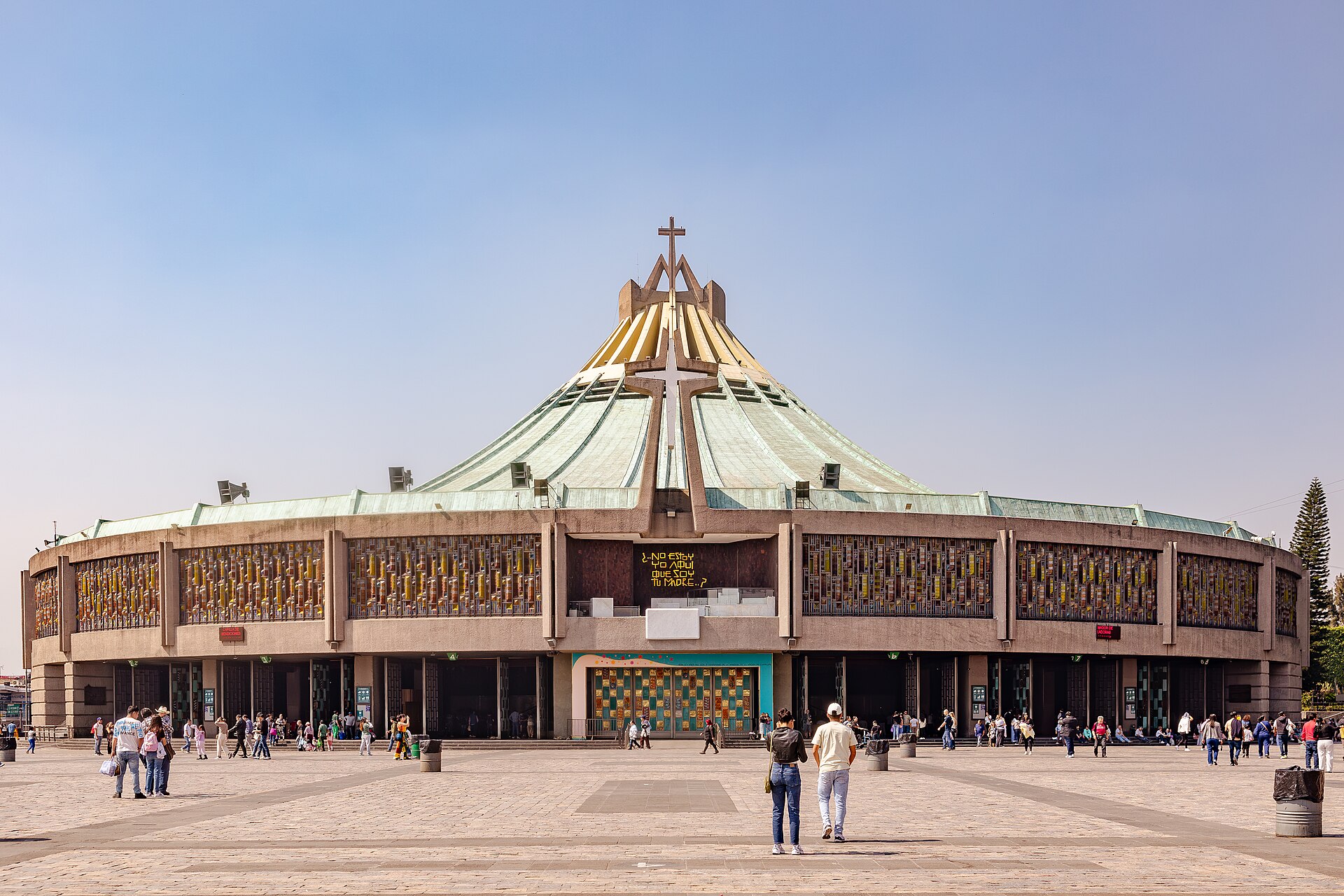
The new basilica, inaugurated in 1976, was designed to hold the vast crowds that gather here. Its circular structure of concrete and glass, conceived by architect Pedro Ramírez Vázquez, breaks from tradition, offering an open, airy space where the altar is visible from every angle. Above it, the image of Our Lady of Guadalupe glows under soft lighting, drawing the eyes of thousands. Some sit in the pews, but many choose to kneel or shuffle forward on their knees, moving in slow circles to get closer to the relic. The sheer scale of the building feels fitting for a place that draws such devotion.
The cloak of Juan Diego, bearing the miraculous image, is the basilica’s most revered treasure. According to legend, the fabric—made from agave fibers—should have disintegrated centuries ago, yet it remains intact. Scientists have offered explanations, but for the faithful, its preservation is nothing short of divine. The cloak is displayed behind glass, and pilgrims linger before it, leaving flowers, handwritten prayers, and lit candles. On December 12th, the feast day of Our Lady of Guadalupe, the line to see it stretches for blocks, a river of people moving patiently toward the shrine.
Nearby, the chapel on Tepeyac Hill marks the spot where the Virgin is said to have appeared. This small, red-roofed building stands where an Aztec temple once honored Tonantzin, the earth goddess. The Spanish destroyed the original structure but couldn’t erase the hill’s sacred significance, so they repurposed it into a Christian site. Today, visitors climb the steep steps or take the funicular to reach it, leaving offerings and taking in the view of Mexico City sprawling below. From this height, the contrast is striking—the ancient hillside overlooking a modern metropolis where skyscrapers stand beside colonial churches.
The atmosphere around the basilica is unlike anywhere else. The scent of burning candles mingles with the aroma of street food—tamales, roasted corn, sweet atole—sold by vendors in the plaza. Families arrive together, carrying children, singing hymns, or praying aloud. Some crawl the last few meters on their knees, their faces set with determination. It’s a scene that reveals why this place holds such power for Mexicans. It’s not just about faith; it’s about history, resilience, and the unbroken thread connecting past and present.
For visitors, the basilica offers more than a glimpse into Mexican Catholicism. It’s a chance to see how faith lives here—vibrant, communal, woven into daily life. Even those who don’t share the beliefs can sense the weight of the place. Maybe it’s the stories embedded in the walls, or the way people from all walks of life gather here, united by something deeper than themselves. The basilica doesn’t demand belief; it simply invites reflection.
More than a church, the Basilica of Our Lady of Guadalupe is a living symbol. It has evolved alongside Mexico, yet remains a constant—a place where history, devotion, and identity converge. For some, it’s a destination of pilgrimage; for others, an architectural marvel or a historical artifact. But for everyone who visits, it offers a moment of stillness, a pause from the noise of the world. In a city of endless motion, it stands as a reminder of what endures.