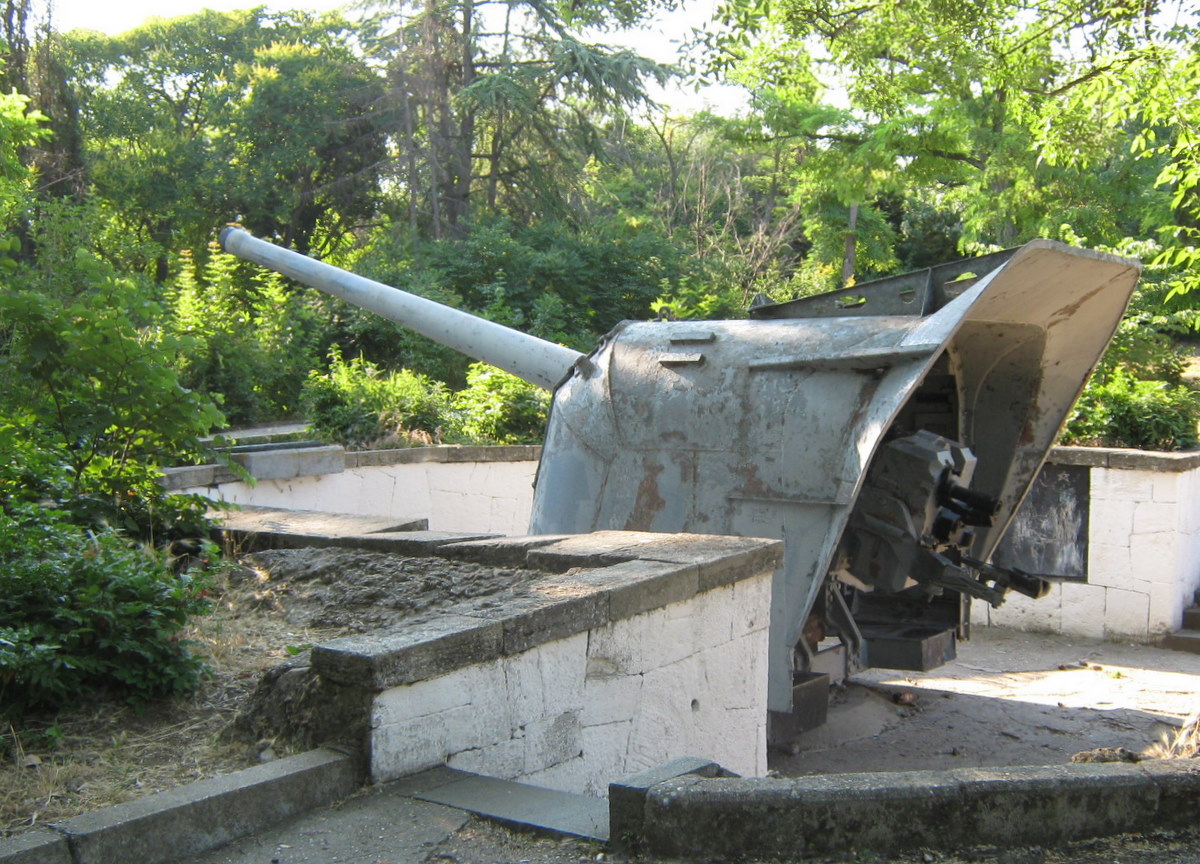
Perched on the northern edge of Sevastopol Bay, Matyukhin Battery is one of those rare places where history doesn’t just linger in books or museums—it presses against your skin. Built in the mid-19th century as part of a sprawling coastal defense network, the battery was designed to turn the bay into a death trap for any fleet foolish enough to challenge Russia’s grip on the Black Sea. Its location wasn’t chosen by accident. From here, the guns could sweep the entire approach to the city, their fire crossing with other fortifications to create an impenetrable barrier. Even now, standing among the weathered stone walls, it’s easy to imagine the tension that must have crackled in the air when the first enemy ships appeared on the horizon.
The architecture is unapologetically utilitarian, every angle and curve shaped by the demands of war. Thick limestone walls, low and squat, absorb the force of the wind and the memory of cannon fire. The embrasures—narrow slits for the guns—are angled precisely to cover the bay, their geometry a silent testament to the calculations of 19th-century military engineers. Inside, the casemates feel like the belly of a ship: dim, cool, and slightly damp, with just enough light filtering through the gun ports to make out the rough-hewn stone. Some of the original gun platforms remain, their circular shapes worn smooth by time, though the massive cannons that once stood here are long gone. What hasn’t faded is the sense of purpose embedded in every block. This wasn’t a place built for beauty or comfort; it was built to kill, and to endure.
The battery takes its name from Captain Matyukhin, the officer who oversaw its construction and commanded its garrison during the Crimean War. That conflict, which dragged on for nearly a year, saw Sevastopol become a symbol of Russian defiance. The city’s defenses, including Matyukhin Battery, held firm against relentless bombardment by British and French forces. Day after day, the guns here fired back, their crews working in shifts to keep the enemy at bay. The battery wasn’t just a static fortification—it was a living organism, its rhythm dictated by the tides of war. When the siege finally lifted, the walls bore the scars of battle, but the structure itself had survived, a small but crucial part of Sevastopol’s stubborn resistance.
The battery’s story didn’t end with the Crimean War. By the late 19th century, it had been rearmed with newer, more powerful guns, reflecting the rapid evolution of naval warfare. When the First World War loomed, it was integrated into a modernized coastal defense system, though the real test came during the Second World War. Sevastopol’s second great siege, this time against Nazi Germany, saw the battery pressed back into service. Its guns fired on German positions, while the underground chambers provided shelter for soldiers and civilians alike. The city fell in 1942, but not before the battery had played its part in a defense that would later earn Sevastopol the title of Hero City.
Today, Matyukhin Battery feels like a place suspended in time. There are no crowds, no souvenir stalls, no guided tours with loudspeakers. Just the wind off the bay, the cry of gulls, and the occasional rustle of dry grass between the stones. The view hasn’t changed much since the 19th century: the same low hills, the same expanse of water, the same ships gliding in and out of the harbor. It’s a quiet reminder that history isn’t just about grand battles or famous names—it’s also about the ordinary people who stood here, waiting for orders, watching the horizon, and wondering if the next shell would be the one to find them.
Walking through the battery, you can still find traces of those who passed through. In some of the casemates, the walls are covered in graffiti—names, dates, and crude drawings left by soldiers over the decades. Some are from the Crimean War era, their letters barely legible under layers of grime. Others are from the 1940s, hastily scrawled in pencil or charcoal. These aren’t the polished memorials of a museum; they’re raw, unfiltered fragments of lives lived under fire. It’s hard not to pause and wonder about the hands that left them behind—what they saw, what they feared, and what they hoped for.
Matyukhin Battery isn’t the kind of place that makes it onto postcards. It’s not advertised in travel brochures, and getting here takes a bit of effort. There’s no convenient public transport, no paved walkways, just a dirt path leading up from the nearest road. But that’s part of its appeal. In a city where so much of the past has been polished for tourists, the battery remains stubbornly authentic. There are no reconstructions, no actors in period costumes, no interactive displays—just the bones of the fort itself, slowly crumbling but still standing. The silence here isn’t the hushed reverence of a museum; it’s the quiet of a place that has seen too much to care about being impressive.
For those with an interest in military history, the battery offers a rare chance to see how coastal defenses evolved over a century. The original 19th-century design, with its emphasis on stone and earthworks, contrasts sharply with the later modifications—concrete reinforcements, updated gun emplacements, and the scars of 20th-century warfare. It’s a tangible lesson in how technology changed, but the fundamental challenges of defending a city from the sea remained the same. For everyone else, it’s simply a place to step away from the noise of modern life and feel the weight of the past. There’s no grand narrative here, no neatly packaged story—just the sense that you’re standing where others stood, looking out at the same sea, and wondering what comes next.
In recent years, there have been efforts to stabilize the battery’s walls, to keep them from collapsing entirely. But preservation here isn’t about turning it into a pristine monument. The goal is more modest: to keep the structure standing long enough for future visitors to experience it as it is—flawed, imperfect, and utterly real. The battery doesn’t need embellishment. Its power lies in its honesty, in the way it refuses to romanticize war or gloss over the harsh realities of history. It’s a place that doesn’t offer easy answers, only questions—and the quiet space to consider them.